Tunable metamaterial optical tweezer based on liquid crystal material
What is AI technical title?
AI technical title is built by PatSnap AI team. It summarizes the technical point description of the patent document.
A technology of liquid crystal material layer and metamaterial, applied in optics, nonlinear optics, instruments, etc.
Active Publication Date: 2012-10-17
DALIAN UNIV OF TECH
View PDF3 Cites 5 Cited by
Summary
Abstract
Description
Claims
Application Information
AI Technical Summary
This helps you quickly interpret patents by identifying the three key elements:
Problems solved by technology
Method used
Benefits of technology
Problems solved by technology
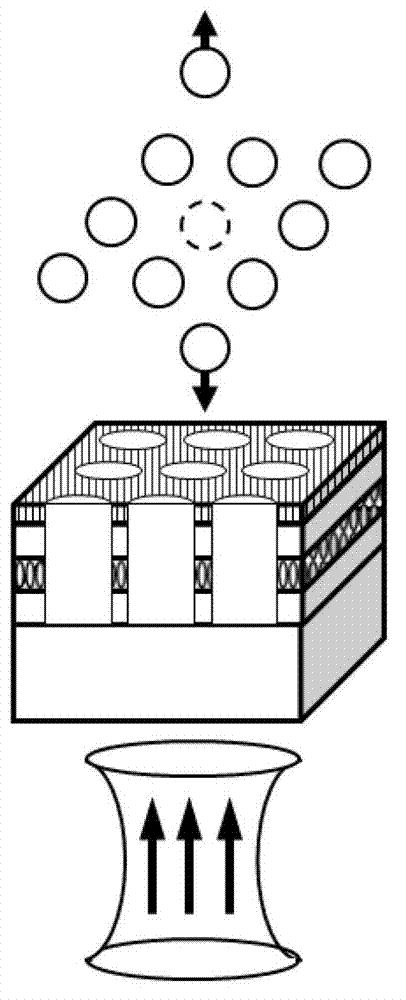
[0006] Aiming at the above-mentioned problems of tunable optical tweezers, the present invention provides a tunable metamaterial optical tweezers based on liquid crystal material, which has the characteristics of simple structure, easy operation, and large operating frequency tuning range.
Method used
the structure of the environmentally friendly knitted fabric provided by the present invention; figure 2 Flow chart of the yarn wrapping machine for environmentally friendly knitted fabrics and storage devices; image 3 Is the parameter map of the yarn covering machine
View more
Image
Smart Image Click on the blue labels to locate them in the text.
Viewing Examples
Smart Image
Click on the blue label to locate the original text in one second.
Reading with bidirectional positioning of images and text.
Smart Image
Examples
Experimental program
Comparison scheme
Effect test
Embodiment 1
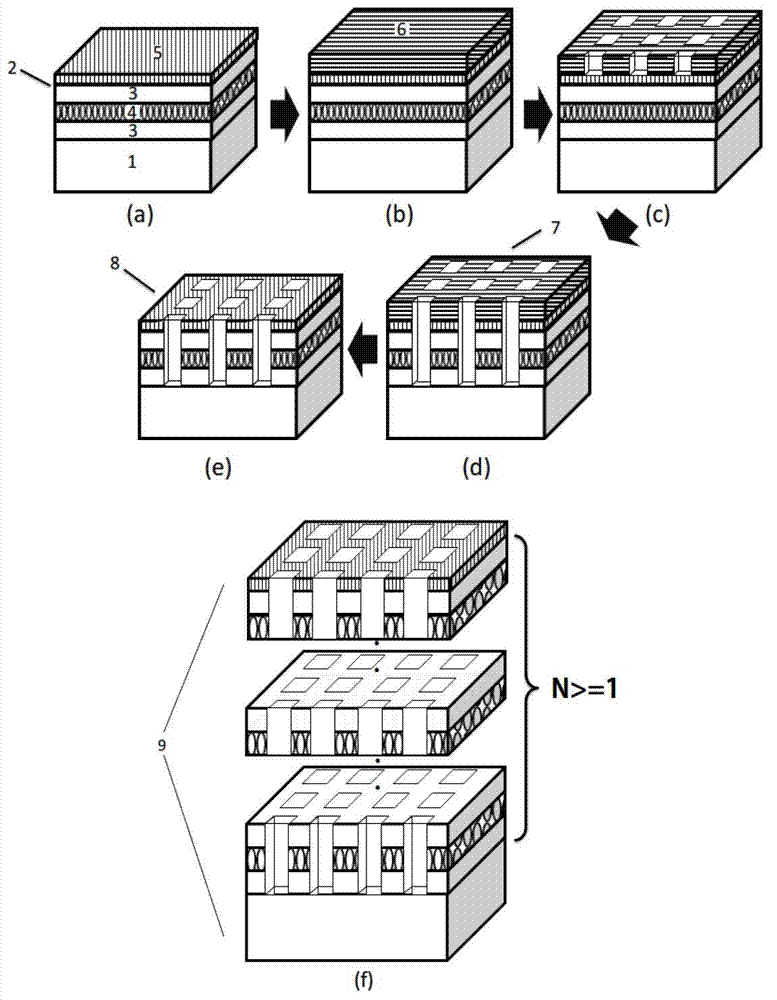
[0019] First, an N (N>=1) layer multilayer structure (metal layer 3-liquid crystal material layer 4-metal layer 3-oxide layer 5) 2 is formed on a glass substrate 1 by a material growth process, as shown in the attached figure 2 (a) shown.
[0020] Second, deposit SiO on the multilayer structure 2 2 film as a mask 6, as attached figure 2 (b) shown.
[0021] Then, the designed periodic hole matrix sample is transferred to the mask through the mask process, as shown in the attached figure 2 (c) shown. Among them, the structure design can adopt algorithms such as finite time domain difference method and finite element method.
[0022] Then, through an etching process, a periodic hole matrix 7 is prepared on the 2 material, as shown in the attached figure 2 as shown in (d)
[0023] Finally, the mask 6 is removed to obtain the tunable metamaterial optical tweezers 8, as shown in the attached figure 2 (e) shown. Among them, the tunable metamaterial optical tweezers9 base...
Embodiment 2
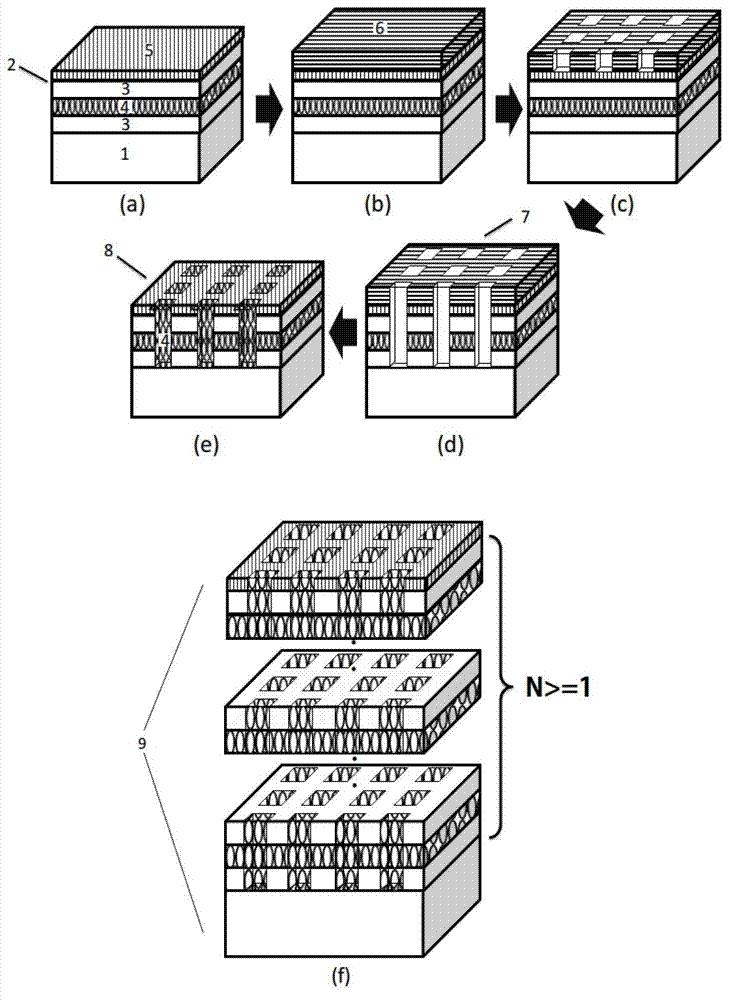
[0025] First, an N (N>=1) layer multilayer structure (metal layer 3-liquid crystal material layer 4-metal layer 3-oxide layer 5) 2 is formed on a glass substrate 1 by a material growth process, as shown in the attached image 3 (a) shown.
[0026] Second, deposit SiO on the multilayer structure 2 2 film as a mask 6, as attached image 3 (b) shown.
[0027] Then, the designed periodic hole matrix sample is transferred to the mask through the mask process, as shown in the attached image 3 (c) shown. Among them, the structure design can adopt algorithms such as finite time domain difference method and finite element method.
[0028] Then, through an etching process, a periodic hole matrix 7 is prepared on the 2 material, as shown in the attached image 3 as shown in (d)
[0029] Finally, the mask 6 is removed, and liquid crystal material 4 is injected into the hole matrix 7 to seal the holes to obtain a tunable metamaterial optical tweezers 8, as shown in the attached im...
the structure of the environmentally friendly knitted fabric provided by the present invention; figure 2 Flow chart of the yarn wrapping machine for environmentally friendly knitted fabrics and storage devices; image 3 Is the parameter map of the yarn covering machine
Login to View More
PUM
Property
Measurement
Unit
Width
aaaaa
aaaaa
Height
aaaaa
aaaaa
Width
aaaaa
aaaaa
Login to View More
Abstract
The invention provides a tunable metamaterial optical tweezer based on liquid crystal material. By introducing the liquid crystal material in the multilayer structure-based metamaterial, the birefringence and the dielectric coefficient of the liquid crystal material are changed, and an optical trapping force variable in direction and size is generated, thus, accurate capturing and selection to the biomolecules in different sizes are realized. According to the invention, based on the character that the birefringence and the dielectric coefficient of the liquid crystal material vary with the change of the external electric field or the temperature, the tunable function of the metamaterial-based optical tweezer is realized. The optical tweezer has the characteristics of small volume, high capturing force, high stability and so on.
Description
technical field [0001] The invention relates to a tunable metamaterial optical tweezers based on a liquid crystal material, which can be applied to the fields of life science and detection of tiny biomolecules. Background technique [0002] Since Ashkin et al first proposed the theory of optical tweezers in 1980, optical tweezers technology has made significant progress in many scientific fields. Because optical tweezers can perform non-invasive and non-contact simple manipulation of micro-nano-scale biomolecules, its application in the field of life sciences has attracted widespread attention. Optical trapping force is one of the important components of optical tweezers, and its characteristics depend on the field intensity gradient of light. How to construct the optical trap force and realize the optical tweezers technology is currently a research hotspot in this field. In 2002, Erikesen et al. used phase contrast technology to generate optical trapping force. In the sa...
Claims
the structure of the environmentally friendly knitted fabric provided by the present invention; figure 2 Flow chart of the yarn wrapping machine for environmentally friendly knitted fabrics and storage devices; image 3 Is the parameter map of the yarn covering machine
Login to View More
Application Information
Patent Timeline
Application Date:The date an application was filed.
Publication Date:The date a patent or application was officially published.
First Publication Date:The earliest publication date of a patent with the same application number.
Issue Date:Publication date of the patent grant document.
PCT Entry Date:The Entry date of PCT National Phase.
Estimated Expiry Date:The statutory expiry date of a patent right according to the Patent Law, and it is the longest term of protection that the patent right can achieve without the termination of the patent right due to other reasons(Term extension factor has been taken into account ).
Invalid Date:Actual expiry date is based on effective date or publication date of legal transaction data of invalid patent.



 Login to View More