
Method for continuously preparing sodium azide
A technology of sodium azide and sodium hydroxide, applied in the direction of azide/azide/halogen azide, etc., can solve the problem of large inorganic salt wastewater, achieve low energy consumption, easy to widely popularize, and simple process Effect
- Summary
- Abstract
- Description
- Claims
- Application Information
AI Technical Summary
Problems solved by technology
Method used
Image

Examples
Embodiment 1
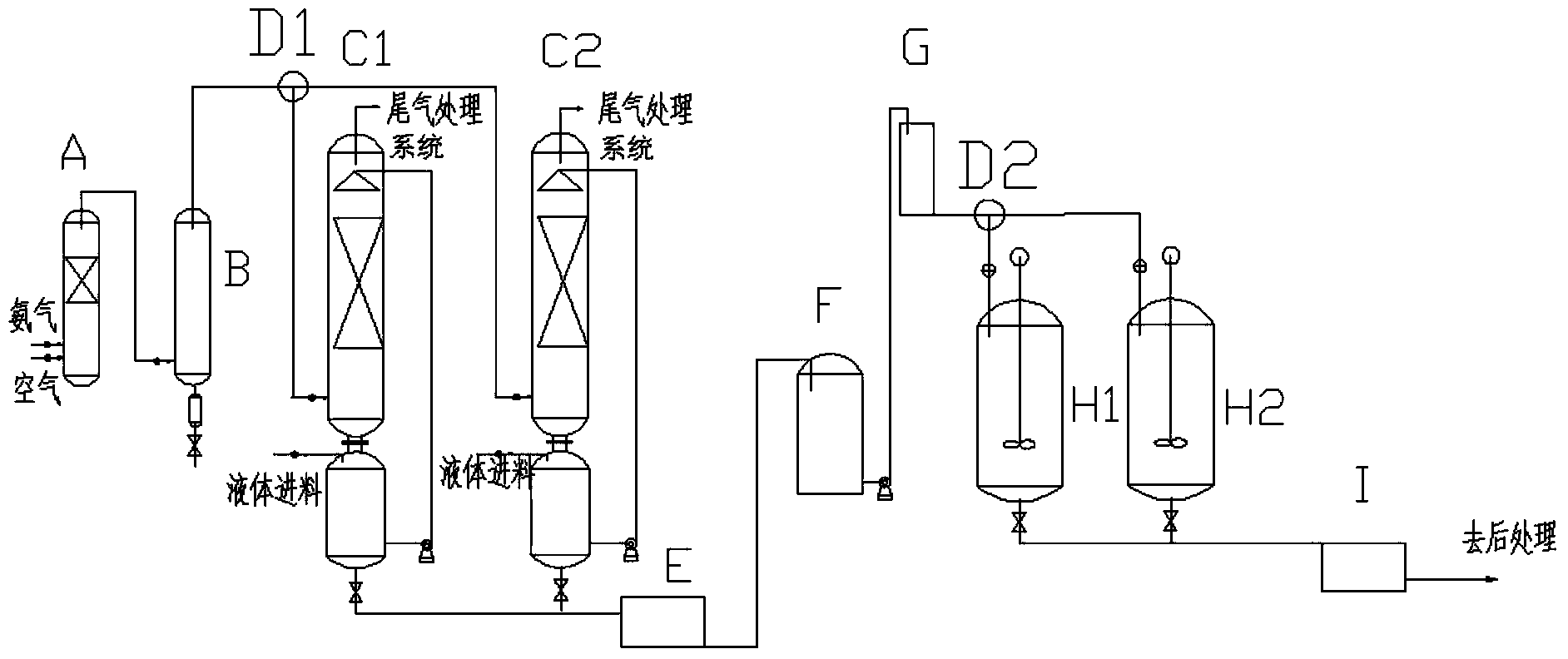
[0042] The present embodiment provides a kind of method for continuously preparing sodium azide, and the method adopts such as figure 1 The continuous reaction device shown realizes the continuous preparation of sodium azide, and described continuous reaction device comprises ammonia oxidation furnace A, and the top of ammonia oxidation furnace A communicates with the feed inlet of heat exchanger B, and the top of heat exchanger B The discharge port is connected with the feed port of the first three-way valve D1, and a discharge port of the first three-way valve D1 is connected with the bottom of the first tower esterification reactor C1 tower body, and the first three-way valve D1 The other outlet is communicated with the bottom of the second tower type esterification reactor C2 tower body, and the first tower type esterification reactor C1 tower still and the second tower type esterification reactor C2 tower still pass through the pump respectively. The liquid is transported...
Embodiment 2
[0051] The present embodiment provides a kind of method for continuously preparing sodium azide, and the method adopts such as figure 1 Shown continuous reaction device realizes the continuous preparation of sodium azide, and continuous reaction device is identical with embodiment 1.
[0052] The method for continuously preparing sodium azide specifically comprises the following steps:
[0053] Step 1: Pass ammonia and air respectively from the bottom of ammonia oxidation furnace A to carry out catalytic oxidation reaction, and the generated nitrogen oxides are passed to the bottom of heat exchanger B for heat exchange, and the temperature of nitrogen oxides is reduced to 30°C-40°C °C, wherein: the reaction temperature of ammonia oxidation is controlled within the range of 700 °C to 720 °C, the pressure is within the range of 0.1 to 0.15 Mpa, the molar ratio of ammonia to oxygen is 1:1.5, and the catalyst is a platinum-rhodium catalyst;
[0054] Step 2, the nitrogen oxides co...
Embodiment 3
[0060] The present embodiment provides a kind of method for continuously preparing sodium azide, and the method adopts such as figure 1 Shown continuous reaction device realizes the continuous preparation of sodium azide, and continuous reaction device is identical with embodiment 1.
[0061] The method for continuously preparing sodium azide specifically comprises the following steps:
[0062] Step 1: Pass ammonia and air respectively from the bottom of ammonia oxidation furnace A to carry out catalytic oxidation reaction, and the generated nitrogen oxides are passed to the bottom of heat exchanger B for heat exchange, and the temperature of nitrogen oxides is reduced to 30°C-40°C °C, wherein: the reaction temperature of ammonia oxidation is controlled within the range of 700 °C to 720 °C, the pressure is within the range of 0.1 to 0.15 Mpa, the molar ratio of ammonia to oxygen is 1:1.5, and the catalyst is a platinum-rhodium catalyst;
[0063] Step 2, the nitrogen oxides cool...
PUM
 Login to View More
 Abstract
Description
Claims
Application Information
 Login to View More