A kind of natural fiber softener and preparation method thereof
What is AI technical title?
AI technical title is built by Patsnap AI team. It summarizes the technical point description of the patent document.
A natural fiber, softener technology, used in fiber processing, textiles and papermaking, etc., can solve problems such as poor biodegradability and environmental impact
Active Publication Date: 2016-08-03
佛山市魔晶科技发展有限公司
View PDF4 Cites 0 Cited by
Summary
Abstract
Description
Claims
Application Information
AI Technical Summary
This helps you quickly interpret patents by identifying the three key elements:
Problems solved by technology
Method used
Benefits of technology
Problems solved by technology
Although its use effect is good, there are still some problems, such as poor biodegradability, which may cause environmental impact
Method used
the structure of the environmentally friendly knitted fabric provided by the present invention; figure 2 Flow chart of the yarn wrapping machine for environmentally friendly knitted fabrics and storage devices; image 3 Is the parameter map of the yarn covering machine
View more
Image
Smart Image Click on the blue labels to locate them in the text.
Viewing Examples
Smart Image
Click on the blue label to locate the original text in one second.
Reading with bidirectional positioning of images and text.
Smart Image
Examples
Experimental program
Comparison scheme
Effect test
Embodiment 1
[0018] (1) In 30kg deionized water, adding sodium alginate 5kg, relative molecular weight is 2.5kg of polyethylene glycol of 400, relative molecular weight is 2.5kg of polyethylene glycol of 800, serine 1kg, zinc oxide 2kg, lignin 3kg and polyethylene glycol Dimethylsiloxane diquaternary ammonium salt 10kg, at 45°C, the stirring rate is 1200 rpm, and the stirring time is 1 hour;
[0019] (2) Add 70kg of deionized water to the solution of step (1), slowly add 2kg of boric acid, stir evenly, and obtain the natural fiber softener.
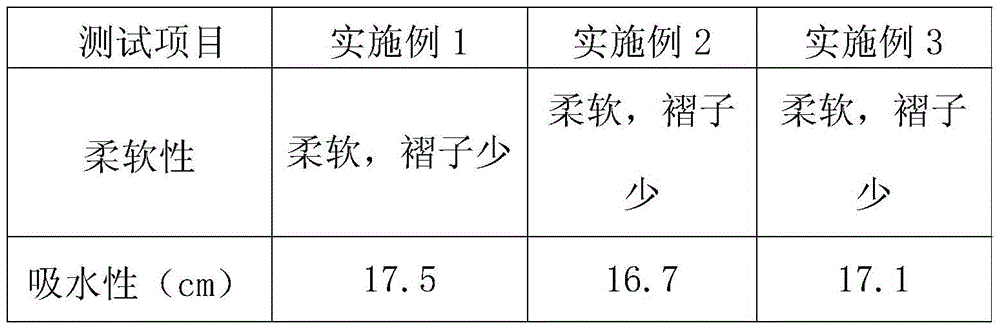
[0020] The performance test results of the prepared natural fiber softener are shown in Table 1.
Embodiment 2
[0022] (1) in 30kg deionized water, add sodium alginate 15kg, relative molecular weight is 400 polyethylene glycol 7.5kg, relative molecular weight is 800 polyethylene glycol 7.5kg, serine 3kg, zinc oxide 3kg, lignin 2kg and polyethylene glycol Dimethylsiloxane diquaternary ammonium salt 20kg, at 50°C, the stirring rate is 1200 rpm, and the stirring time is 3 hours;
[0023] (2) Add 70 kg of deionized water to the solution of step (1), slowly add 0.5 kg of boric acid, stir evenly, and obtain a natural fiber softener.
[0024] The performance test results of the prepared natural fiber softener are shown in Table 1.
Embodiment 3
[0026] (1) In 30kg of deionized water, add 10kg of sodium alginate, 5kg of polyethylene glycol with a relative molecular weight of 400, 5kg of polyethylene glycol with a relative molecular weight of 800, 2kg of serine, 2kg of zinc oxide, 5kg of lignin and polyethylene glycol 15kg of siloxane diquaternary ammonium salt, at 40°C, the stirring rate was 1200 rpm, and the stirring time was 2 hours;
[0027] (2) Add 70 kg of deionized water to the solution of step (1), slowly add 1 kg of boric acid, stir evenly, and obtain a natural fiber softener.
[0028] The performance test results of the prepared natural fiber softener are shown in Table 1.
[0029] Water absorption test method: Under the conditions of 25°C and 40% humidity, the lower end of a cotton towel (2.5cm×25cm) is immersed in water at 25°C, and the height of the water rising after 15 minutes is measured.
[0030] Table 1
[0031]
the structure of the environmentally friendly knitted fabric provided by the present invention; figure 2 Flow chart of the yarn wrapping machine for environmentally friendly knitted fabrics and storage devices; image 3 Is the parameter map of the yarn covering machine
Login to View More
PUM
Login to View More
Abstract
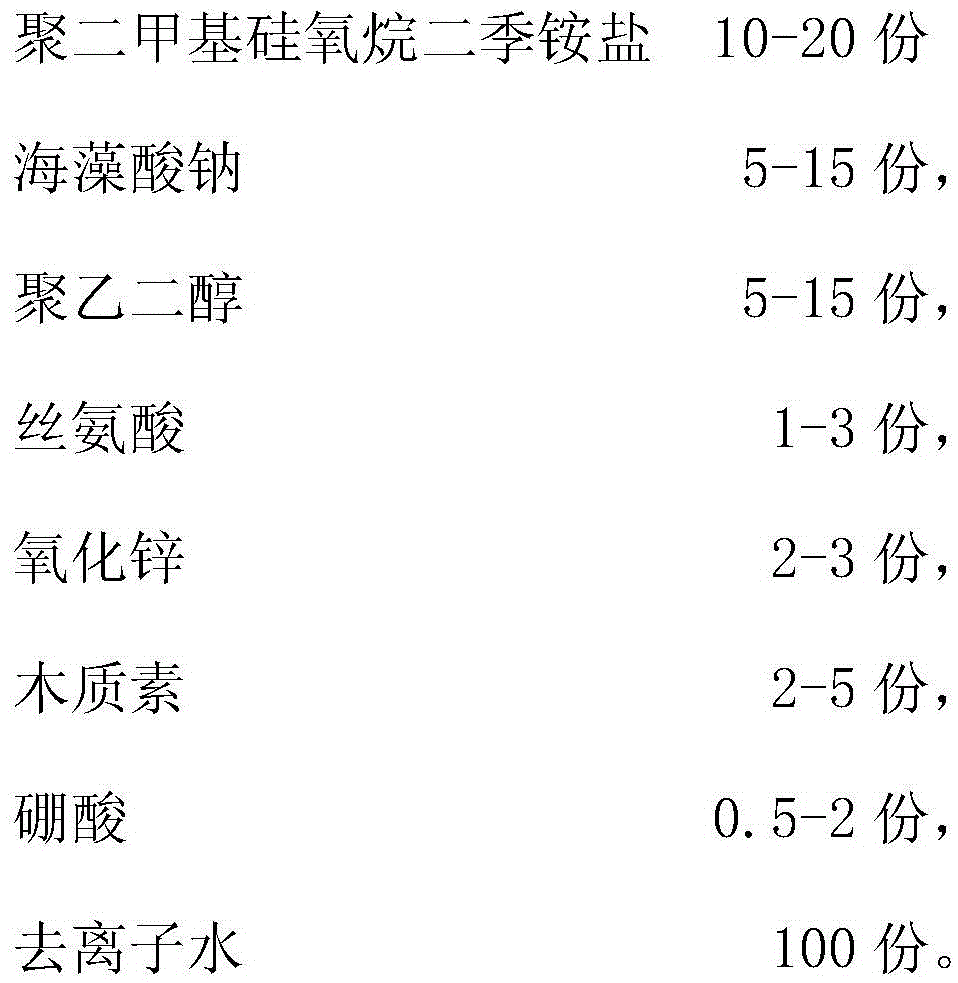
The invention discloses a natural fiber softener and a preparation method thereof. The softener comprises the following components in parts by weight: 10-20 parts of polydimethylsiloxane di-quaternary amine, 5-15 parts of sodium alginate, 5-15 parts of polyethylene glycol, 1-3 parts of serine, 2-3 parts of zinc oxide, 2-5 parts of lignin, 0.5-2 parts of boric acid and 100 parts of deionized water. The softener disclosed by the invention has the advantages that sodium alginate, polyethylene glycol, lignin and the like belonging to degradable, biodegradable and environment-friendly components are selected in the aspect of main components; various components in the softener have hydroxyl structures similar to the structures of natural fiber fabrics and can be in full contact with the surface of the natural fiber, and the softener can be used for treating clothes which are hardened after being washed, so that the washed clothes are soft, and the softener has the effects of maintaining and repairing the damaged fiber surface of the clothes.
Description
technical field [0001] The invention belongs to the field of softening agents, in particular to a natural fiber softening agent and a preparation method thereof. Background technique [0002] With the popularization of household washing machines and the increase of synthetic fibers and their blended fabrics, the demand for fabric softeners is increasing. Most synthetic fabrics, pure wool and cotton velvet fabrics gradually become hard after repeated washing, with a rough hand feeling and a comfortable wearing feeling. Uncomfortable, and even electrostatic dust collection and sparking. [0003] The most representative product in the existing softening agent is cationic surfactant, wherein the most used is dioctadecyl dimethyl ammonium chloride or double hydrogenated tallow dimethyl ammonium chloride. Although its use effect is better, there are also some problems, such as poor biodegradability, which may cause environmental impact. Therefore, the textiles used in contact wi...
Claims
the structure of the environmentally friendly knitted fabric provided by the present invention; figure 2 Flow chart of the yarn wrapping machine for environmentally friendly knitted fabrics and storage devices; image 3 Is the parameter map of the yarn covering machine
Login to View More
Application Information
Patent Timeline
Application Date:The date an application was filed.
Publication Date:The date a patent or application was officially published.
First Publication Date:The earliest publication date of a patent with the same application number.
Issue Date:Publication date of the patent grant document.
PCT Entry Date:The Entry date of PCT National Phase.
Estimated Expiry Date:The statutory expiry date of a patent right according to the Patent Law, and it is the longest term of protection that the patent right can achieve without the termination of the patent right due to other reasons(Term extension factor has been taken into account ).
Invalid Date:Actual expiry date is based on effective date or publication date of legal transaction data of invalid patent.



 Login to View More
  Login to View More