
Read optimization method for asynchronously updating indexes based on B+ tree
A B+ tree, read optimization technology, applied in special data processing applications, instruments, electrical and digital data processing, etc., can solve problems such as low performance, a large amount of index data in a single storage area, and cannot perfectly solve query performance problems, etc. The effect of blocking time
- Summary
- Abstract
- Description
- Claims
- Application Information
AI Technical Summary
Problems solved by technology
Method used
Image

Examples
Embodiment
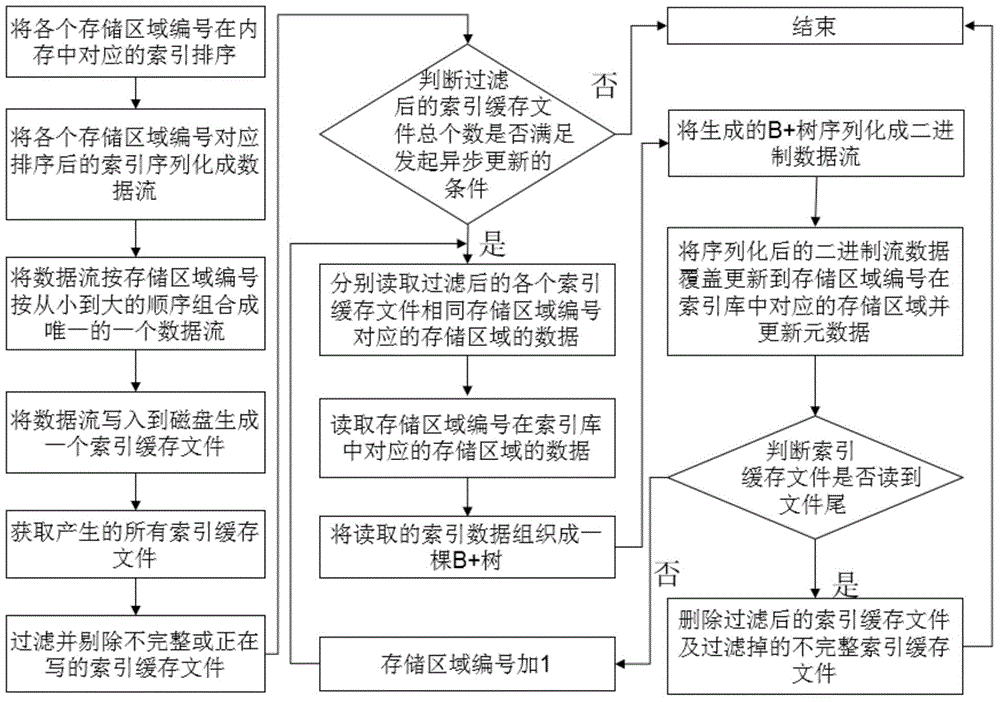
[0037] Assuming that the number of records in the index is 100 million, the index database divides the index into 500,000 storage areas according to 500,000. A batch write operation is initiated every time the index records in the memory reach 1 million. Assuming that the total number of all index cache files after excluding incomplete index cache files and the index cache files being written reaches 3, the condition is considered to be satisfied and an asynchronous update operation can be initiated . Such as figure 1 As shown, this example includes the following steps:
[0038] 1. Divert the 1 million index records cached in the memory according to the storage area numbers 0 to 499999.
[0039] 2. Sort the index corresponding to each storage area number in step 1 in ascending order.
[0040] 3. Serialize the sorted indexes corresponding to each storage area number in step 2 into data streams.
[0041] 4. Combine the serialized data streams in step 3 into a unique data str...
PUM
 Login to View More
 Abstract
Description
Claims
Application Information
 Login to View More