

Formation process for reducing self-discharging rate of lithium ion battery
A lithium-ion battery, self-discharge rate technology, applied in the direction of secondary battery charging/discharging, non-aqueous electrolyte storage battery, electrolyte storage battery manufacturing, etc., can solve the requirements of reducing the battery self-discharging ratio, reducing the service life of the battery pack, and battery consistency high level question
- Summary
- Abstract
- Description
- Claims
- Application Information
AI Technical Summary
Problems solved by technology
Method used
Image



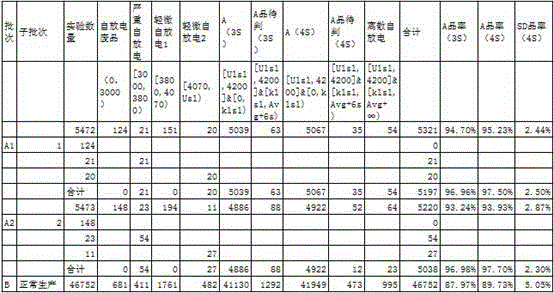
Examples
Embodiment Construction
[0017] Below in conjunction with accompanying drawing and embodiment the invention is described in detail:
[0018] The invention designs a formation process that can reduce the accumulation of single metals in the formation of lithium-ion batteries, and can greatly reduce the self-discharge ratio of batteries after use.
[0019] The chemical conversion process of the present invention has as follows:
[0020] The lithium-ion battery to be formed is first charged with a short time and low current (20-40min, 50-200mA) to make the battery cell reach a voltage that can corrode the positive metal (except Li), and then store the battery cell at a high temperature of 45 degrees Celsius After 12 to 36 hours in the environment, all the elemental metal impurities in the positive electrode are slowly oxidized, and then diffuse to the surroundings and migrate to the surface of the negative electrode through multiple channels to precipitate, reducing the proportion of the positive metal e...
PUM
 Login to View More
 Abstract
Description
Claims
Application Information
 Login to View More