
Tribromophenoxybromopropyl dimethylsilicate compound and preparation method thereof
A technology of tribromophenoxy and dimethylsilicic acid, which is applied in the field of dimethylsilicic acid diester compounds and their preparation, can solve the problems of difficulty in finding substitutes and the like, and achieves high molecular weight, low volatility, and high phase performance. Good capacitive effect
- Summary
- Abstract
- Description
- Claims
- Application Information
AI Technical Summary
Problems solved by technology
Method used
Image

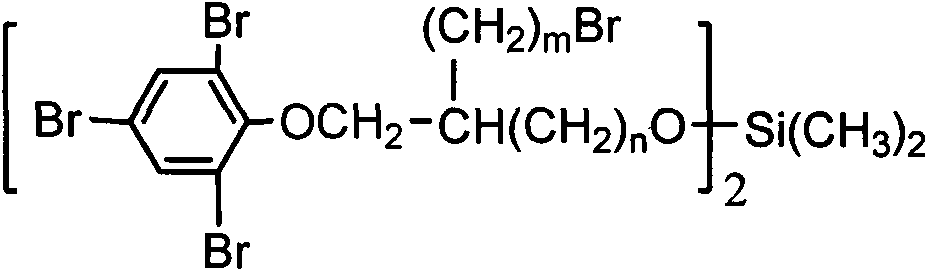
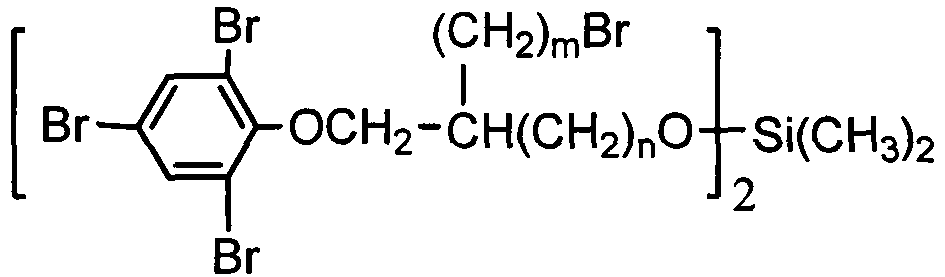

Examples
Embodiment 1
[0027] Example 1 In a 250ml four-necked flask equipped with a stirrer, a thermometer and a condenser tube, replace the air in the bottle with nitrogen, and add 38.75g (0.1mol) of 2,4,6-tribromophenylepoxypropyl Ether and 100ml of benzene, add 10.9g (0.05mol) dimethyldibromosilane dropwise, and control the reaction temperature not higher than 30°C at the rate of addition, after the drop is completed, raise the temperature to 30°C, keep the temperature for 11 hours, and distill off the solvent under reduced pressure and a small amount of low boiling point substances to obtain bis(2,4,6-tribromophenoxybromopropyl) dimethyl silicate, the yield: 94.8%.
Embodiment 2
[0028] Example 2 In a 250ml four-neck flask equipped with a stirrer, a thermometer and a condenser tube, replace the air in the bottle with nitrogen, and add 38.75g (0.1mol) of 2,4,6-tribromophenylepoxypropyl Ether and 130ml xylene, add 10.9g (0.05mol) dimethyldibromosilane dropwise, and control the reaction temperature not higher than 30°C with the rate of addition. Solvent and a small amount of low-boiling point substances, to obtain bis(2,4,6-tribromophenoxybromopropyl) dimethyl silicate, the yield: 98.3%.
Embodiment 3
[0029] Example 3 In a 250ml four-necked flask equipped with a stirrer, a thermometer and a condenser, replace the air in the bottle with nitrogen, and add 38.75g (0.1mol) of 2,4,6-tribromophenylepoxypropyl Ether and 120ml xylene, add 10.9g (0.05mol) dimethyldibromosilane dropwise, and control the reaction temperature not higher than 30°C with the rate of addition. Solvent and a small amount of low-boiling point substances, to obtain bis(2,4,6-tribromophenoxybromopropyl) dimethyl silicate, yield: 97.5%.
PUM
| Property | Measurement | Unit |
|---|---|---|
| decomposition temperature | aaaaa | aaaaa |
| density | aaaaa | aaaaa |
| refractive index | aaaaa | aaaaa |
Abstract
Description
Claims
Application Information
 Login to View More