
Preparation and application of a compound microbial agent for degrading garden waste
A compound bacterial agent and cellulose-degrading technology, applied in the field of environmental biology, can solve the problems of long composting cycle and refractory cellulose degradation, and achieve the effects of accelerating the composting process, improving the fermentation efficiency and reducing the processing cost.
- Summary
- Abstract
- Description
- Claims
- Application Information
AI Technical Summary
Problems solved by technology
Method used
Image

Examples
Embodiment 1
[0023] Example 1 Screening and identification of high-temperature cellulose-degrading bacteria
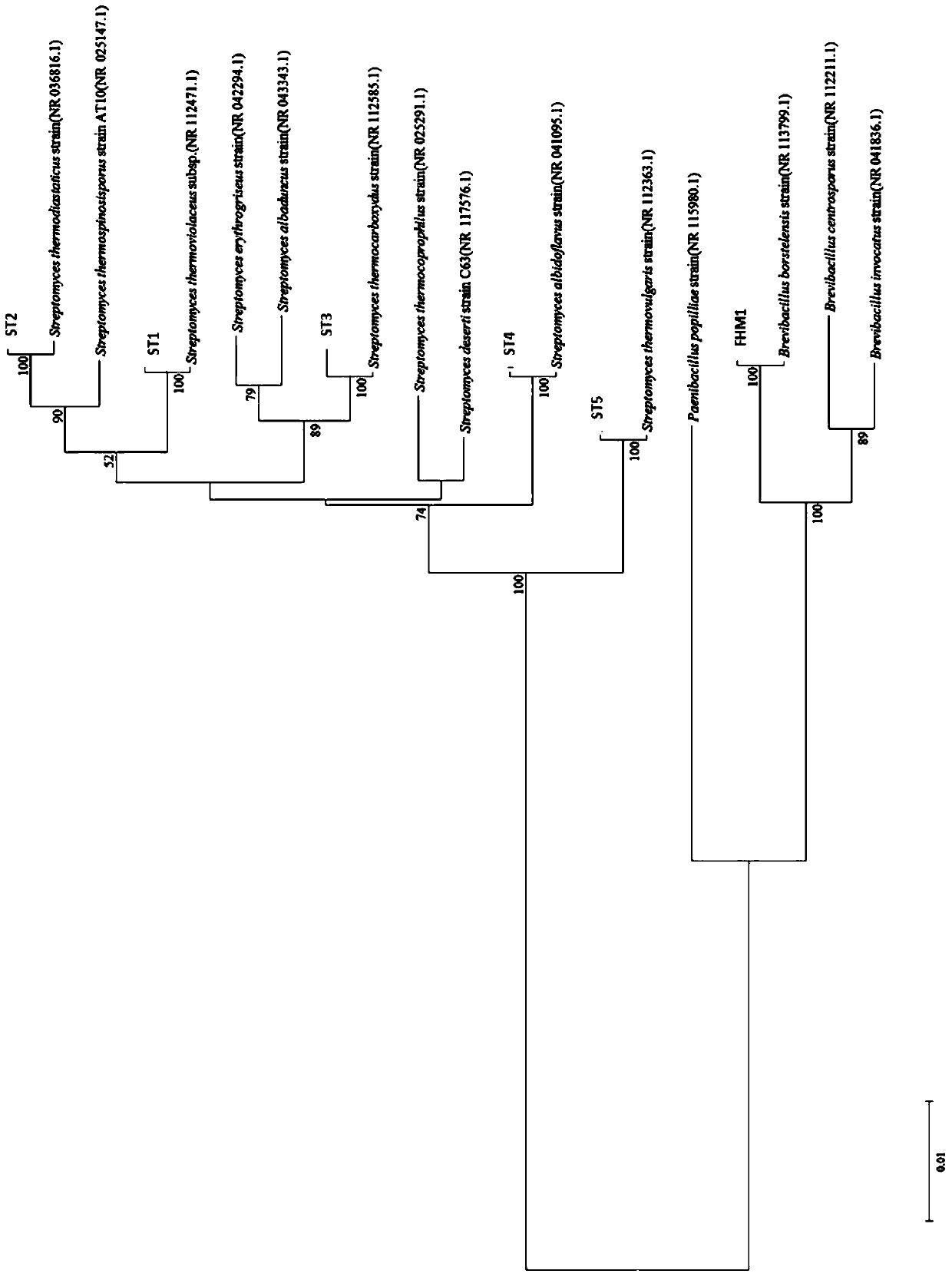
[0024] Samples were collected from composting of garden waste in an apple orchard in Changping District, Beijing at the early stage of high temperature, middle stage of high temperature, and late stage of high temperature material, and the accumulation of landscaping waste in the afforestation area of Yanqing Plain in Beijing; 10 g of the above fresh samples were weighed and placed in a container containing 10 glass beads. , and filled with 90 ml of sterile water in a conical flask, placed in a shaker at 30°C and 150 rpm for 30 minutes to fully disperse the samples, and left to enrich at 50°C for 24 hours. Use a sterile pipette to draw 1 ml of the supernatant and add it to a test tube containing 9 ml of sterile water, which is 10 -1 Sample diluent, again from 10 -1 Take 1ml of the sample and add it to 9ml sterile water, which is 10 -2 sample diluent, and so on, to get 10 -3 、1...
Embodiment 2
[0027] Example 2 Antagonism between bacterial strains
[0028] The above-mentioned six cellulose-degrading strains were streaked two by two on the carboxymethyl cellulose medium but not intersecting each other, cultured at 50°C for 3 days. If a sterile zone is formed at the intersection of two bacteria, it means that a zone of inhibition has formed between the two bacteria, and the two bacteria are antagonistic to each other and cannot be combined together. combination. From the results, there is no antagonistic effect between the various strains, and they will not interfere with each other and affect the growth of the strains, so it can be made into a compound bacterial agent.
Embodiment 3
[0029] Example 3 Cellulase-producing Ability of Mixed Bacteria
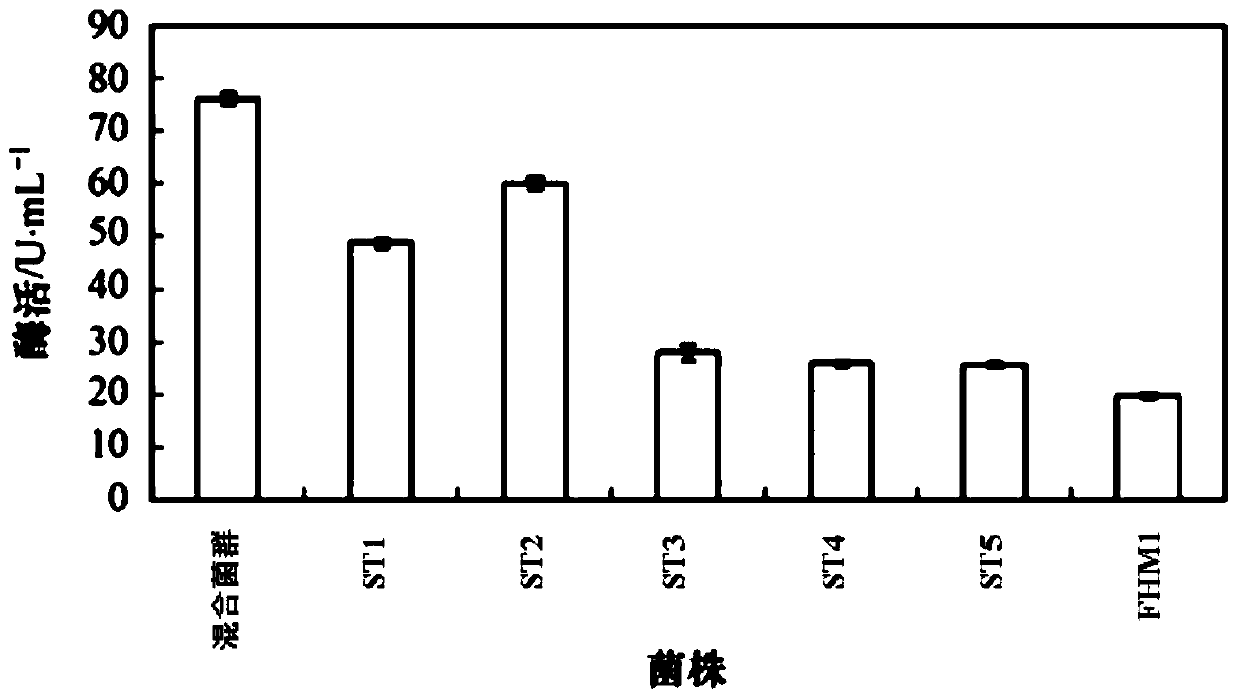
[0030] The 6 strains of high-temperature and high-efficiency cellulose-degrading bacteria screened were inoculated in CMC-Na liquid medium, and cultured in a constant temperature shaker at 50°C with a rotation speed of 150rpm / min. Streptomyces, Streptomyces vulgaris and Brevibacillus Potsdam were cultured for 12 hours, Streptomyces carbomonoxide and Streptomyces albiflous were cultured for 72 hours, and the turbidity OD600 of each culture solution was adjusted to 0.2, and then the suspensions of these 6 strains were prepared according to the The ratio of volume to volume is evenly mixed to obtain a mixed bacterial liquid. Use the same inoculation amount of the mixed bacteria liquid and each single strain to carry out fermentation and enzyme production under the same fermentation conditions, and compare the enzyme production ability of the mixed bacteria group and the single strain, see figure 1 . Depend on f...
PUM
 Login to View More
 Abstract
Description
Claims
Application Information
 Login to View More