Unlock instant, AI-driven research and patent intelligence for your innovation.

OCDMA (Optical Code Division Multiple Access) and OFDM (Orthogonal Frequency Division Multiplexing) hybrid passive optical network system

A technology of passive optical network and output terminal, applied in the direction of transmission system, multi-frequency code system, digital transmission system, etc., can solve problems such as difficulty in maintenance, achieve high transmission security performance, increase frequency band utilization, and reduce complexity.

Active Publication Date: 2016-05-11
GUANGXI NORMAL UNIV
View PDF7 Cites 3 Cited by
  • Summary
  • Abstract
  • Description
  • Claims
  • Application Information

AI Technical Summary

Problems solved by technology

However, since the current access network is the integration of various service networks and the emergence of various new services
The current EPON and GPON technologies are gradually becoming difficult to maintain, and a better solution needs to be found

Method used

the structure of the environmentally friendly knitted fabric provided by the present invention; figure 2 Flow chart of the yarn wrapping machine for environmentally friendly knitted fabrics and storage devices; image 3 Is the parameter map of the yarn covering machine
View more

Image

Smart Image Click on the blue labels to locate them in the text.
Viewing Examples
Smart Image
  • OCDMA (Optical Code Division Multiple Access) and OFDM (Orthogonal Frequency Division Multiplexing) hybrid passive optical network system
  • OCDMA (Optical Code Division Multiple Access) and OFDM (Orthogonal Frequency Division Multiplexing) hybrid passive optical network system
  • OCDMA (Optical Code Division Multiple Access) and OFDM (Orthogonal Frequency Division Multiplexing) hybrid passive optical network system

Examples

Experimental program
Comparison scheme
Effect test

Embodiment Construction

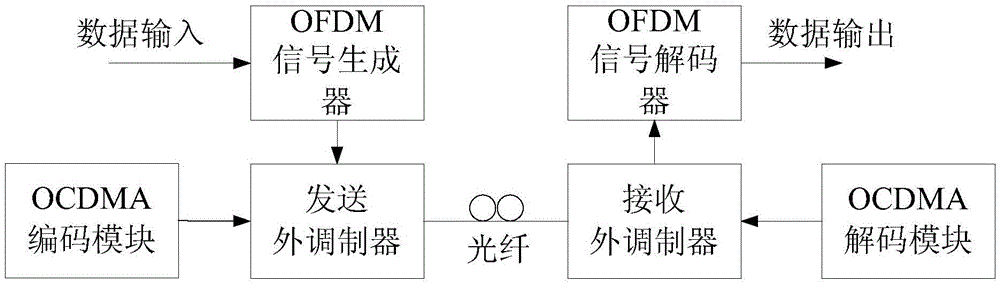
[0020] A passive optical network system combining OCDMA and OFDM, such as figure 1 As shown, the sending end and the receiving end are included, and the sending end and the receiving end are connected by optical fibers.

[0021] The transmitting end is composed of an OCDMA encoding module, an OFDM signal generator and a transmitting external modulator. The input data is sent to the input end of the OFDM signal generator, the output end of the OFDM signal generator is connected to one input end of the sending external modulator, the output end of the OCDMA encoding module is connected to the other input end of the sending external modulator, and the sending external modulator The output end is connected to one end of the optical fiber.

[0022] The above-mentioned OCDMA encoding module includes an encoding light source and an encoding wavelength division multiplexer. The output end of the encoding light source is connected to the input end of the encoding wavelength division multipl...

the structure of the environmentally friendly knitted fabric provided by the present invention; figure 2 Flow chart of the yarn wrapping machine for environmentally friendly knitted fabrics and storage devices; image 3 Is the parameter map of the yarn covering machine
Login to View More

PUM

No PUM Login to View More

Abstract

The invention discloses an OCDMA and OFDM hybrid passive optical network system. At a sending end, input data are sent to the input end of an OFDM signal generator; the output end of the OFDM signal generator is connected to one input end of an external sending modulator; the output end of an OCDMA coding module is connected to the other input end of the external sending modulator; the output end of the external sending modulator is connected to one end of an optical fiber; at a receiving end, the other end of the optical fiber is connected to one input end of an external receiving modulator; the output end of an OCDMA decoding module is connected to the other input end of the external receiving modulator; the output end of the external receiving modulator is connected to the input end of an OFDM signal decoder; and the output end of the OFDM signal decoder sends out output data. According to the system of the invention, the advantages of the OFDM technique and the OCDMA technique in a PON (passive optical network) system are fully utilized; the data bandwidth is fully utilized; and the cost is reduced.

Description

Technical field [0001] The invention belongs to the technical field of optical fiber communication, and specifically relates to a passive optical network system that is a hybrid of OCDMA (Orthogonal Frequency Division Multiplexing) and OFDM (Optical Code Division Multiple Access). Background technique [0002] With the emergence of various new services and people's increasing demand for bandwidth, the "last mile" has become a bottleneck in the access network. As the best way to solve the demand for broadband optical access, passive optical network (PON) technology has achieved a certain scale in many areas of the world due to its advantages such as high bandwidth, low cost, simple structure, and good reliability. Implement. In the current PON technology, there are many implementation methods, mainly including wavelength division multiplexing passive optical network (WDM-PON), time division multiplexing passive optical network (TDM-PON), EPON (Ethernet passive optical network) A...

Claims

the structure of the environmentally friendly knitted fabric provided by the present invention; figure 2 Flow chart of the yarn wrapping machine for environmentally friendly knitted fabrics and storage devices; image 3 Is the parameter map of the yarn covering machine
Login to View More

Application Information

Patent Timeline
no application Login to View More
Patent Type & Authority Applications(China)
IPC IPC(8): H04Q11/00H04L27/26
CPCH04L27/2697H04Q11/0067
Inventor 李传起孔一卜陆叶蒋颜辉周省邦张东闯曾汝琦乐翔
Owner GUANGXI NORMAL UNIV
Features
  • R&D
  • Intellectual Property
  • Life Sciences
  • Materials
  • Tech Scout
Why Patsnap Eureka
  • Unparalleled Data Quality
  • Higher Quality Content
  • 60% Fewer Hallucinations
Social media
Patsnap Eureka Blog
Learn More