A new method for efficient resource utilization of electroplating sludge and carbon dioxide co-processing
What is AI technical title?
AI technical title is built by PatSnap AI team. It summarizes the technical point description of the patent document.
A technology for electroplating sludge and carbon dioxide, applied in chemical instruments and methods, separation methods, metallurgical wastewater treatment, etc., to achieve stable performance, mild reaction conditions, and low cost
Active Publication Date: 2018-06-29
GUANGZHOU INST OF ENERGY CONVERSION - CHINESE ACAD OF SCI
View PDF9 Cites 0 Cited by
Summary
Abstract
Description
Claims
Application Information
AI Technical Summary
This helps you quickly interpret patents by identifying the three key elements:
Problems solved by technology
Method used
Benefits of technology
Problems solved by technology
Both harmless and thermochemical treatment of electroplating sludge will have varying degrees of impact on the environment, and resources cannot be effectively used
Method used
the structure of the environmentally friendly knitted fabric provided by the present invention; figure 2 Flow chart of the yarn wrapping machine for environmentally friendly knitted fabrics and storage devices; image 3 Is the parameter map of the yarn covering machine
View more
Image
Smart Image Click on the blue labels to locate them in the text.
Viewing Examples
Smart Image
Click on the blue label to locate the original text in one second.
Reading with bidirectional positioning of images and text.
Smart Image
Examples
Experimental program
Comparison scheme
Effect test
Embodiment 1
[0029] Use electroplating sludge rich in Fe, Ni, and Cu heavy metals as raw materials, bake at 105°C for 2 hours, pyrolyze at 900°C for 4 hours under nitrogen gas atmosphere, stir in 2mol / L HCl solution for 24 hours after cooling, wash with water until neutral, 105 ℃ drying, grinding to 100-150 mesh, that is, sludge biochar.
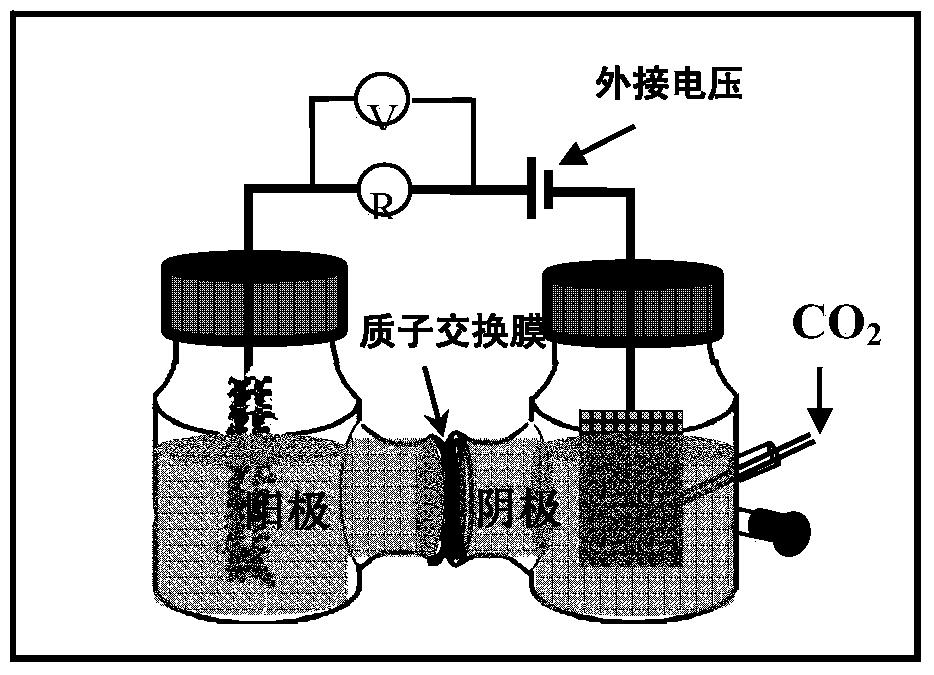
[0030] Mix the prepared sludge biochar (20mg) or the electroplating sludge (20mg) before pyrolysis with 1ml of ethanol and 1μl of nafion solution, ultrasonically form a paste mixture, and mix the paste mixture at 0.5-1mg / cm 2 The loading of the carbon cloth is loaded on the carbon cloth, and the carbon cloth loaded with the paste mixture is used as figure 1 In the cathode catalyst of the bioelectrochemical system shown, carbon dioxide is introduced into the cathode chamber of the bioelectrochemical system to realize the synergistic treatment of electroplating sludge and carbon dioxide.
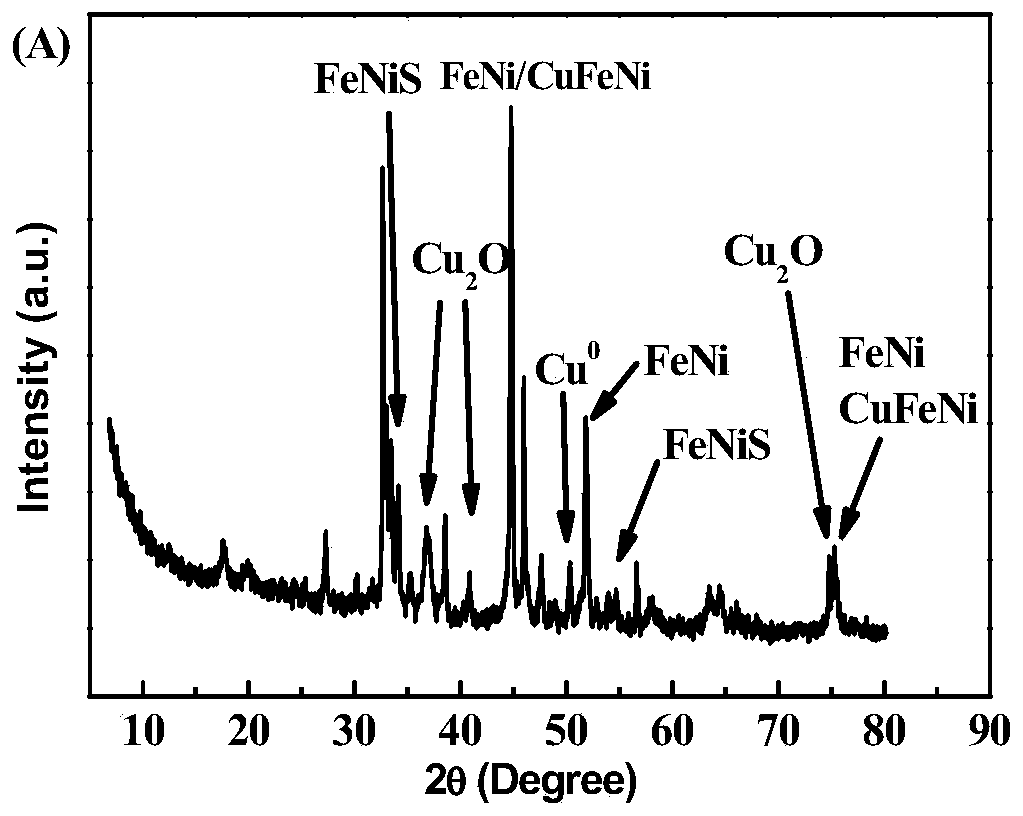
[0031] The physical and chemical characterization of the prepared ...
Embodiment 2
[0034] Same as Example 1, the difference is:
[0035] Pyrolysis at 700°C for 2h under nitrogen gas atmosphere.
[0036] Because 4 hours pyrolysis time makes pyrolysis reaction more thorough in embodiment 1, therefore, its pyrolysis prepares CuFeNi, FeNi, Fe 1.6 Ni 2.4 , Fe 8.7 NeS 10 and Cu 2 The effect of metal compounds such as O is better than that of pyrolysis for 2 hours in Example 2.
Embodiment 3
[0038] Same as Example 1, the difference is:
[0039] Adjusting the applied voltage is 0.6V, and monitoring its cathode product finds that a small amount of formic acid, acetic acid and methane are produced, and the acetic acid output is as follows: Figure 5 and formic acid production as Figure 6As shown, the concentrations of formic acid, acetic acid and methane were significantly higher than when the applied voltage was 0.3V.
the structure of the environmentally friendly knitted fabric provided by the present invention; figure 2 Flow chart of the yarn wrapping machine for environmentally friendly knitted fabrics and storage devices; image 3 Is the parameter map of the yarn covering machine
Login to View More
PUM
Login to View More
Abstract
The present invention discloses a novel efficient resource utilization method of electroplating sludge and carbon dioxide co-processing. The novel method uses electroplating sludge as a raw material to prepare biochar, which is used as a cathode catalyst for a bioelectrochemical system, to achieve efficient resource utilization of electroplating sludge, and conducts co-processing of carbon dioxide to obtain the an organic product with high added value. The present invention uses electroplating sludge rich in heavy metals as the raw material for preparing biochar, which is used as the cathode catalyst for the bioelectrochemical system; the method has simple process, low cost, mild reaction conditions; and the prepared biochar has stable performance, strong ability to catalytic reduction of carbon dioxide, and can be used to catalytic reduction of carbon dioxide to achieve co-efficient resource utilization of the electroplating sludge and carbon dioxide.
Description
Technical field: [0001] The invention relates to a new efficient resource utilization method for synergistic treatment of electroplating sludge and carbon dioxide. Background technique: [0002] Electroplating sludge is a hazardous solid waste that mainly comes from the wastewater treatment process in the electroplating industry. With the development of my country's economy and the rapid development of the electroplating industry, the annual discharge of electroplating wastewater in my country has increased rapidly, resulting in a gradual increase in electroplating sludge, which has caused a series of resource and environmental problems. The chemical composition of electroplating sludge is very complex, mainly containing heavy metal compounds such as iron, nickel, copper, zinc, chromium and soluble salts. Among them, electroplating sludge usually contains 0.5-1% nickel, 1-2% copper, 3% chromium, 1-2% zinc, etc., and its metal grade is much higher than that of metal-rich ore...
Claims
the structure of the environmentally friendly knitted fabric provided by the present invention; figure 2 Flow chart of the yarn wrapping machine for environmentally friendly knitted fabrics and storage devices; image 3 Is the parameter map of the yarn covering machine
Login to View More
Application Information
Patent Timeline
Application Date:The date an application was filed.
Publication Date:The date a patent or application was officially published.
First Publication Date:The earliest publication date of a patent with the same application number.
Issue Date:Publication date of the patent grant document.
PCT Entry Date:The Entry date of PCT National Phase.
Estimated Expiry Date:The statutory expiry date of a patent right according to the Patent Law, and it is the longest term of protection that the patent right can achieve without the termination of the patent right due to other reasons(Term extension factor has been taken into account ).
Invalid Date:Actual expiry date is based on effective date or publication date of legal transaction data of invalid patent.



 Login to View More
  Login to View More