
Method for detecting trace elements in human body whole blood through inductively coupled plasma mass spectrometry method
A medium and trace element and inductive coupling technology, which is applied in the direction of measuring devices, preparation of test samples, material analysis by electromagnetic means, etc., can solve the problems of pollution, long time consumption, large amount of reagents, etc., and achieve simple pretreatment, sample The effect of less dosage and lower cost
- Summary
- Abstract
- Description
- Claims
- Application Information
AI Technical Summary
Problems solved by technology
Method used
Image

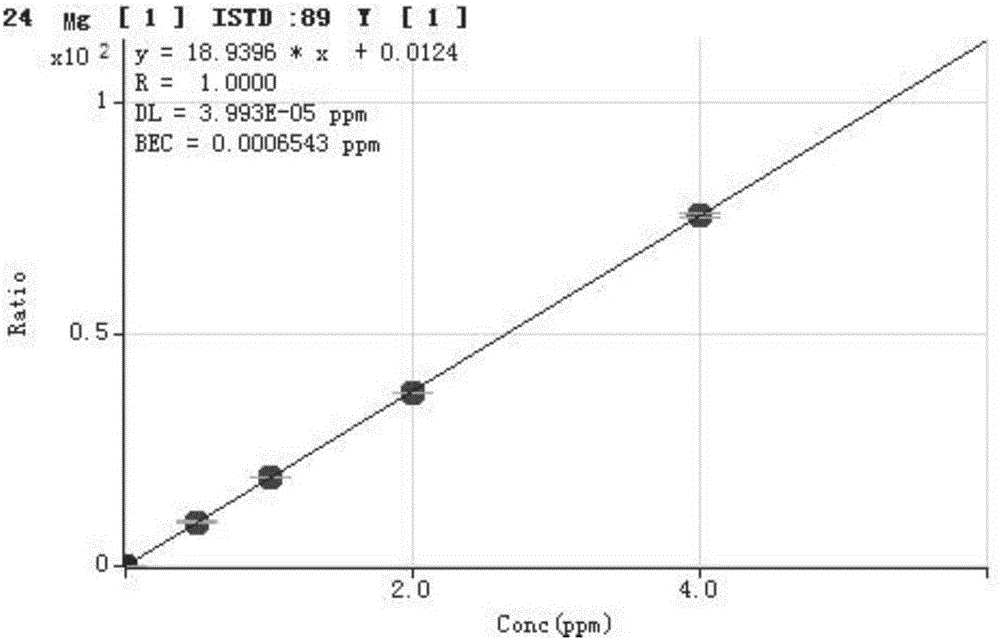
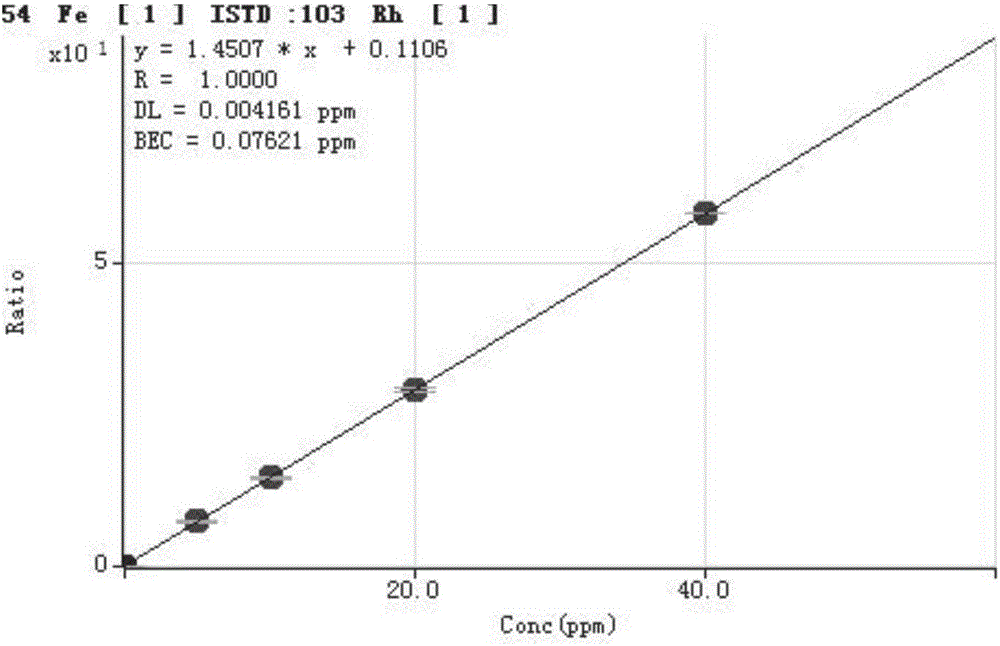
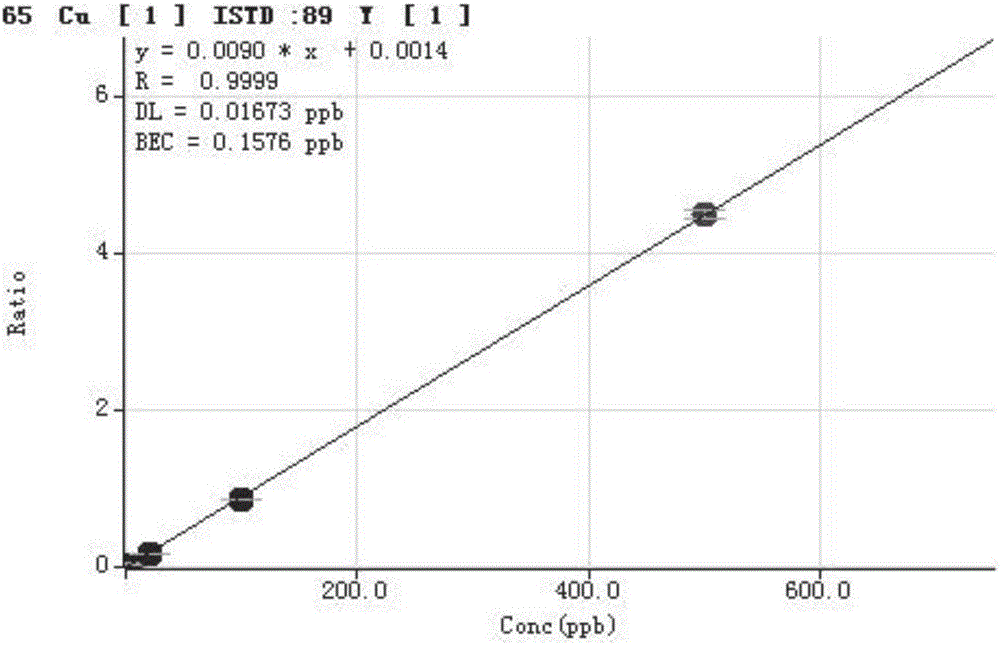
Examples
Embodiment 1
[0029] The detection of trace element magnesium, manganese, calcium, iron, copper, zinc and lead in embodiment one human body whole blood
[0030] 1. Instrument: Inductively Coupled Plasma Mass Spectrometer
[0031] 2. Solution preparation:
[0032] Preparation of diluent: add deionized water at a volume ratio of 1:999 to prepare a mixed solution of nitric acid and triton with a mass concentration of 0.1%, which is the diluent.
[0033] Preparation of tuning solution: prepare the tuning stock solution with nitric acid solution with a volume concentration of 0.2% to prepare a tuning solution with a mass concentration of 10 μg / L for use. The tuning elements are lithium, cobalt, yttrium, thallium, cerium, indium and barium.
[0034] Preparation of internal standard working solution: prepare the internal standard stock solution with nitric acid solution with a volume concentration of 0.2% to prepare an internal standard working solution with a mass concentration of 100 μg / L for u...
Embodiment 2
[0047] The mensuration of embodiment 2 detection method detection limit
[0048] Take 0.25mL deionized water, mix deionized water and diluent at a ratio of 1:30 as the sample blank, repeat the sample blank 20 times for intra-batch determination, calculate the mean value X and standard deviation SD, and use 3 times the standard deviation SD as the detection limit. The detection limits of each element are shown in Table 2.
[0049] Table 2 The detection limit of each element detection method
[0050] Analyte Magnesium (mg / L) Manganese (μg / L) Iron (mg / L) Copper (μg / L) Zinc (mg / L) Lead (μg / L) Calcium (mg / L) average 0.023 0.383 0.998 1.400 0.008 0.632 0.233 standard deviation 0.009 0.113 0.830 0.636 0.002 0.064 0.040 The detection limit 0.026 0.339 2.491 1.908 0.005 0.192 0.120
Embodiment 3
[0051] Embodiment 3 detection method precision measurement
[0052] 1. Preparation of quality control products:
[0053] The quality control product is Seronom TM TraceElementsWholeBloodL-2 (purchased from Auspan), accurately draw 3mL of ultrapure water into the bottle with a pipette according to the instructions, let it stand for 30min, then invert the vial, after standing for 1 hour, shake it gently and divide it, store in Store in a -20°C refrigerator and use within the stable period.
[0054] The second quality control product is whole blood of self-breeding bovine.
[0055] Add the standard solution of each element to be tested in the quality control product as the sample to be tested, so that the concentration of each element in the quality control product is reflected in the medically determined level range of the whole blood. Among them, lead is 100.0 μg / L, manganese is 6.6 μg / L L, copper 720.0μg / L, zinc 3.7mg / L, iron 557.2mg / L, magnesium 50.4mg / L, calcium 84.0mg / L....
PUM
| Property | Measurement | Unit |
|---|---|---|
| concentration | aaaaa | aaaaa |
Abstract
Description
Claims
Application Information
 Login to View More