
EPO4 erythropoietin stimulant kit based on high-affinity stimulant aptamer and detection method thereof
An erythropoietin and nucleic acid aptamer technology, which is applied in the field of medical testing and determination, can solve the problems of operational technical errors, poor repeatability, and high testing costs, and achieve the effects of high repeatability, convenient transportation and high sensitivity.
- Summary
- Abstract
- Description
- Claims
- Application Information
AI Technical Summary
Problems solved by technology
Method used
Image

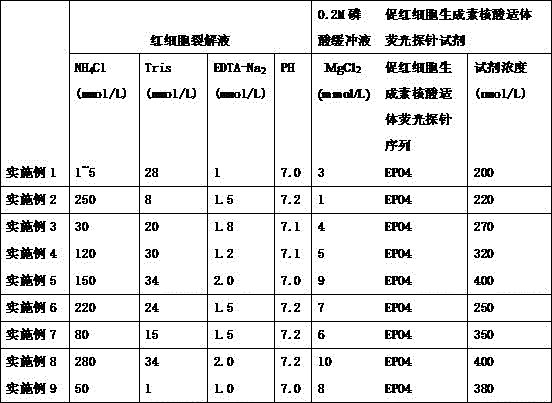
Examples
Embodiment 1
[0033] After dissolving and preparing the required reagent components according to Example 1 in Table 1, divide into bottles and freeze-dry to make a dry powder reagent; before use, add ultrapure water and use after reconstitution. Three parallels were set for each sample, and the detection steps were as follows:
[0034] (1) Blood sample lysing: Mix heparin anticoagulated whole blood and erythrocyte lysate at a volume ratio of 1:0.5, let stand for 30 minutes, then centrifuge at a medium speed for 7 minutes, and collect the supernatant;
[0035] (2) Mixed egg incubation: take 20 μl of the supernatant obtained in step 1) and mix with 45ul of the erythropoietin nucleic acid aptamer fluorescent probe reagent obtained by dissolving the erythropoietin nucleic acid aptamer fluorescent probe in 0.2M phosphate buffer, Incubate the eggs at room temperature for 5 minutes to obtain the test solution;
[0036] (3) Fluorescence detection: 50ul of the test solution obtained in the detectio...
Embodiment 2
[0040] After dissolving and preparing the required reagent components according to Example 2 in Table 1, divide into bottles and freeze-dry to make a dry powder reagent; before use, add ultrapure water and use after reconstitution. Three parallels were set for each sample, and the detection steps were as follows:
[0041] (1) Blood sample lysis: Mix peripheral blood and red blood cell lysate at a volume ratio of 1:2.5, let stand for 5 minutes, then centrifuge at a medium speed for 6 minutes, and collect the supernatant;
[0042] (2) Mixed egg incubation: Take 50μl of the supernatant obtained in step 1) and 30ul of
[0043] The erythropoietin nucleic acid aptamer fluorescent probe reagent obtained by dissolving the erythropoietin nucleic acid aptamer fluorescent probe in 0.2M phosphate buffer was mixed, and the eggs were incubated at room temperature for 6 minutes to obtain the test solution;
[0044] (3) Fluorescence detection: 50ul of the test solution obtained in the detect...
Embodiment 3
[0047] After dissolving and preparing the required reagent components according to Example 3 in Table 1, divide into bottles and freeze-dry to make a dry powder reagent; before use, add ultrapure water and use after reconstitution. Three parallels were set for each sample, and the detection steps were as follows:
[0048] (1) Blood sample lysis: Mix peripheral blood and red blood cell lysate at a volume ratio of 1:3.5, let stand for 10 minutes, then centrifuge at a medium speed for 5 minutes, and collect the supernatant;
[0049] (2) Mixed egg incubation: Take 75μl of the supernatant obtained in step 1) and 45ul of
[0050] The erythropoietin nucleic acid aptamer fluorescent probe reagent obtained by dissolving the erythropoietin nucleic acid aptamer fluorescent probe in 0.2M phosphate buffer was mixed, and the eggs were incubated at room temperature for 7 minutes to obtain the test solution;
[0051] (3) Fluorescence detection: 50ul of the test solution obtained in the detec...
PUM
 Login to View More
 Abstract
Description
Claims
Application Information
 Login to View More