Newton method power flow calculation method which changes Jacobi matrix with iteration and node types

A technology of node type and power flow calculation, which is applied to AC networks with the same frequency from different sources, complex mathematical operations, etc., can solve problems such as increased number of iterations and poor convergence, achieve fewer iterations and solve convergence problems Effect

CN106532711AInactive Publication Date: 2017-03-22DALIAN MARITIME UNIVERSITY
3 Cites 21 Cited by

Patent Information

Authority / Receiving Office
CN · China
Current Assignee / Owner
Publication Date
2017-03-22
Estimated Expiration
Not applicable · inactive patent

Smart Images

  • Figure 1
    Figure 1
  • Figure 2
    Figure 2
  • Figure 3
    Figure 3
Patent Text Reader

Abstract

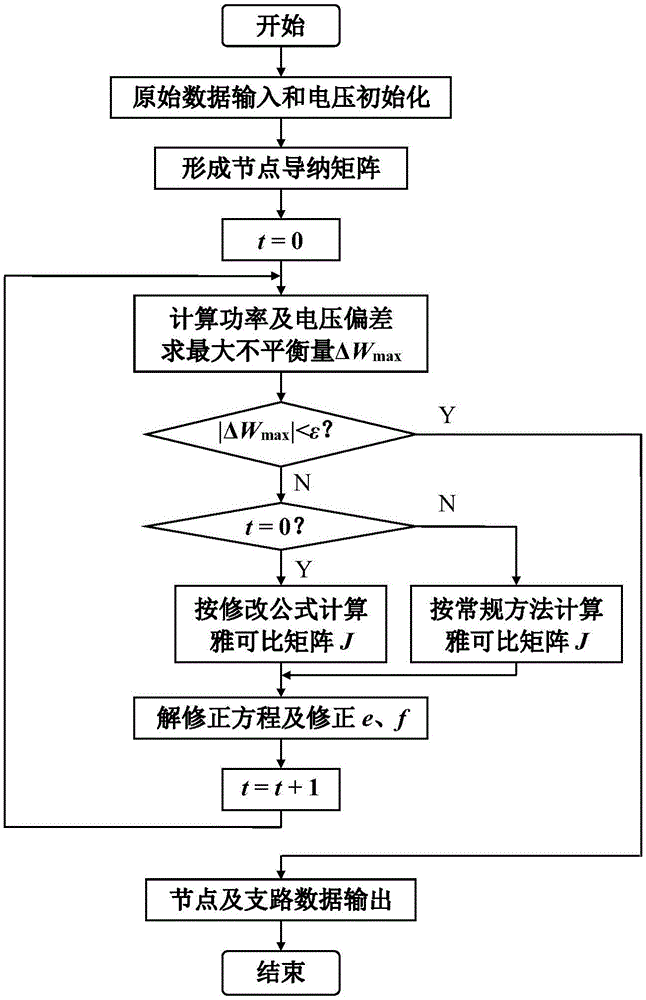
The invention discloses a Newton method power flow calculation method which changes a Jacobi matrix with iteration and node types. A PQ node calculates a Jacobi matrix element by using an ai value and a bi value which are calculated by given values Pis and Qis in the first-time iteration. A PV node and all nodes in the subsequent iteration calculates the Jacobi matrix element by using a conventional method. The method solves a convergence problem of a rectangular coordinate Newton method power flow calculation method in the analysis of a power system containing a low impedance branch in such a way that the PQ node adopts the Jacobi matrix calculation method in the first iteration process and which is different from that in the subsequent iteration processes. The method of the invention can be reliably converged when he conventional rectangular coordinate Newton method are not convergent, is less than the number of iterations than the prior art. The Newton method power flow calculation method can not only solve the convergence problem of the rectangular coordinate Newton method power flow calculation method in the analysis of a power system containing a low impedance branch, but also can calculate the power flow of the normal power system without any adverse effect.
Need to check novelty before this filing date? Find Prior Art

Description

technical field

[0001] The invention relates to a power flow calculation method of a power system with a small impedance branch, in particular to a power flow calculation method of the Cartesian coordinate Newton method of the power system. Background technique

[0002] Power system power flow calculation is a basic calculation for studying the steady-state operation of the power system. It determines the operating state of the entire power system according to the given operating conditions and network structure of the power system. The power flow calculation is also the basis of other analysis of the power system, such as safety analysis, transient stability analysis, etc., all use power flow calculation. Due to the advantages of reliable convergence, fast calculation speed and moderate memory requirements, Newton's method has become the mainstream algorithm for power flow calculation. Newton's method is divided into two forms: polar coordinates and rectangular coordinates...

Examples

Embodiment Construction

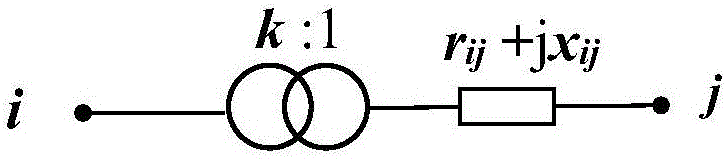
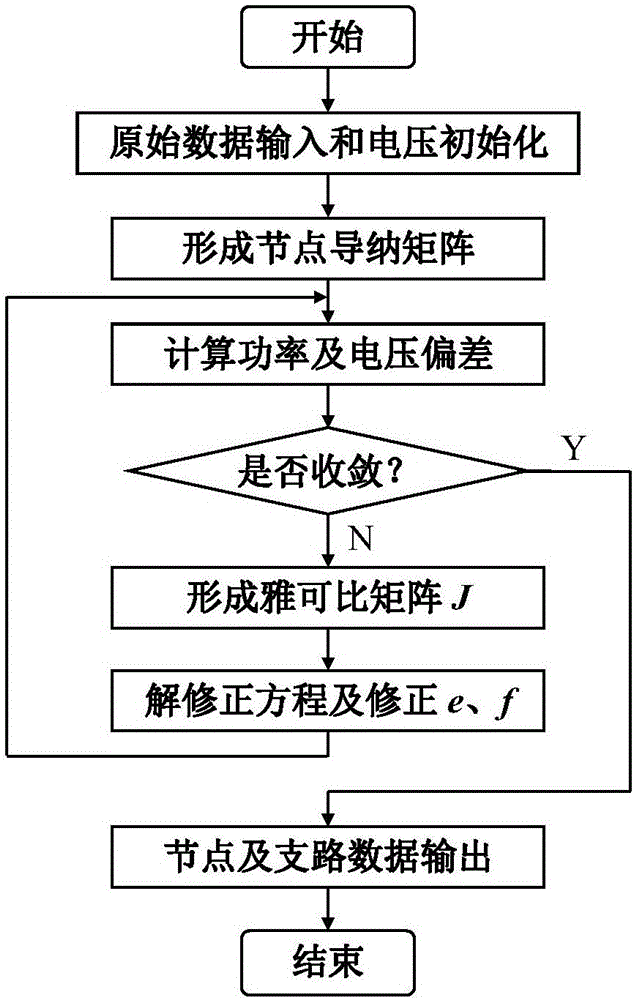
[0089] The present invention will be further described below in conjunction with the accompanying drawings. according to figure 1 The small impedance transformer model shown, using Figure 4 The flow chart of the Cartesian coordinate Newton method power flow calculation is shown, and the power flow calculation is carried out on an actual large-scale power grid. The actual large grid has 445 nodes and contains a large number of small impedance branches. Among them, there are 49 small impedance branches with x≤0.001, 41 small impedance branches with x≤0.0001, and 22 small impedance branches with x≤0.00001. Among them, the smallest impedance value is the small impedance branch l between node 118 and node 125 118-125 x=0.00000001, transformation ratio k=0.9565, and k is located at the node 118 side. The convergence accuracy of the power flow calculation is 0.00001. In order to verify the convergence of the present invention to calculate the small impedance branch power system...