A Low Complexity Robust Subspace Estimation Method
What is AI technical title?
AI technical title is built by Patsnap AI team. It summarizes the technical point description of the patent document.
A space estimation, low-complexity technique, applied in the field of robust subspace estimation, capable of solving low-complexity problems
Active Publication Date: 2019-06-18
UNIV OF ELECTRONICS SCI & TECH OF CHINA
View PDF4 Cites 0 Cited by
Summary
Abstract
Description
Claims
Application Information
AI Technical Summary
This helps you quickly interpret patents by identifying the three key elements:
Problems solved by technology
Method used
Benefits of technology
Problems solved by technology
[0004] The purpose of the present invention is to overcome the deficiencies in the prior art, solve the subspace from the viewpoint of low-rank matrix decomposition, propose a kind of low-complexity robust subspace estimation method, specifically an efficient iterative reweighting algorithm, the method Does not require any step size search, each iteration is an optimal closed-form solution to a subproblem
Method used
the structure of the environmentally friendly knitted fabric provided by the present invention; figure 2 Flow chart of the yarn wrapping machine for environmentally friendly knitted fabrics and storage devices; image 3 Is the parameter map of the yarn covering machine
View more
Image
Smart Image Click on the blue labels to locate them in the text.
Viewing Examples
Smart Image
Click on the blue label to locate the original text in one second.
Reading with bidirectional positioning of images and text.
Smart Image
Examples
Experimental program
Comparison scheme
Effect test
example 1
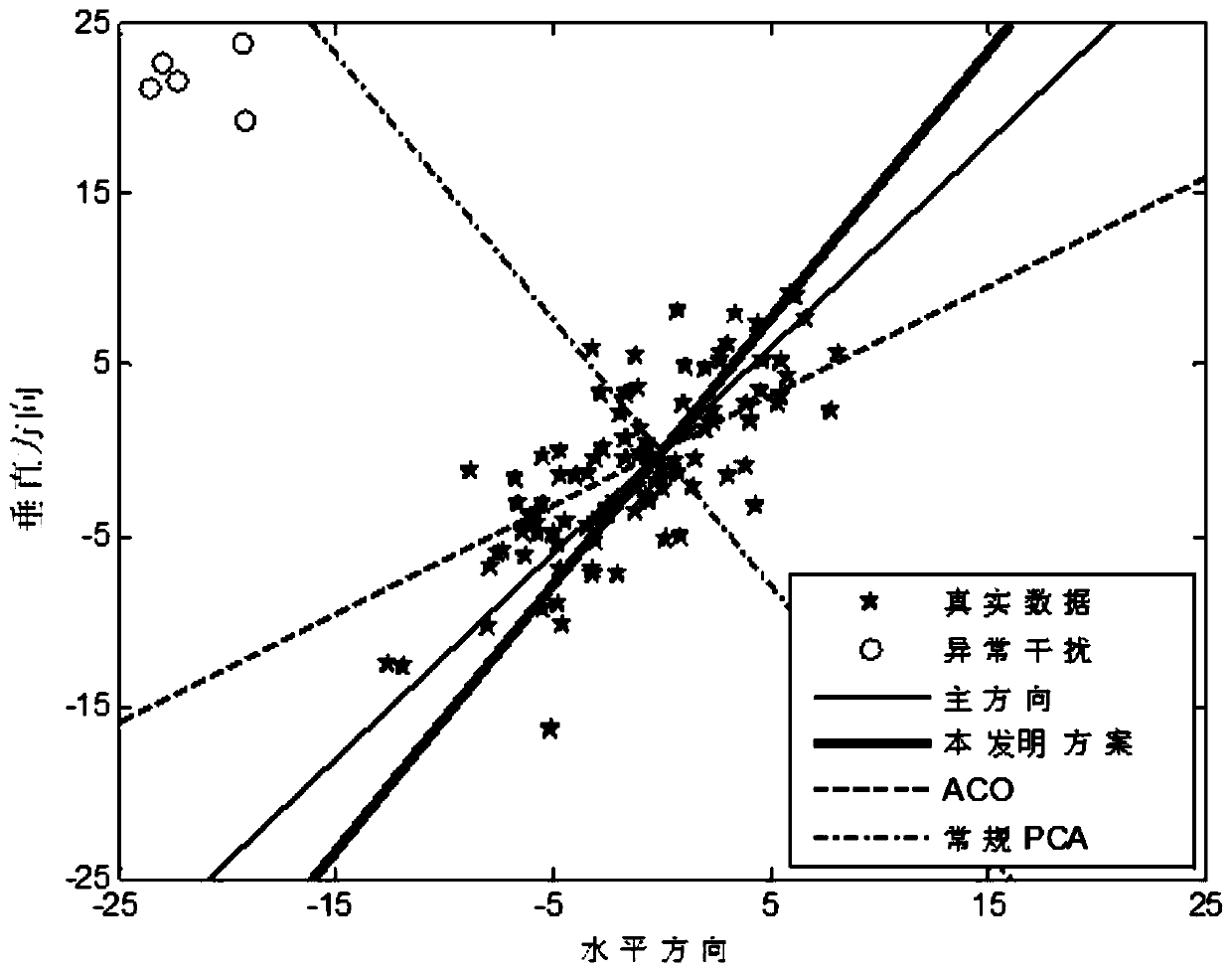
[0056] Example 1 The following uses robust (real number) data dimensionality reduction as an example to elaborate on the specific application of the robust subspace method proposed in the present invention. First, we generate 150 two-dimensional real data samples (Such as figure 1 The five-pointed star in), and obey the following Gaussian distribution:
[0057]
[0058] among them, Represents normal distribution, 0 2 (2-dimensional column vector) is the mean value, Indicates its variance. At the same time, 5 abnormal data points are generated, o 1 ,...,O 5 ,Such as figure 1 The circle point in the upper left corner. At the same time, 5 random abnormal data points obey the following Gaussian distribution:
[0059]
[0060] In this example, define Y in Algorithm 1 as At the same time, let ε=1, γ=0.5, and p=1. The initialization of U(0) and V(0) are the results obtained by conventional PCA (Singular ValueDecomposition) respectively, and suppose the maximum number of iteration...
example 2
[0061] Example 2 The following describes the application of the solution of the present invention in the positioning of the source of the sensor array. Suppose K direction of arrival angles are θ=[θ 1 ,...,θ K ]'S narrowband source is located at M(M> K) far field of uniform linear array (ULA) structure, then the receiving signal model of N snapshot arrays is
[0062] x(t)=A(θ)s(t)+n(t), t=1,...,N
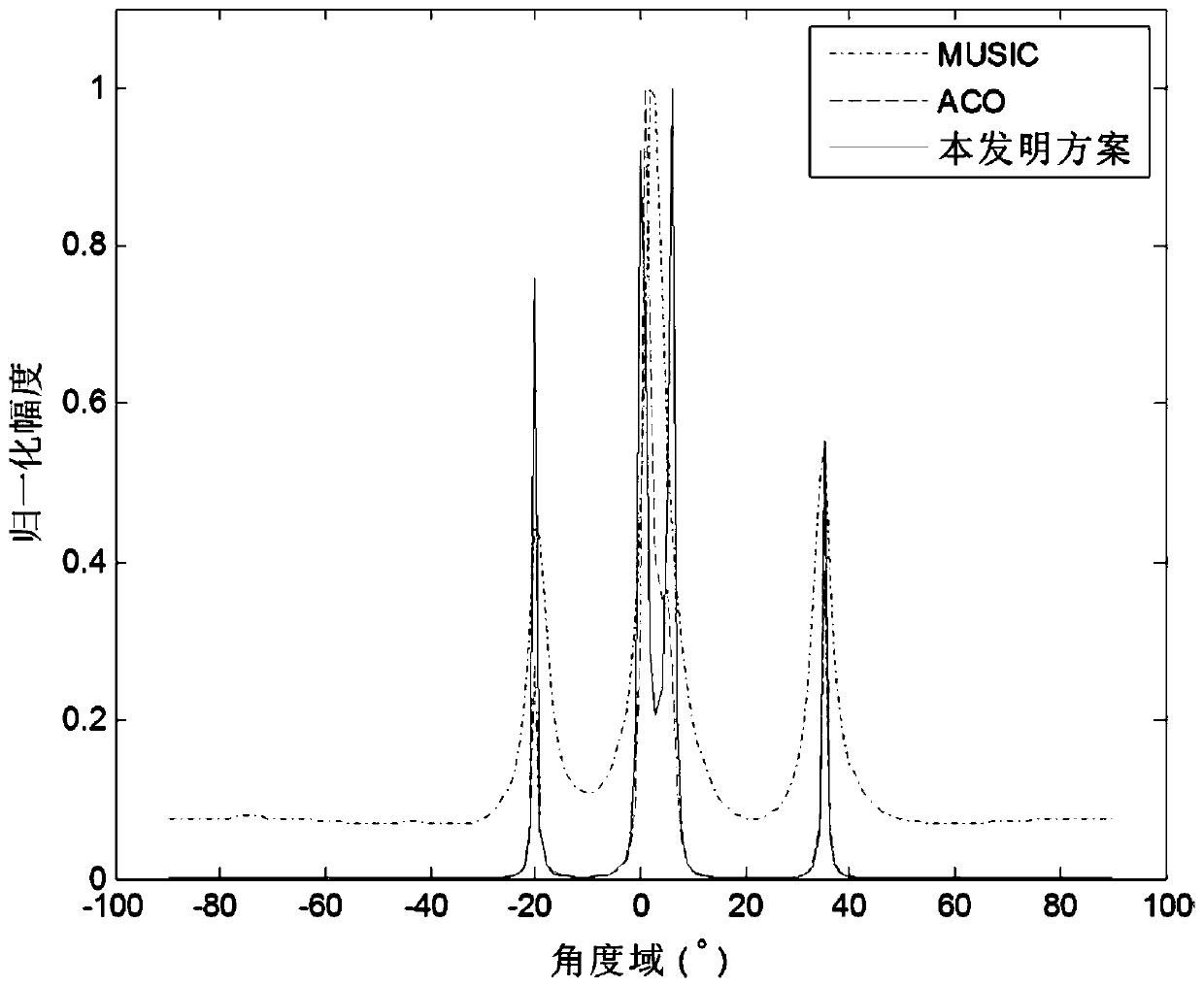
[0063] In the formula, s(t) is the zero mean signal vector, Is the array flow pattern vector, a(θ k ) Is an M-dimensional column vector and its elements are m=1,...,M,θ k Ε(-π / 2,π / 2), λ and d respectively represent the signal wavelength and the distance between array elements. In this case, set the number of antennas M=8, the number of sources K=4, the number of snapshots N=100, and the source position θ=[-20°,0°,6°,35°] T , And d=λ / 2; the superimposed noise is Gaussian mixed impulse noise, and the signal-to-noise ratio is -5dB. In order to make the solution of the present invention s...
the structure of the environmentally friendly knitted fabric provided by the present invention; figure 2 Flow chart of the yarn wrapping machine for environmentally friendly knitted fabrics and storage devices; image 3 Is the parameter map of the yarn covering machine
Login to View More
PUM
Login to View More
Abstract
The invention belongs to the field of signalprocessing and communication, and relates to a low-complexity robust subspace estimation method. In order to reduce the computational complexity, the method of the present invention mainly decomposes the unknown variable into a series of block variables and selects the block update rule, and then finds an appropriate upper bound function corresponding to the original objective function to solve the current problem. The method is based on the gradient descent of inexact block coordinates. For each sub-problem, by finding a reliable approximate solution and only through the four arithmetic operations of vectors, the computational overhead of the highly complex one-dimensional line searchoptimization problem is avoided. At the same time, by introducing a new robust function with adjustable parameters, it not only avoids the calculation problems caused by the non-smoothness of the cost function, but also improves the robustness to outliers or impulse noise.
Description
Technical field [0001] The invention belongs to the field of signalprocessing and communication, and relates to a low-complexity robust subspace estimation method. Background technique [0002] The subspace method has important applications in signalprocessing, communication and computer vision. Its main function is to represent high-dimensional data by selecting low-dimensional uncorrelated variable components to achieve the effect of noise reduction and dimensionality reduction. Traditional subspace methods are mostly based on the Euclidean norm (l 2 ) Low-rank matrix decomposition in space, such as PCA (principal component analysis) method based on truncated singular value or eigen decomposition; "Multiple emitter location and signal parameterestimation". As we all know, this tradition is based on l 2 The norm method cannot be applied to impulse noise, because l 2 The norm is optimal only under Gaussianbackground noise. In fact, in many practical applications, in addition...
Claims
the structure of the environmentally friendly knitted fabric provided by the present invention; figure 2 Flow chart of the yarn wrapping machine for environmentally friendly knitted fabrics and storage devices; image 3 Is the parameter map of the yarn covering machine
Login to View More
Application Information
Patent Timeline
Application Date:The date an application was filed.
Publication Date:The date a patent or application was officially published.
First Publication Date:The earliest publication date of a patent with the same application number.
Issue Date:Publication date of the patent grant document.
PCT Entry Date:The Entry date of PCT National Phase.
Estimated Expiry Date:The statutory expiry date of a patent right according to the Patent Law, and it is the longest term of protection that the patent right can achieve without the termination of the patent right due to other reasons(Term extension factor has been taken into account ).
Invalid Date:Actual expiry date is based on effective date or publication date of legal transaction data of invalid patent.



 Login to View More
  Login to View More