
Trench type super junction and method of making the same
A manufacturing method and super junction technology, which is applied in semiconductor/solid-state device manufacturing, semiconductor devices, electrical components, etc., can solve problems such as poor uniformity of reverse breakdown voltage, and achieve the effect of improving in-plane uniformity
- Summary
- Abstract
- Description
- Claims
- Application Information
AI Technical Summary
Problems solved by technology
Method used
Image

Examples
Embodiment Construction
[0050] Before describing the embodiments of the present invention, the influence of process mismatch on the breakdown voltage of existing trench-type super junction devices is introduced first:
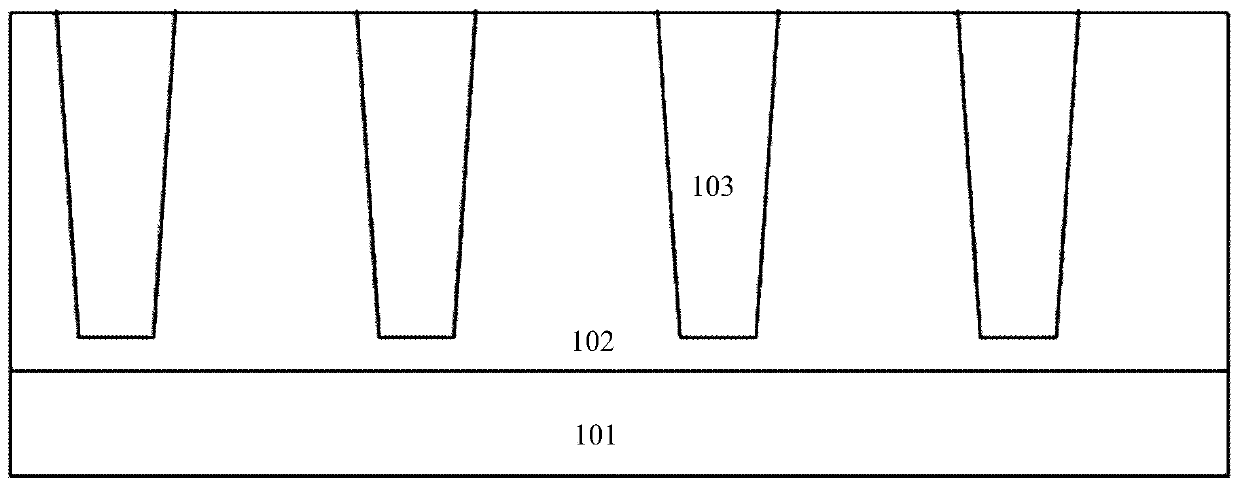
[0051] Such as figure 1 As shown, it is a schematic structural diagram of an existing groove-type super junction; an N-type epitaxial layer 102 is formed on the surface of an N-type semiconductor substrate such as a silicon substrate 101, and a plurality of trenches are formed in the N-type epitaxial layer 102. Each trench is filled with a P-type epitaxial layer 103, and the P-type epitaxial layer 103 filled in each trench forms a P-type thin layer, that is, a P-type column 103, and the N-type epitaxial layer between each P-type thin layer 103 Layer 102 constitutes an N-type thin layer. figure 1 The structure shown shows that the super junction is composed of a plurality of N-type thin layers and P-type thin layers 103 arranged alternately. figure 1 shows an alternate arrangement of...
PUM
 Login to View More
 Abstract
Description
Claims
Application Information
 Login to View More