
Paper prepared from forestry and agricultural waste and method thereof
A technology for agricultural and forestry waste and paper, which is applied in the field of pulping and papermaking, can solve the problems of low kappa value, high whiteness, and low pulping yield, and achieves low kappa value, high whiteness and high fiber yield. Effect
- Summary
- Abstract
- Description
- Claims
- Application Information
AI Technical Summary
Problems solved by technology
Method used
Image

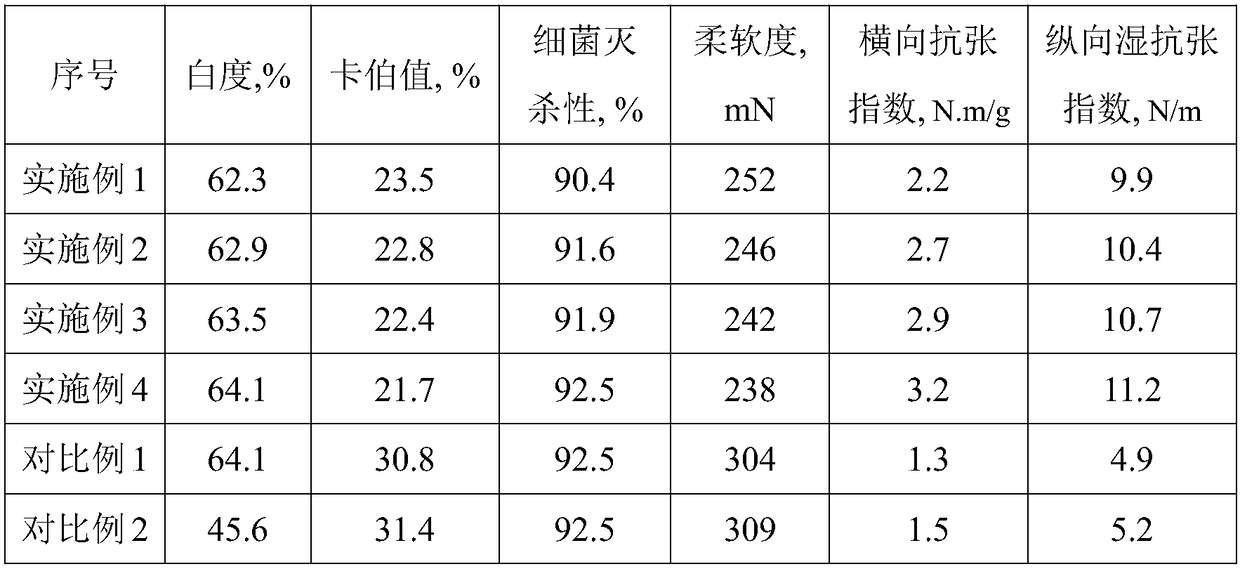

Examples
Embodiment 1
[0030] This embodiment provides a method for preparing paper from agricultural and forestry waste, and the specific operation steps are as follows:
[0031] S1. Deslagging the agricultural and forestry wastes, removing the silt and dust therein, drying until the water content is 20%, carrying out the screw extrusion processing on the above agricultural and forestry wastes, and then standby; the compression ratio of the screw extrusion processing is 1:1;
[0032] S2. Place the agricultural and forestry waste in step S1 in an ultrasonic reactor, the ultrasonic power is 1200W, the frequency is 30KHz, add catalase, xylanase and water, the amount of catalase is 2 kg / ton of material, wood The amount of glycanase is 4 kg / ton of material, the mass ratio of water to agricultural and forestry waste is 15:2, fully mixed, and fermented, the fermentation time is 2 hours, the temperature is 80°C, and after the fermentation is completed, filter to obtain filtrate and filtrate ;
[0033] S3...
Embodiment 2
[0038] This embodiment provides a method for preparing paper from agricultural and forestry waste, and the specific operation steps are as follows:
[0039] S1. The agricultural and forestry wastes are subjected to deslagging treatment, after removing the silt and dust therein, and dried until the water content is 30%, and the above-mentioned agricultural and forestry wastes are subjected to screw extrusion processing, and then set aside; the compression ratio of the screw extrusion processing is 2:1;
[0040] S2. Place the agricultural and forestry waste in step S1 in an ultrasonic reactor, the ultrasonic power is 1600W, the frequency is 20KHz, add catalase, xylanase and water, the amount of catalase is 4 kg / ton of material, wood The amount of glycanase is 6 kg / ton of material, the mass ratio of water to agricultural and forestry waste is 15:4, fully mixed, and fermented, the fermentation time is 4 hours, the temperature is 70°C, and after the fermentation is completed, filte...
Embodiment 3
[0046] This embodiment provides a method for preparing paper from agricultural and forestry waste, and the specific operation steps are as follows:
[0047] S1. The agricultural and forestry wastes are subjected to deslagging treatment, after removing the silt and dust therein, and dried until the water content is 25%, and the above-mentioned agricultural and forestry wastes are subjected to screw extrusion processing, and then set aside; the compression ratio of the screw extrusion processing is 1.5:1;
[0048] S2. Place the agricultural and forestry waste in step S1 in an ultrasonic reactor, the ultrasonic power is 1300W, the frequency is 25KHz, add catalase, xylanase and water, the amount of catalase is 3 kg / ton of material, wood The amount of glycanase is 5 kg / ton of material, the mass ratio of water to agricultural and forestry waste is 15:3, fully mixed, and then fermented. The fermentation time is 3 hours, the temperature is 75°C, and after the fermentation is completed...
PUM
| Property | Measurement | Unit |
|---|---|---|
| water content | aaaaa | aaaaa |
Abstract
Description
Claims
Application Information
 Login to View More