Interlayer for laminated glass and laminated glass
What is AI technical title?
AI technical title is built by Patsnap AI team. It summarizes the technical point description of the patent document.
A technology of laminated glass and interlayer film, applied in the direction of glass/slag layered products, windshields, applications, etc., which can solve the problems of poor appearance of laminated glass
Active Publication Date: 2018-06-08
SEKISUI CHEM CO LTD
View PDF8 Cites 2 Cited by
Summary
Abstract
Description
Claims
Application Information
AI Technical Summary
This helps you quickly interpret patents by identifying the three key elements:
Problems solved by technology
Method used
Benefits of technology
Problems solved by technology
As a result, laminated glass is prone to poor appearance
Method used
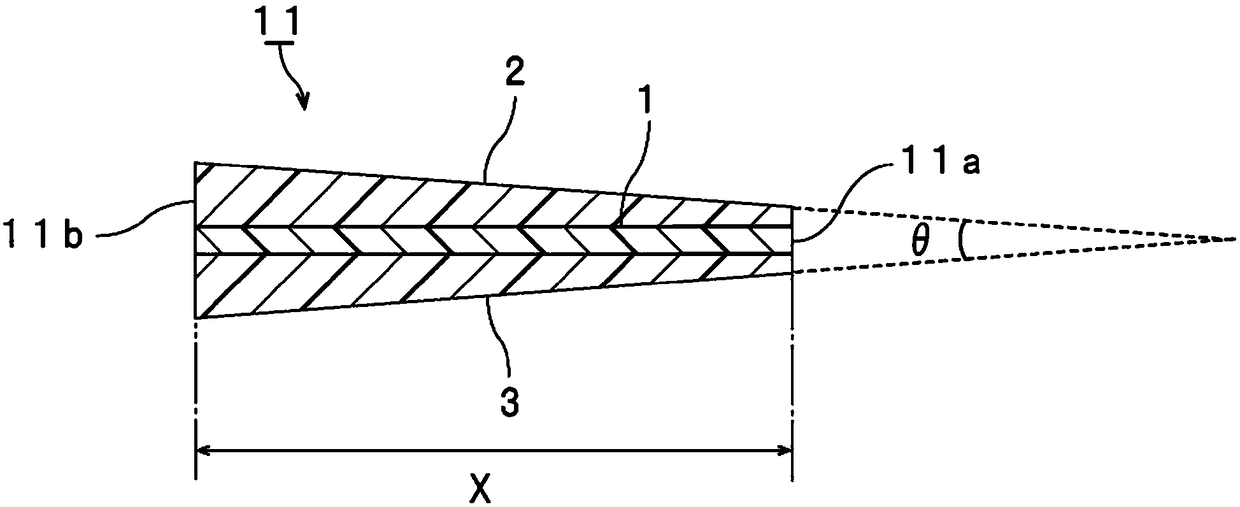
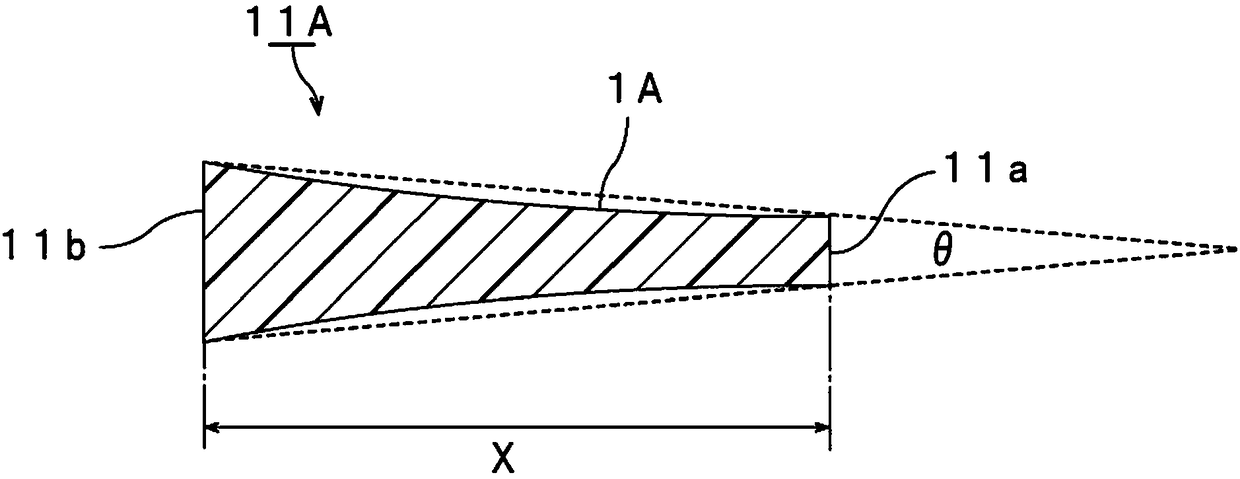
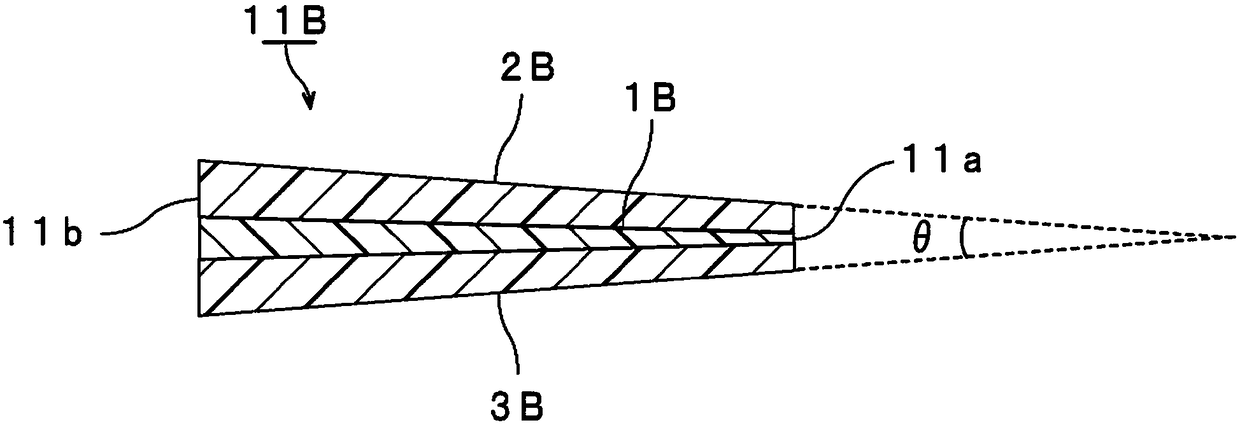
the structure of the environmentally friendly knitted fabric provided by the present invention; figure 2 Flow chart of the yarn wrapping machine for environmentally friendly knitted fabrics and storage devices; image 3 Is the parameter map of the yarn covering machine
View more
Image
Smart Image Click on the blue labels to locate them in the text.
Viewing Examples
Smart Image
Click on the blue label to locate the original text in one second.
Reading with bidirectional positioning of images and text.
Smart Image
Examples
Experimental program
Comparison scheme
Effect test
Embodiment 1
[0219] Preparation of the composition for forming the first layer:
[0220] 100 parts by weight of polyvinyl acetal resin shown in Table 1 below, 60 parts by weight of plasticizer shown in Table 1 below, 0.2 part by weight of ultraviolet shielding agent (Tinuvin326), and antioxidant ( H-BHT) 0.2 parts by weight were thoroughly mixed to obtain a composition for forming the first layer.
[0221] Preparation of compositions for forming the second and third layers:
[0222] 100 parts by weight of polyvinyl acetal resin shown in Table 1 below, 38 parts by weight of plasticizer shown in Table 1 below, 0.2 parts by weight of ultraviolet shielding agent (Tinuvin326), and antioxidant (H-BHT) 0.2 weight part, the composition for forming the 2nd layer and the 3rd layer was obtained.
[0223] Production of interlayer film:
[0224] Using an extruder, the composition for forming the first layer and the compositions for forming the second and third layers are coextruded, and the intermed...
Embodiment 2
[0226] Preparation of the composition for forming the interlayer:
[0227] 100 parts by weight of polyvinyl acetal resin shown in Table 1 below, 38 parts by weight of plasticizer shown in Table 1 below, 0.2 parts by weight of ultraviolet shielding agent (Tinuvin326), and antioxidant (H-BHT) 0.2 weight part, the composition for forming an intermediate film was obtained.
[0228] Production of interlayer film:
[0229] Use an extruder to extrude the composition for forming the intermediate film, heat the intermediate film to 100°C to 150°C, hold it for a holding time of 1 minute, then lower the temperature to 25°C, and wind the intermediate film to obtain a coil body. A single-layer interlayer film having a wedge-shaped cross-sectional shape in the thickness direction was fabricated. The thicknesses at the first position of 0.05X from one end to the other end, the second position of 0.5X from one end to the other end, and the third position of 0.95X from one end to the other ...
Embodiment 3
[0235] A three-layer interlayer film was obtained in the same manner as in Example 1 except that the mold temperature was changed and the thickness of the interlayer film was changed according to Table 1 below.
the structure of the environmentally friendly knitted fabric provided by the present invention; figure 2 Flow chart of the yarn wrapping machine for environmentally friendly knitted fabrics and storage devices; image 3 Is the parameter map of the yarn covering machine
Login to View More
PUM
Property
Measurement
Unit
thickness
aaaaa
aaaaa
thickness
aaaaa
aaaaa
particle size
aaaaa
aaaaa
Login to View More
Abstract
Provided is an interlayer for laminated glass, whereby a laminated glass unlikely to have creases in the interlayer and having suppressed external defects can be obtained. This interlayer for laminated glass has: an MD direction and a TD direction; and one end and another end on the opposite side to the one end and having a greater thickness than the one end. The one end and the other end are positioned on both sides of the interlayer, in the TD direction. When the distance between the one end and the other end is X, the absolute value for the difference between a maximum heat shrinkage and aminimum heat shrinkage is no more than 5%, between: a first heat shrinkage at 150 DEG C at a first position at 0.05 X from the one end towards the other end, in the MD direction; a second heat shrinkage at 150 DEG C at a second position at 0.5 X from the one end towards the other end, in the MD direction; and a third heat shrinkage at 150 DEG C at a third position at 0.95 X from the one end towards the other end, in the MD direction.
Description
technical field [0001] The present invention relates to an interlayer film for laminated glass for obtaining laminated glass. Also, the present invention relates to a laminated glass using the interlayer film for laminated glass. Background technique [0002] In general, even when laminated glass is damaged by external impact, the amount of glass shards scattered is small, and it is excellent in safety. Therefore, the laminated glass is widely used in automobiles, rail vehicles, airplanes, ships, buildings, and the like. The laminated glass is produced by interposing an interlayer film for laminated glass between a pair of glass plates. [0003] Examples of the above-mentioned interlayer film for laminated glass include a single-layer interlayer film having a one-layer structure and a multilayer interlayer film having a two-layer or more structure. [0004] As an example of the above-mentioned interlayer film for laminated glass, the following Patent Document 1 discloses ...
Claims
the structure of the environmentally friendly knitted fabric provided by the present invention; figure 2 Flow chart of the yarn wrapping machine for environmentally friendly knitted fabrics and storage devices; image 3 Is the parameter map of the yarn covering machine
Login to View More
Application Information
Patent Timeline
Application Date:The date an application was filed.
Publication Date:The date a patent or application was officially published.
First Publication Date:The earliest publication date of a patent with the same application number.
Issue Date:Publication date of the patent grant document.
PCT Entry Date:The Entry date of PCT National Phase.
Estimated Expiry Date:The statutory expiry date of a patent right according to the Patent Law, and it is the longest term of protection that the patent right can achieve without the termination of the patent right due to other reasons(Term extension factor has been taken into account ).
Invalid Date:Actual expiry date is based on effective date or publication date of legal transaction data of invalid patent.


 Login to View More