
Environmental voice recognition method based on keypoint encoding and multi-pulse learning
A technology of environmental sound and recognition methods, applied in neural learning methods, speech recognition, speech analysis, etc., can solve problems such as low biological confidence and far-reaching information processing methods
- Summary
- Abstract
- Description
- Claims
- Application Information
AI Technical Summary
Problems solved by technology
Method used
Image


Examples
Embodiment Construction
[0042] The present invention will be described in further detail below in conjunction with the accompanying drawings and specific experiments.
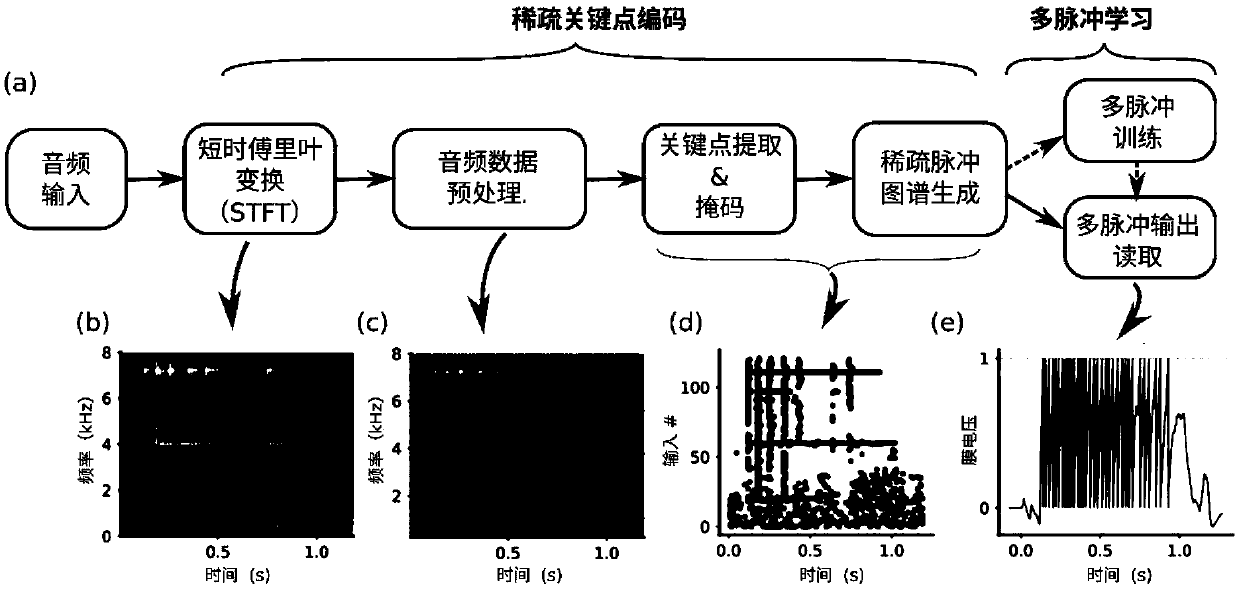
[0043] Such as figure 1 As shown, the system frame diagram based on sparse key point coding and impulse neural network involved in the present invention mainly includes the following steps:
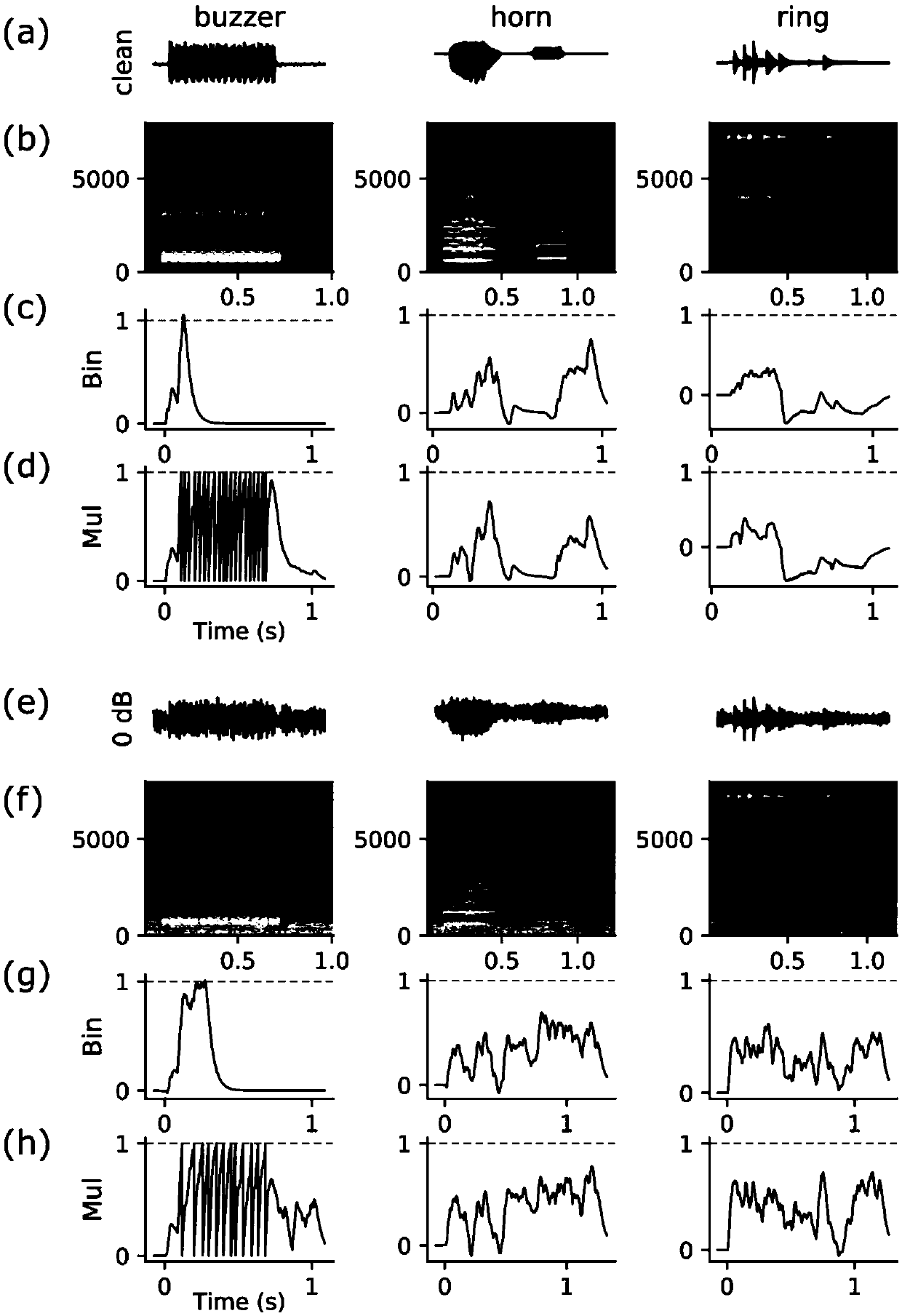
[0044]Step 1, RWCP database preprocessing: select 10 different sounds from the RWCP database for recognition, namely bells (bells5), bottle (bottle1), buzzer (buzzer), cymbals (cymbals), horn Sound (horn), Kara (kara), metal (metal15); all audio sampling frequency is 16KHz, each audio sample is about 0.5-3 seconds long. The first 80 files of each category are selected as the experimental database, among which 40 are randomly selected as the training set and the other 40 are used as the test set. In addition, the "speech babble" noise is selected from the NOISEX'92 database to evaluate the robustness of the system. As shown in Table 1 and Table...
PUM
 Login to View More
 Abstract
Description
Claims
Application Information
 Login to View More