
A High Gain Voltage Type Quasi-Y Source DC-DC Converter
A DC converter, voltage-type technology, applied in the direction of converting DC power input to DC power output, adjusting electrical variables, instruments, etc., can solve problems such as limited boosting capacity, increased circuit cost, and complex control of the converter, and achieve voltage The effect of high gain, small start-up inrush current, and continuous input current
- Summary
- Abstract
- Description
- Claims
- Application Information
AI Technical Summary
Problems solved by technology
Method used
Image

Examples
Embodiment
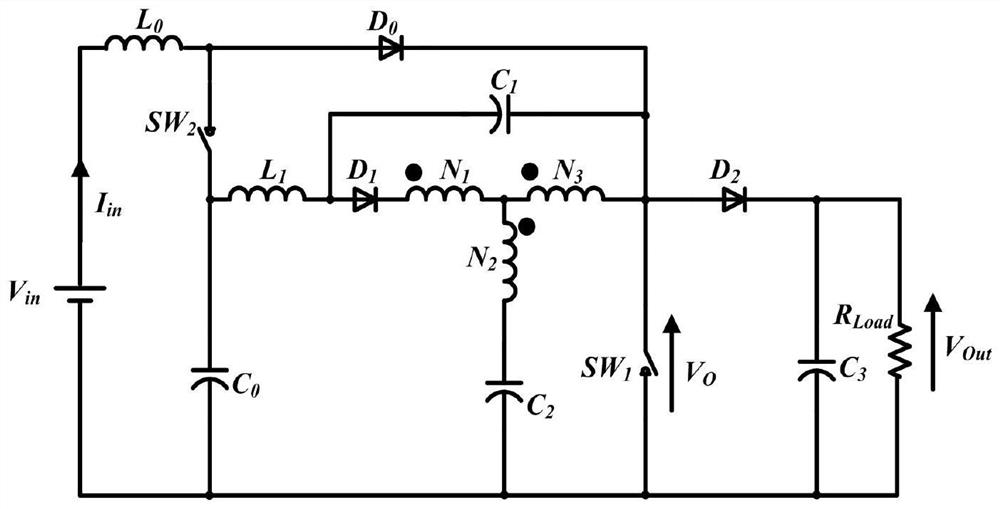
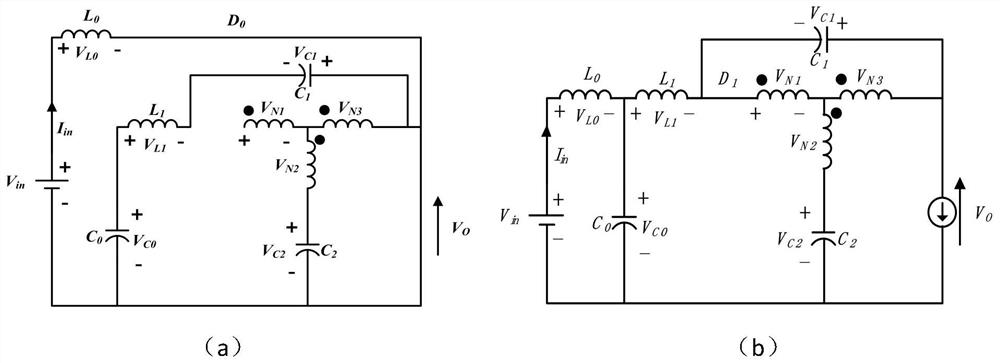
[0036] When SW 1 closed, SW 2 When disconnected, the circuit of the present invention is in a straight-through state, and the circuit connection situation is: V in Positive through L 0 Connect back to V in Negative pole, L 0 with V in The nodes between the negative poles pass through the third end of the three-winding coupled inductor in turn, and the second end of the three-winding coupled inductor passes through C 2 Connect back to V in Negative pole, L 0 with V in The nodes between the negative poles also pass through C in turn 1 , L 1 and C 0 Connect back to V in negative electrode.
[0037] like image 3 (a) The circuit shown in (a) works in a straight-through state, and the diode D 0 conduction, the diode D 1 and D 2 is reverse biased and turned off. Applying Kirchhoff's Voltage Law (KVL) in this mode, the voltage equation in the shoot-through state is:
[0038] -V in +V L0 =0 (1)
[0039] -V C0 +V L1 -V C1 =0 (2)
[0040] V C2 +V N2 -V N3 =0 ...
PUM
 Login to View More
 Abstract
Description
Claims
Application Information
 Login to View More