A fine-grained sentiment classification method
A sentiment classification and fine-grained technology, applied in neural learning methods, text database clustering/classification, semantic analysis, etc., can solve problems such as poor performance and weakening network feature expression ability, and achieve improved accuracy and discrimination accuracy Improve and improve the effect of network performance
- Summary
- Abstract
- Description
- Claims
- Application Information
AI Technical Summary
Problems solved by technology
Method used
Image

Examples
Embodiment 1
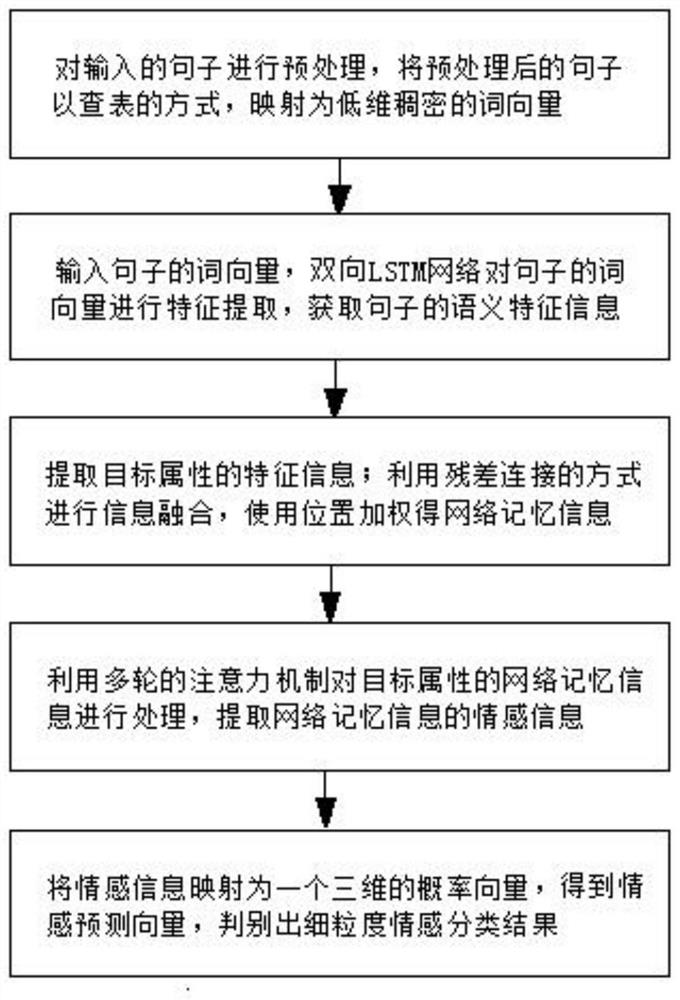
[0082] like Figure 1 to Figure 3 As shown, a fine-grained sentiment classification method includes the following steps:
[0083] Step 1: preprocess the input sentence, and map the preprocessed sentence into a low-dimensional dense word vector in a table lookup manner;
[0084] Step 2: Input the word vector of the sentence, and the bidirectional LSTM network performs feature extraction on the word vector of the sentence to obtain the semantic feature information of the sentence
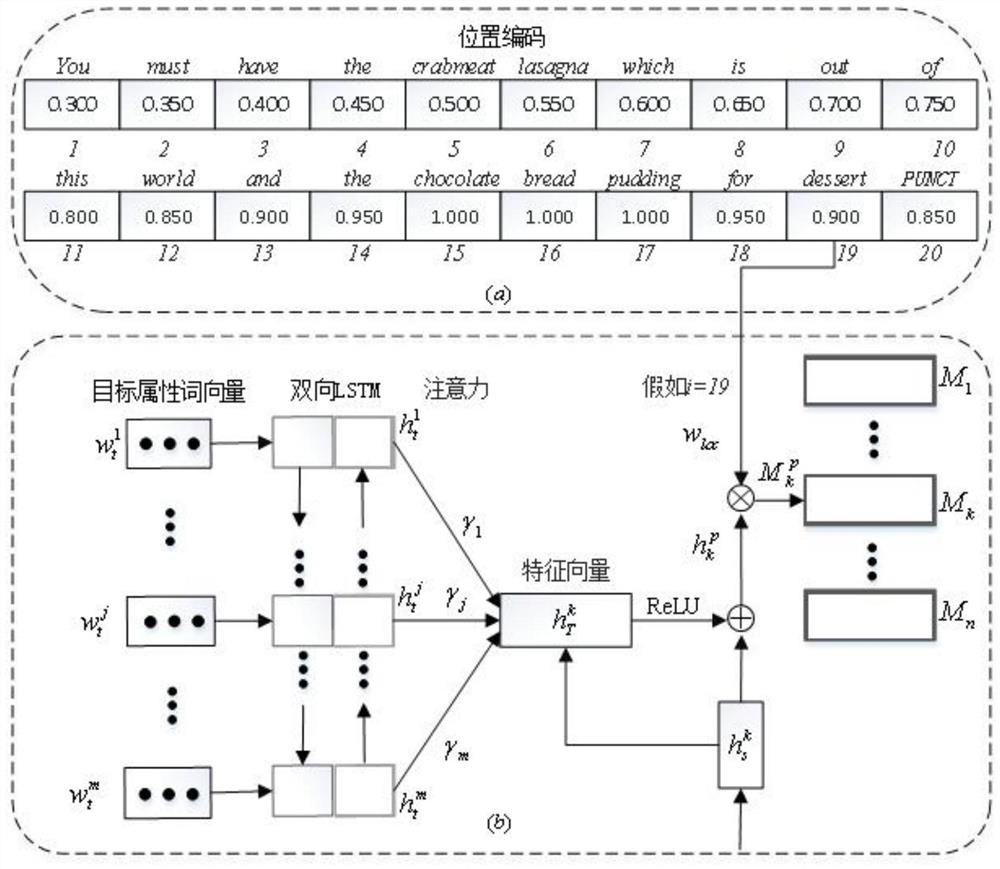
[0085] Step 3: Utilize the semantic feature information of sentences and attention mechanism to extract feature information of target attributes Using the residual connection method, the feature information of the target attribute is Information about semantic features of sentences Perform information fusion to obtain feature information feature information Perform positional encoding to obtain memory information Use location informationL o extended memory information The network me...
Embodiment 2
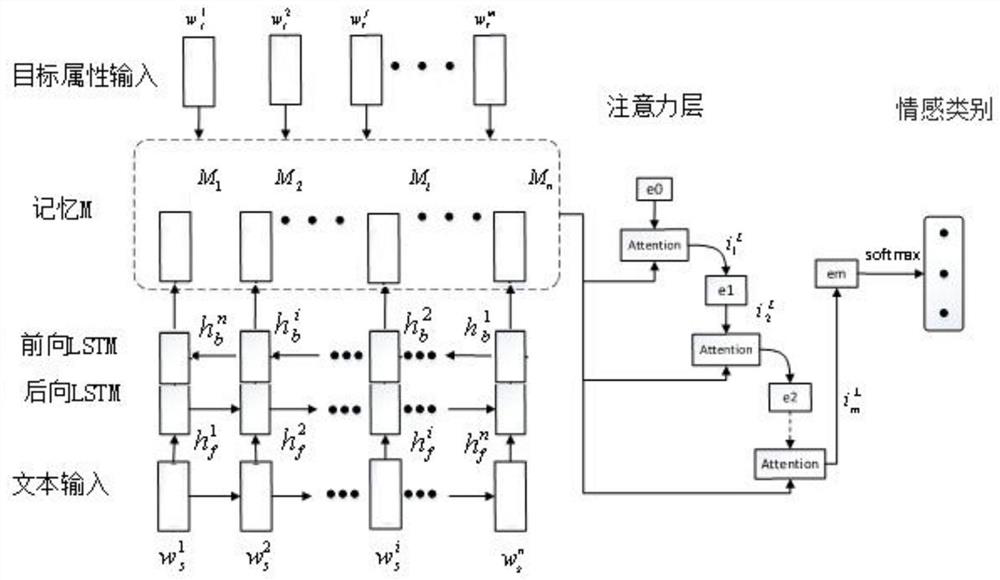
[0133] like Figure 2 to Figure 4 shown, a fine-grained sentiment classification system, including:
[0134] Preprocessing layer 1, used to preprocess the input sentence;
[0135] The word vector layer 2 is used to map the preprocessed sentence into a low-dimensional dense word vector by looking up a table;
[0136]The bidirectional LSTM network layer 3 is used to extract the feature of the word vector of the sentence and obtain the semantic feature information of the sentence
[0137] Memory network layer 4, used to utilize the semantic feature information of sentences and attention mechanism to extract feature information of target attributes Using the residual connection method, the feature information of the target attribute is Information about semantic features of sentences Perform information fusion to obtain feature information feature information Perform positional encoding to obtain memory information Use location informationL o extended memory info...
PUM
 Login to View More
 Abstract
Description
Claims
Application Information
 Login to View More
 - R&D
- Intellectual Property
- Life Sciences
- Materials
- Tech Scout
- Unparalleled Data Quality
- Higher Quality Content
- 60% Fewer Hallucinations
Browse by: Latest US Patents, China's latest patents, Technical Efficacy Thesaurus, Application Domain, Technology Topic, Popular Technical Reports.
© 2025 PatSnap. All rights reserved.Legal|Privacy policy|Modern Slavery Act Transparency Statement|Sitemap|About US| Contact US: help@patsnap.com