
Lilium regale WRKY transcription factor gene LrWRKY4 and application thereof
A transcription factor and gene technology, applied in application, genetic engineering, plant genetic improvement and other directions, can solve the problems affecting the yield and quality of cut lily flowers, scale rot and shedding, and the quality of seed bulbs, and achieve broad market application prospects and breeding cycles. The effect of shortening, reducing usage
- Summary
- Abstract
- Description
- Claims
- Application Information
AI Technical Summary
Problems solved by technology
Method used
Image


Examples
Embodiment 1
[0020] Example 1: LrWRKY4 Full-length gene cloning and sequence analysis
[0021] The roots of lily were inoculated with Fusarium oxysporum, total RNA was extracted from the root 24 h after inoculation, the treated root of lily was ground into powder with liquid nitrogen, then transferred into a centrifuge tube, and extracted by guanidine isothiocyanate method Total RNA; M-MLV reverse transcriptase (promega) was used to synthesize the first strand of cDNA using total RNA as a template. The reaction system and operation process were as follows: take 5 μg Total RNA, add 50 ng oligo (dT), 2 μL dNTP Mix ( 2.5mM each), the reaction volume was made up to 14.5 μL with DEPC water; after mixing, heat denaturation at 70°C for 5 min, then rapidly cool on ice for 5 min, then add 4 μL 5×First-stand buffer, 0.5 μL RNasin (200U), 1 μL M-MLV (200U), mix well and centrifuge briefly, incubate at 42°C for 1.5 h, take it out and heat at 70°C for 10 min to terminate the reaction; after the first ...
Embodiment 2
[0024] Embodiment 2: plant overexpression vector construction
[0025] Use the SanPrep column plasmid DNA mini-extraction kit (Shanghai Sangong) to extract the insert LrWRKY4 coli plasmid pGEM-T- LrWRKY4 As well as the plasmid of the plant expression vector pCAMBIA2300S, take 1 μL for agarose gel electrophoresis to detect the integrity and concentration of the extracted plasmid; Xba I and Eco RI respectively for plasmid pGEM-T- LrWRKY4 and pCAMBIA2300S for double enzyme digestion (100 μL system), the reaction system and operation process are as follows: take 20 μL pGEM-T- LrWRKY4 and pCAMBIA2300S plasmid, add 10μL 10×M buffer, 5μL Xba I, 5 μL Eco RI, 60 μL ddH 2 O, after mixing, centrifuge for a short time, and place at 37°C for overnight reaction. All digested products were subjected to agarose gel electrophoresis, and then the LrWRKY4 The fragments and the large fragments of the pCAMBIA2300S vector were gel-recovered separately, and 1 μL of the recovered product ...
Embodiment 3
[0028] Example 3: Plant genetic transformation mediated by Agrobacterium and screening of transgenic plants
[0029] The transgenic recipient in this experiment was tobacco ( Nicotiana tabacum ), the tobacco seeds were soaked in 75% alcohol for 30s, washed with sterile water and washed with 0.1% HgCl 2 Soak for 8 minutes, then wash several times with sterile water, sow on 1 / 2 MS medium, culture in dark at 28°C for 5-8d, transfer to light incubator after germination (25°C, 16h / d light), and then Subculture once a month with 1 / 2 MS medium.
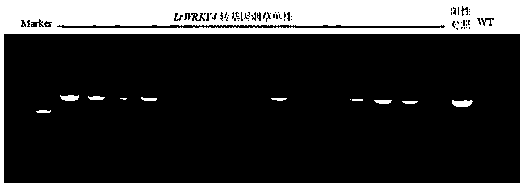
[0030] Take out the stored pCAMBIA2300S-containing pCAMBIA2300S- LrWRKY4 Agrobacterium LBA4404 strain of the plasmid, inoculated 20 μL into 5 mL LB liquid medium containing 50 mg / L Km and 20 mg / L rifampin, and cultured at 28°C until the medium was turbid. Pipette 1 mL of turbid bacterial solution onto LB solid medium containing 50 mg / L Km, and incubate at 28°C for 48 h; then scrape off an appropriate amount of Agrobacterium on LB solid m...
PUM
| Property | Measurement | Unit |
|---|---|---|
| Full length | aaaaa | aaaaa |
Abstract
Description
Claims
Application Information
 Login to View More