Linear motion demodulation implementation method based on improved differential cross multiplication
A technology of linear motion and implementation method, applied in the field of radar detection, can solve problems affecting the robustness and anti-noise ability of the algorithm, reduce the accuracy and stability of the demodulation signal, increase the cumulative noise and approximation error of the demodulation result, and achieve Effects of high linearity, improved operating efficiency, and noise robustness
- Summary
- Abstract
- Description
- Claims
- Application Information
AI Technical Summary
Problems solved by technology
Method used
Image

Examples
Embodiment 1
[0023] small motion detection
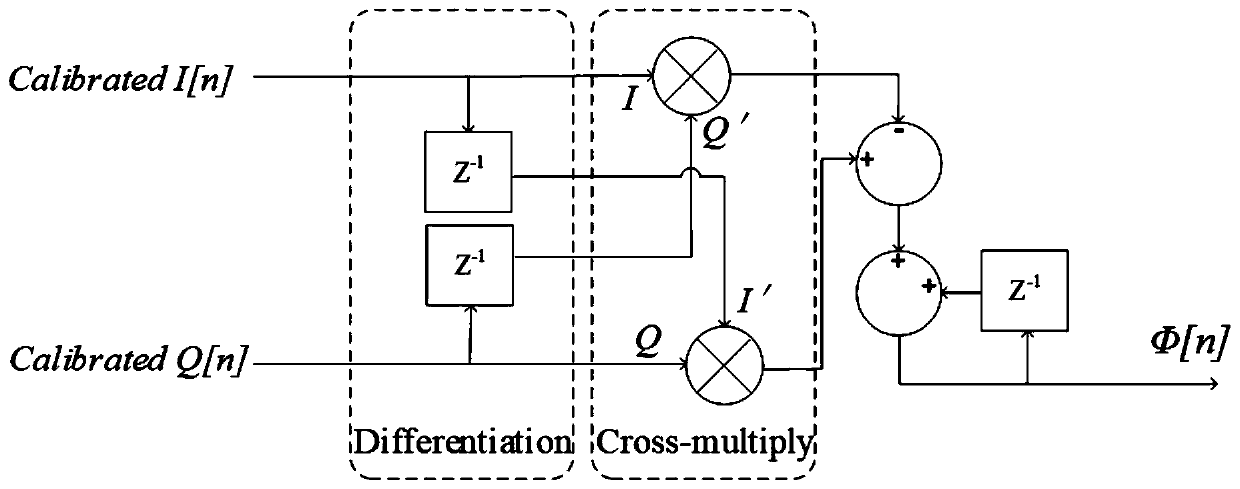
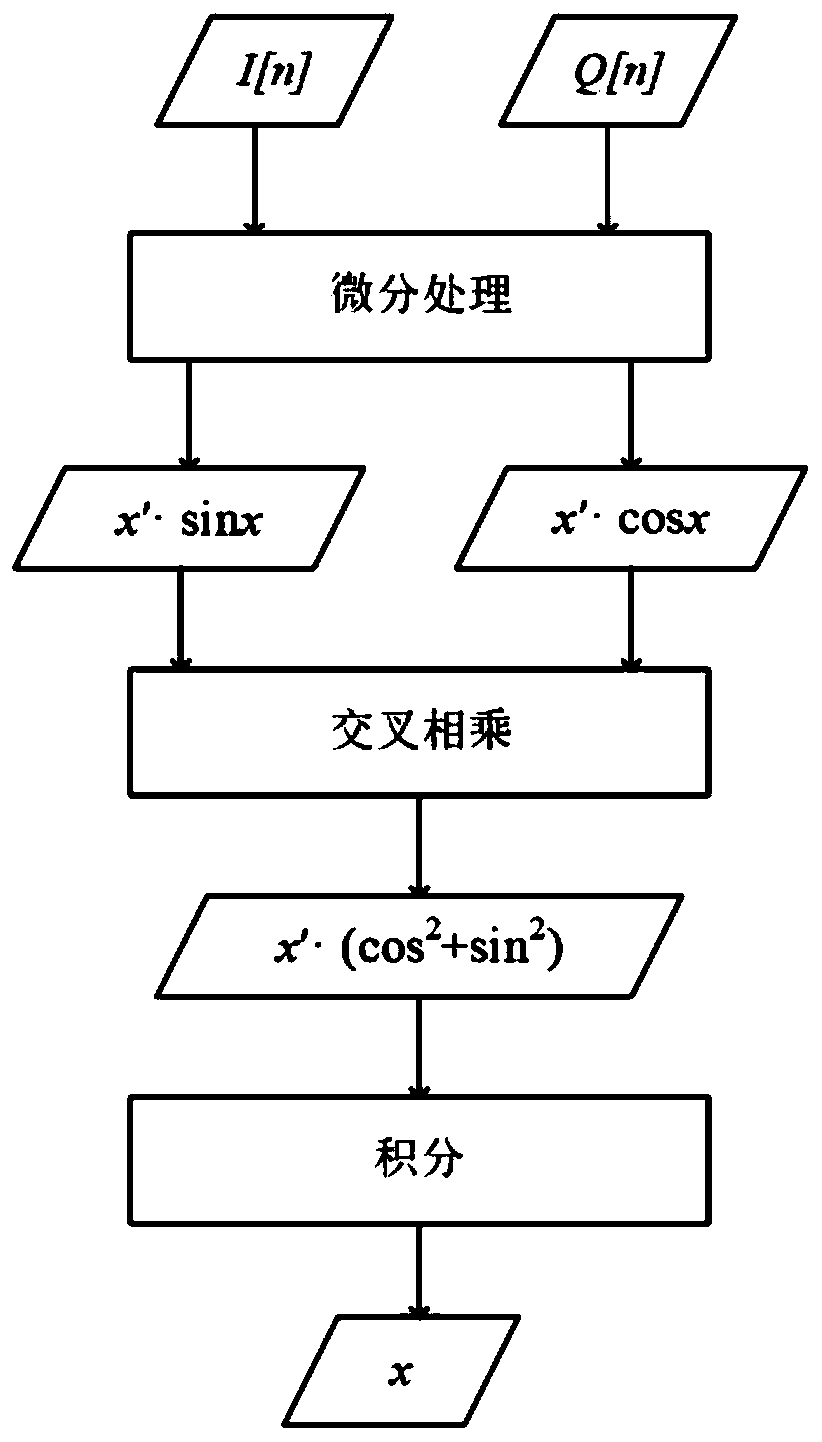
[0024] In this embodiment, a 2.4GHz radar sensor system is used to detect the mechanical movement of the target object within 10mm. Based on the geometric theorem of trigonometric functions, without arctangent transformation, the calibration signal is directly cross-multiplied to realize demodulation of motion information. for:
[0025] Step ① Differentiate the calibration signal directly in the time domain to obtain:
[0026]
[0027] Step ② Use the geometric theorem cos of trigonometric functions 2 Φ+sin 2 Φ=1, directly extract the motion signal to be measured from the differential result of step ①: Since the signal in the differential form is susceptible to noise interference and is not conducive to the processing of subsequent circuits, the motion signal to be measured is restored to the motion signal in the digital domain in a further step, and the final digital algorithm expression is obtained:
[0028] The experimental results...
Embodiment 2
[0030] large motion detection
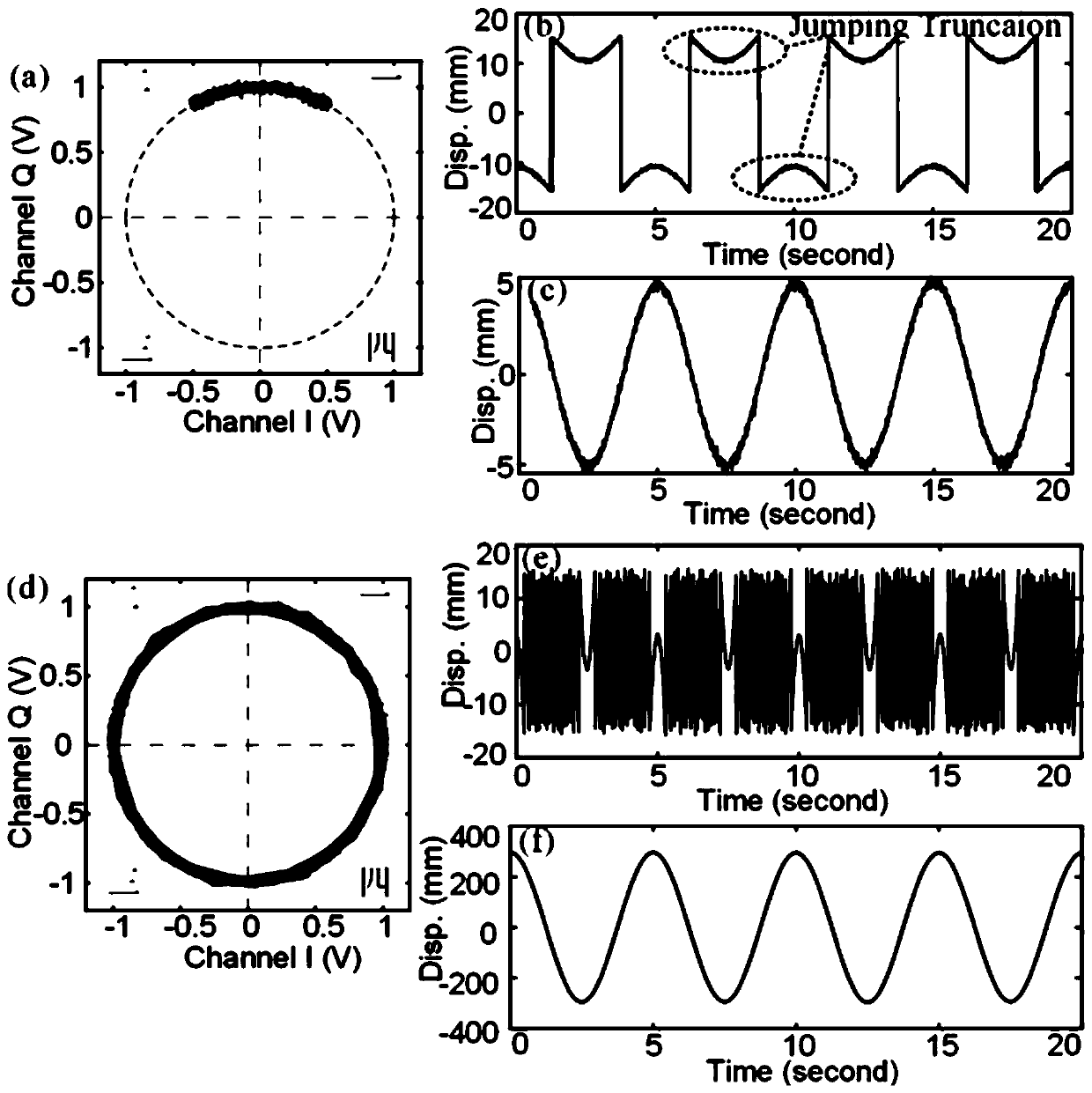
[0031] In this embodiment, a 120GHz radar detection module with a wavelength of only 2.5mm is used to measure large-scale motion signals. Except for small-amplitude motions that are not within the value range, large-displacement motions will also cause phase aliasing and phase ambiguity. exist image 3 In (a)-(c), the I / Q signal phase trajectory spans the first and second quadrants and the trajectory range is less than π / 2. In this case, the motion signal reconstructed by arctangent algorithm has phase ambiguity, but the demodulated signal obtained by this method has no phase distortion. In addition, when the I / Q phase trajectory is far beyond 2π, such as image 3 As shown in (d)-(f), the phase discontinuity appears again in the arctangent demodulation result. On the contrary, this method can still maintain the high linearity, authenticity and integrity of the target motion information.
[0032] In this embodiment, based on the geometric the...
Embodiment 3
[0039] Motion Information Demodulation Simulation under Loud Noise
[0040] The traditional DACM algorithm performs arctangent transformation on Q / I as a whole, and performs differentiation and cross multiplication on this basis, which introduces a large number of approximation errors and cumulative noise during the operation process, which seriously affects the anti-noise ability of the algorithm. In addition, higher requirements are placed on the accuracy of the pre-calibration steps. In contrast, the DACM algorithm in this method has a more streamlined expression, which greatly reduces the number of operations and approximation errors, and optimizes the stability and anti-noise ability of the demodulation process. Figure 4 It is the demodulated signal obtained by each algorithm under 25dB SNR. It can be seen that compared with the existing DACM algorithm, the arctangent algorithm has the smallest variance, and the algorithm proposed by this method also has high stability ...
PUM
 Login to View More
 Abstract
Description
Claims
Application Information
 Login to View More