Check patentability & draft patents in minutes with Patsnap Eureka AI!

Variable lane and traffic signal cooperative control method based on deep reinforcement learning

A technology of reinforcement learning and collaborative control, applied in traffic control systems of road vehicles, traffic control systems, traffic signal control, etc., can solve problems such as poor coupling optimization and reduced traffic efficiency at intersections, and optimize time and space resources The effect of utilization efficiency

Active Publication Date: 2020-11-10
BEIHANG UNIV
View PDF8 Cites 14 Cited by
  • Summary
  • Abstract
  • Description
  • Claims
  • Application Information

AI Technical Summary

Problems solved by technology

The two are not well coupled and optimized
In addition, the optimization of one of traffic signals and variable lanes will definitely affect the other, if the other does not change accordingly, it may even reduce the traffic efficiency of the intersection

Method used

the structure of the environmentally friendly knitted fabric provided by the present invention; figure 2 Flow chart of the yarn wrapping machine for environmentally friendly knitted fabrics and storage devices; image 3 Is the parameter map of the yarn covering machine
View more

Image

Smart Image Click on the blue labels to locate them in the text.
Viewing Examples
Smart Image
  • Variable lane and traffic signal cooperative control method based on deep reinforcement learning
  • Variable lane and traffic signal cooperative control method based on deep reinforcement learning
  • Variable lane and traffic signal cooperative control method based on deep reinforcement learning

Examples

Experimental program
Comparison scheme
Effect test

Embodiment Construction

[0043] The following will clearly and completely describe the technical solutions in the embodiments of the present invention with reference to the accompanying drawings in the embodiments of the present invention. Obviously, the described embodiments are only some, not all, embodiments of the present invention. Based on the embodiments of the present invention, all other embodiments obtained by persons of ordinary skill in the art without making creative efforts belong to the protection scope of the present invention.

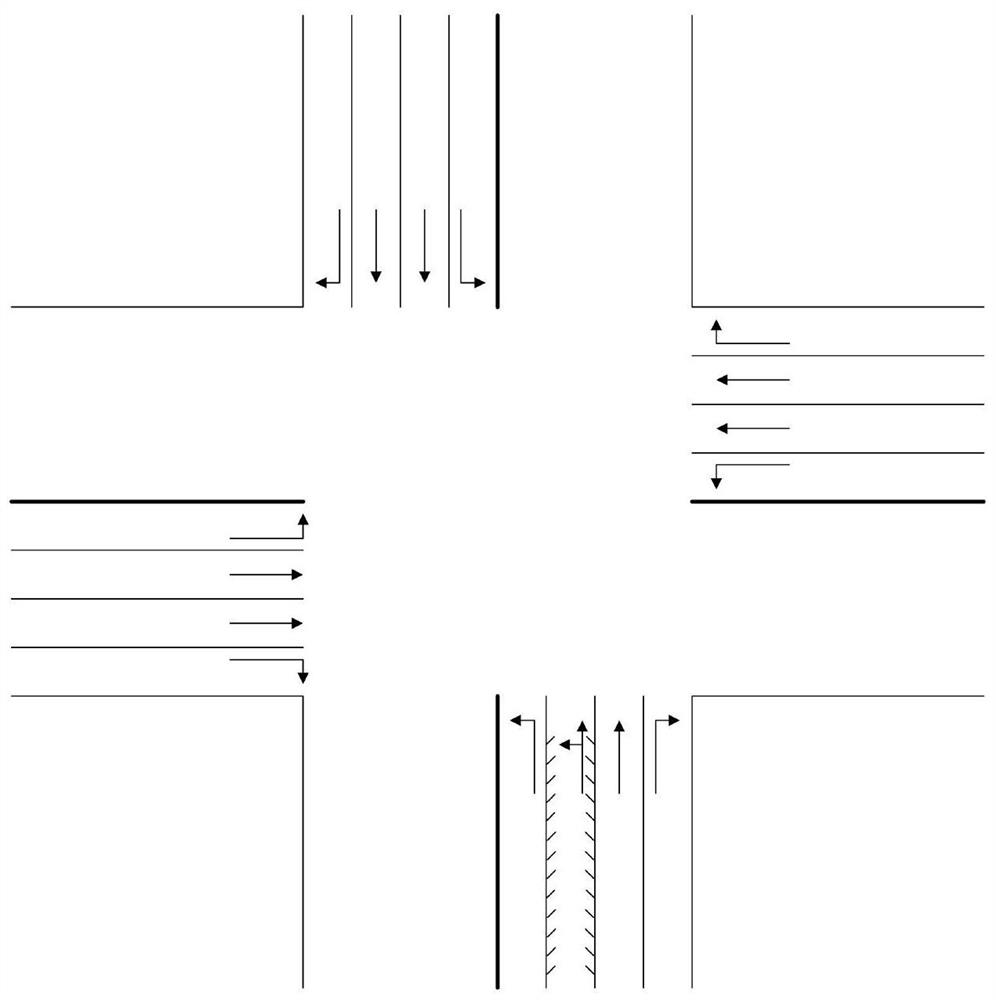
[0044] Such as figure 1 As shown, a conventional signalized intersection is taken as an example. Assume that the second single lane of the entrance road in the north-south direction is set as a variable lane, and each entrance road is set as a detection area at a certain distance from the intersection, such as figure 2 shown. exist figure 2 Only a schematic diagram of the detection area of ​​the entrance road in the north-south direction is given in , and t...

the structure of the environmentally friendly knitted fabric provided by the present invention; figure 2 Flow chart of the yarn wrapping machine for environmentally friendly knitted fabrics and storage devices; image 3 Is the parameter map of the yarn covering machine
Login to View More

PUM

No PUM Login to View More

Abstract

The invention discloses a variable lane and traffic signal cooperative control method based on deep reinforcement learning, and the method comprises the steps: collecting an intersection state observation value which comprises vehicle data, signal lamp data and variable lane data, carrying out the preprocessing, and inputting the preprocessed data to a neural network; continuously training and updating the neural network based on reinforcement learning until the model converges; and performing optimal control based on the trained neural network, and outputting an optimal control strategy. Coupling control over the variable lane and the traffic signal is achieved, real-time optimal control can be conducted according to the real-time state of the intersection area, manual operation is not needed, switching of the variable lane and control over the traffic signal are adjusted in a self-adaptive mode completely according to the traffic flow data, secondary parking of vehicles is not caused, and the time-space resource utilization efficiency of the signal control intersection is optimized.

Description

technical field [0001] The invention relates to the technical field of road traffic control, and more specifically relates to a cooperative self-adaptive optimal control method for variable lanes and traffic signals at signal-controlled intersections in a vehicle-road collaborative environment. Background technique [0002] Signal-controlled intersections are often places where urban road traffic congestion occurs, which has a huge impact on the overall operation of urban traffic. Traffic lights can ensure that vehicles pass through the intersection in an orderly manner from the time perspective, and variable lanes can ensure that vehicles in different directions can efficiently use road space resources from the spatial perspective. [0003] Although both traffic lights and variable lanes can go a long way toward ensuring traffic runs smoothly, there is often a lack of close coordination between them. Since the intersection is a dynamic scene where vehicles pass continuousl...

Claims

the structure of the environmentally friendly knitted fabric provided by the present invention; figure 2 Flow chart of the yarn wrapping machine for environmentally friendly knitted fabrics and storage devices; image 3 Is the parameter map of the yarn covering machine
Login to View More

Application Information

Patent Timeline
no application Login to View More
IPC IPC(8): G08G1/01G08G1/08G06N3/08
CPCG06N3/08G08G1/0125G08G1/0137G08G1/08
Inventor 丁川聂午阳鹿应荣鲁光泉
Owner BEIHANG UNIV
Features
  • R&D
  • Intellectual Property
  • Life Sciences
  • Materials
  • Tech Scout
Why Patsnap Eureka
  • Unparalleled Data Quality
  • Higher Quality Content
  • 60% Fewer Hallucinations
Social media
Patsnap Eureka Blog
Learn More