Biopotential recorder

A biopotential and recorder technology, applied in the circuit field, can solve the problems that the circuit is susceptible to common mode interference, high total harmonic distortion, and sacrifices noise performance

CN112274158AActive Publication Date: 2021-01-29TSINGHUA UNIV
17 Cites 3 Cited by

Patent Information

Authority / Receiving Office
CN · China
Current Assignee / Owner
Publication Date
2021-01-29

Smart Images

  • Figure 1
    Figure 1
  • Figure 2
    Figure 2
  • Figure 3
    Figure 3
Patent Text Reader

Abstract

The invention discloses a biopotential recorder. The biopotential recorder comprises a chopper amplification module and a low-pass filtering module; the chopper amplification module comprises an offset elimination unit, a common mode elimination unit, a feedback unit, a direct current servo unit, an output amplification unit, an impedance lifting unit, a first modulation unit and a second modulation unit; the offset elimination unit is connected with the common mode elimination unit, the feedback unit, the direct current servo unit, the first modulation unit and the second modulation unit; theoutput amplification unit is connected with the feedback unit, the DC servo unit, the second modulation unit, the impedance lifting unit and the low-pass filtering module; and the first modulation unit is connected with the impedance lifting unit. Input noise is reduced through a first modulation unit of the chopper amplification module, electrode direct current offset is removed through the direct current servo unit, finally filtering is conducted through the low-pass filtering module, and the noise reduction capacity is high; the common mode elimination unit is used for reducing common-modeinterference; and while an input signal is amplified, the interference of the noise is reduced, and the performance is high.
Need to check novelty before this filing date? Find Prior Art

Description

technical field

[0001] The present application relates to the field of circuit technology, in particular to a biological potential recorder. Background technique

[0002] High-efficiency biopotential recorders play a vital role in brain-machine interface (Brain-Machine-Interface, BMI) systems. The amplitude of Targeted Signals, such as Action Potential (AP), Local Field Potential (LFP), Electrocardiograph (ECG), Electromyography (EMG) and EEG ( The amplitude of Electroencephalo-graph (EEG) is usually between tens of volts and several millivolts, and the frequency band distribution is usually between tens of microvolts (μV) and several millivolts (mV). Power consumption performance is critical in the design of a biopotential recorder. Most existing low-power designs improve power performance by reducing current, at the expense of noise performance. In order to optimize the power efficiency factor (Power Efficiency Factor, PEF), the existing method proposes to reduce the po...

Examples

Embodiment Construction

[0088] Exemplary embodiments of the present disclosure will be described in more detail below with reference to the accompanying drawings. Although exemplary embodiments of the present disclosure are shown in the drawings, it should be understood that the present disclosure may be embodied in various forms and should not be limited by the embodiments set forth herein. Rather, these embodiments are provided for more thorough understanding of the present disclosure and to fully convey the scope of the present disclosure to those skilled in the art.

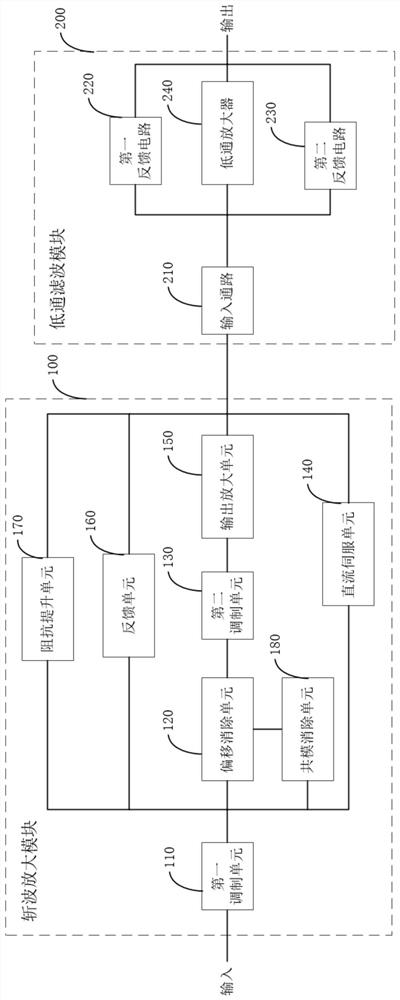
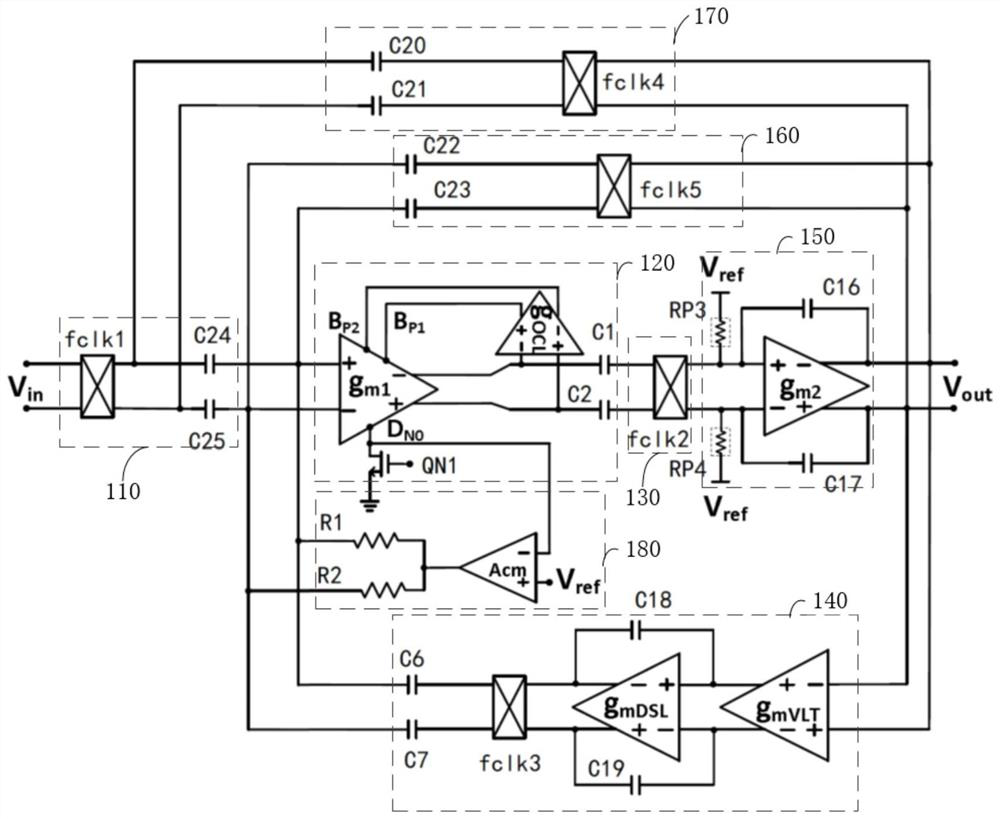
[0089] According to an embodiment of the present application, a biopotential recorder is proposed, such as figure 1 As shown, it includes: a chopper amplifier module 100 and a low-pass filter module 200 . The chopper amplifier module 100 is connected with the low-pass filter module 200 , and the chopper amplifier module 100 performs noise reduction and amplification on the potential input signal, and sends it to the low-pass filter...