Check patentability & draft patents in minutes with Patsnap Eureka AI!

A method for evaluating and predicting the thermal insulation effect of thermal barrier coatings on turbine blades

A technology of thermal barrier coatings and turbine blades, which is applied in the field of evaluation and prediction of thermal barrier coatings for turbine blades, and can solve the problem of insufficient relevant data, difficulty in evaluating and predicting coating thermal insulation effects, and insufficient mechanism of action Clear and other problems to achieve the effect of improving performance

Active Publication Date: 2022-07-19
BEIHANG UNIV
View PDF6 Cites 0 Cited by
  • Summary
  • Abstract
  • Description
  • Claims
  • Application Information

AI Technical Summary

Problems solved by technology

At the same time, some studies have found that thermal barrier coatings have a greater impact on film cooling, but the mechanism of the two is not clear enough, and the relevant data is not sufficient, which makes it more difficult to evaluate and predict the thermal insulation effect of coatings

Method used

the structure of the environmentally friendly knitted fabric provided by the present invention; figure 2 Flow chart of the yarn wrapping machine for environmentally friendly knitted fabrics and storage devices; image 3 Is the parameter map of the yarn covering machine
View more

Image

Smart Image Click on the blue labels to locate them in the text.
Viewing Examples
Smart Image
  • A method for evaluating and predicting the thermal insulation effect of thermal barrier coatings on turbine blades
  • A method for evaluating and predicting the thermal insulation effect of thermal barrier coatings on turbine blades
  • A method for evaluating and predicting the thermal insulation effect of thermal barrier coatings on turbine blades

Examples

Experimental program
Comparison scheme
Effect test

Embodiment Construction

[0015] In order to understand the above objects, features and advantages of the present invention more clearly, the present invention will be further described in detail below with reference to the accompanying drawings and specific embodiments.

[0016] Many specific details are set forth in the following description to facilitate a full understanding of the present invention. However, the present invention can also be implemented in other ways different from those described herein. Therefore, the protection scope of the present invention is not limited by the specific details disclosed below. Example limitations.

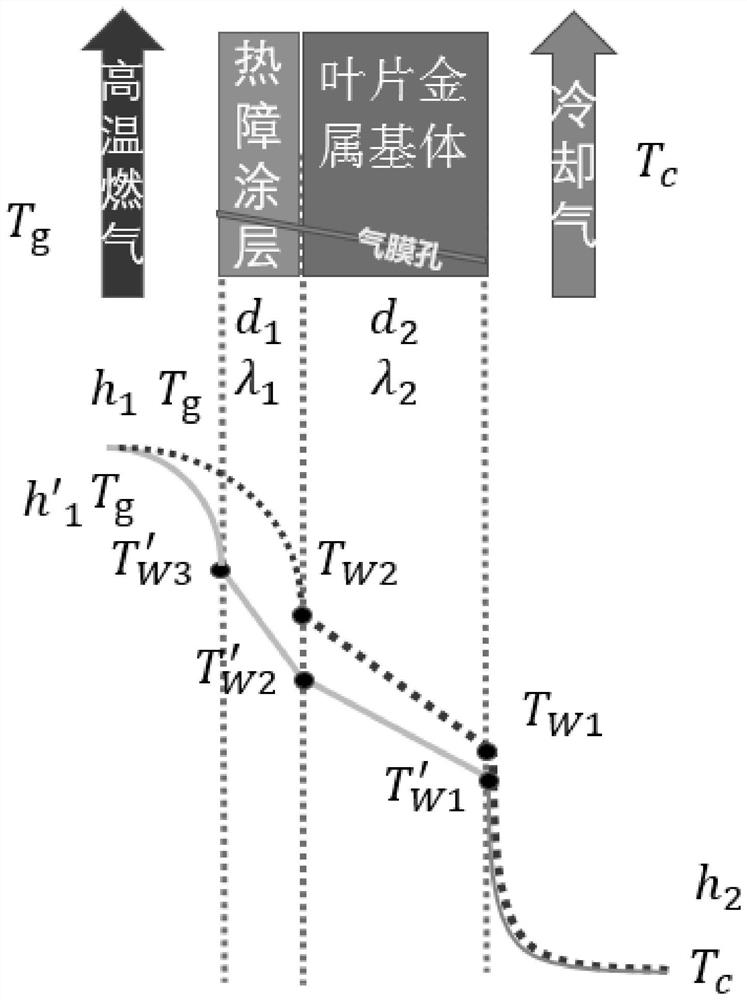
[0017] A method for evaluating and predicting the thermal insulation effect of thermal barrier coatings on turbine blades, establishing a one-dimensional coating-air film theoretical heat transfer model to simulate the heat transfer process of turbine blades with thermal barrier coatings, such as figure 1 The model consists of three parts: the air film hole, the t...

the structure of the environmentally friendly knitted fabric provided by the present invention; figure 2 Flow chart of the yarn wrapping machine for environmentally friendly knitted fabrics and storage devices; image 3 Is the parameter map of the yarn covering machine
Login to View More

PUM

No PUM Login to View More

Abstract

A method for evaluating and predicting the thermal insulation effect of a thermal barrier coating on a turbine blade relates to the technical field of engines, and solves the problem that it is difficult to evaluate and predict the thermal insulation effect of the coating. The method includes the following steps: establishing a one-dimensional coating-air film theory Heat transfer model; based on the model to deduce the heat flow q' and q with or without the thermal barrier coating, according to which the necessary conditions for the thermal barrier coating to play a role in heat insulation are deduced. coefficient and the heat transfer coefficient of the external high temperature gas side without thermal barrier coating, to judge whether the thermal barrier coating has a thermal insulation effect; deduce the temperature difference of the outermost side with or without thermal barrier coating and with or without thermal barrier coating The proportional relationship between the temperature difference between the outer surface of the blade metal substrate, by measuring the outer surface temperature of the thermal barrier coating and the temperature of the outer surface of the blade metal substrate without thermal barrier coating, and then predicting the thermal barrier coating according to the proportional relationship. The numerical value of the surface temperature drop. The present invention can realize the accurate prediction of the thermal insulation effect.

Description

technical field [0001] The invention relates to the technical field of engineering thermophysics and high-performance aero-engines, in particular to a method for evaluating and predicting the thermal insulation effect of a thermal barrier coating of a turbine blade. Background technique [0002] Thermal barrier coatings are widely used in turbine blades by utilizing the superior high temperature resistance, corrosion resistance, wear resistance and thermal insulation properties of ceramic materials to improve the ability of structural parts to resist high temperature corrosion. A large number of applications and technological development of thermal barrier coatings have significantly improved the high temperature resistance of the blades, thereby increasing the temperature in front of the engine turbine, thereby improving the performance of the engine. It prolongs the life and reliability of the blades, reduces the amount of cold air used, and allows more working fluids to p...

Claims

the structure of the environmentally friendly knitted fabric provided by the present invention; figure 2 Flow chart of the yarn wrapping machine for environmentally friendly knitted fabrics and storage devices; image 3 Is the parameter map of the yarn covering machine
Login to View More

Application Information

Patent Timeline
no application Login to View More
Patent Type & Authority Patents(China)
IPC IPC(8): G01N25/20
CPCG01N25/20
Inventor 由儒全李海旺刘洋陶智
Owner BEIHANG UNIV
Features
  • R&D
  • Intellectual Property
  • Life Sciences
  • Materials
  • Tech Scout
Why Patsnap Eureka
  • Unparalleled Data Quality
  • Higher Quality Content
  • 60% Fewer Hallucinations
Social media
Patsnap Eureka Blog
Learn More