Unlock instant, AI-driven research and patent intelligence for your innovation.

Uniform circular array correlation interferometer direction finding method and system

A correlative interferometer and uniform circular array technology, applied in the field of signal processing, can solve the problems of weak received signal, large estimation deviation, large phase difference estimation deviation, etc., and achieve the effect of reducing the amount of calculation and eliminating the large estimation deviation.

Active Publication Date: 2022-05-13
湖南艾科诺维科技有限公司
View PDF9 Cites 0 Cited by
  • Summary
  • Abstract
  • Description
  • Claims
  • Application Information

AI Technical Summary

Problems solved by technology

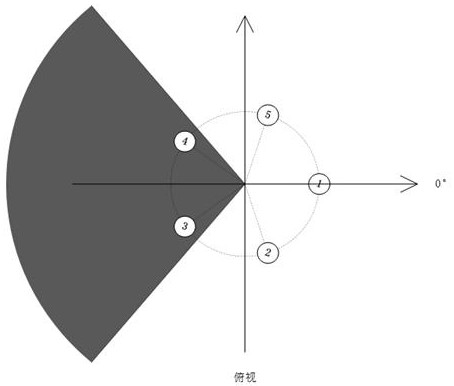
[0006] The antenna array commonly used in the actual direction-finding system is a uniform circular array containing multiple array elements. Each array element is evenly arranged along the circumference of the circle. When the range is incident, the influence of the central array element and structural parts will cause the problems of weak received signal and large deviation of phase difference estimation for individual array elements, such as figure 1 As shown, for a five-element uniform circular array, when the signal incident angle is 0°, the amplitude of the synthesized signal of array element 2, array element 5 and array element 1 is relatively large, while that of array element 3, array element 4 and array element 1 The amplitude of the synthesized signal is small, causing array element 3 and array element 4 to become occluded array sources. The phase difference estimation error based on the phase difference between array element 3 and array element 4 is relatively large. If you directly use the phase difference between array element 3 and array element 4 Phase information will seriously affect the subsequent direction finding accuracy

Method used

the structure of the environmentally friendly knitted fabric provided by the present invention; figure 2 Flow chart of the yarn wrapping machine for environmentally friendly knitted fabrics and storage devices; image 3 Is the parameter map of the yarn covering machine
View more

Image

Smart Image Click on the blue labels to locate them in the text.
Viewing Examples
Smart Image
  • Uniform circular array correlation interferometer direction finding method and system
  • Uniform circular array correlation interferometer direction finding method and system
  • Uniform circular array correlation interferometer direction finding method and system

Examples

Experimental program
Comparison scheme
Effect test

Embodiment 1

[0045] An actual five-element uniform circular array such as figure 2 As shown in the figure, the positive direction of the x-axis is 0°, the radius r of the circle is 0.21 meters, and the array element 2 is used as the reference array. When the incident angle of the incoming wave direction is 180°, due to the influence of the central structure, 1 is greatly affected by occlusion, and array element 2 and array element 3 are less affected by occlusion, and the phase difference between array element 1 and array element 2 can be deduced respectively Theoretical phase difference and the phase difference between array element 3 and array element 2 The theoretical difference is as follows:

[0046] (1)

[0047] In the above formula, r is the radius of the circular array, is the incoming wave azimuth, is the wavelength of the incoming wave, where , c is the speed of light, and f is the frequency.

[0048] The incoming wave direction is 180°, the incoming wave frequency ...

Embodiment 2

[0090] This embodiment proposes a uniform circular array correlation interferometer direction finding system based on Embodiment 1, including:

[0091] A preprocessing unit, configured to receive the measured signal, obtain the magnitude information vector of each array element in the pre-configured direction-finding array element combination, and calculate the value of the reference array element in the direction-finding array element combination according to the amplitude information vector. The relative amplitude of the target array element and the reference array element, and calculate the phase difference information between the target array element and the reference array element according to the amplitude information vector;

[0092] The angle calculation unit is used to judge whether there is an occlusion element according to the relationship between the value of each relative amplitude and the size of the preset interval, and if there is an occlusion element, according...

the structure of the environmentally friendly knitted fabric provided by the present invention; figure 2 Flow chart of the yarn wrapping machine for environmentally friendly knitted fabrics and storage devices; image 3 Is the parameter map of the yarn covering machine
Login to View More

PUM

No PUM Login to View More

Abstract

The invention discloses a uniform circular array correlation interferometer direction finding method and system, and the method comprises the following steps: receiving a measured signal, and obtaining the amplitude information vector of each array element in a pre-configured direction finding array element combination, calculating the relative amplitude of a target array element except the reference array element in the direction-finding array element combination and the reference array element according to the amplitude information vector, and calculating the phase difference information of the target array element and the reference array element according to the amplitude information vector; according to the size relationship between the value of each relative amplitude and a preset interval, judging whether there is a shielding array element, if there is a shielding array element, selecting a corresponding first phase difference vector from a phase difference sample library according to a shielding angle range corresponding to the shielding array element, and calculating a correlation coefficient between the phase difference information and the first phase difference vector, the angle corresponding to the maximum value of the correlation coefficient is the incident angle of the measured signal. According to the method, the shielding condition of each array element in the uniform circular array relative to the received signal can be accurately judged, the direction finding error is eliminated, and the calculated amount is reduced.

Description

technical field [0001] The invention relates to the field of signal processing, in particular to a direction finding method and system of a uniform circular array correlation interferometer. Background technique [0002] Radio communication occupies an increasingly important position in the field of communication. With the increasing popularity and wide application of radio communication in military and civilian use, in order to make better use of spectrum resources, the direction of arrival of electromagnetic waves is usually measured in electronic monitoring. Required, i.e. radio direction finding. The structure that uses the phase information contained in the signal received by the array element to measure the incident angle of the incoming wave signal is generally called an interferometer direction finding system. [0003] The interferometer direction finding method is a direction finding method that obtains the direction information of the signal to be measured by extr...

Claims

the structure of the environmentally friendly knitted fabric provided by the present invention; figure 2 Flow chart of the yarn wrapping machine for environmentally friendly knitted fabrics and storage devices; image 3 Is the parameter map of the yarn covering machine
Login to View More

Application Information

Patent Timeline
no application Login to View More
IPC IPC(8): G01S3/14G01S3/46
CPCG01S3/143G01S3/46
Inventor 乔立能冯起张吉楠王萌
Owner 湖南艾科诺维科技有限公司
Features
  • R&D
  • Intellectual Property
  • Life Sciences
  • Materials
  • Tech Scout
Why Patsnap Eureka
  • Unparalleled Data Quality
  • Higher Quality Content
  • 60% Fewer Hallucinations
Social media
Patsnap Eureka Blog
Learn More