

Signal classification and identification method
A recognition method and signal classification technology, applied in character and pattern recognition, advanced technology, climate sustainability, etc., can solve the problem of low classification accuracy of received signals, achieve suppression of modal confusion, reduce calculation load, and reduce weight The effect of construction error
- Summary
- Abstract
- Description
- Claims
- Application Information
AI Technical Summary
Problems solved by technology
Method used
Image

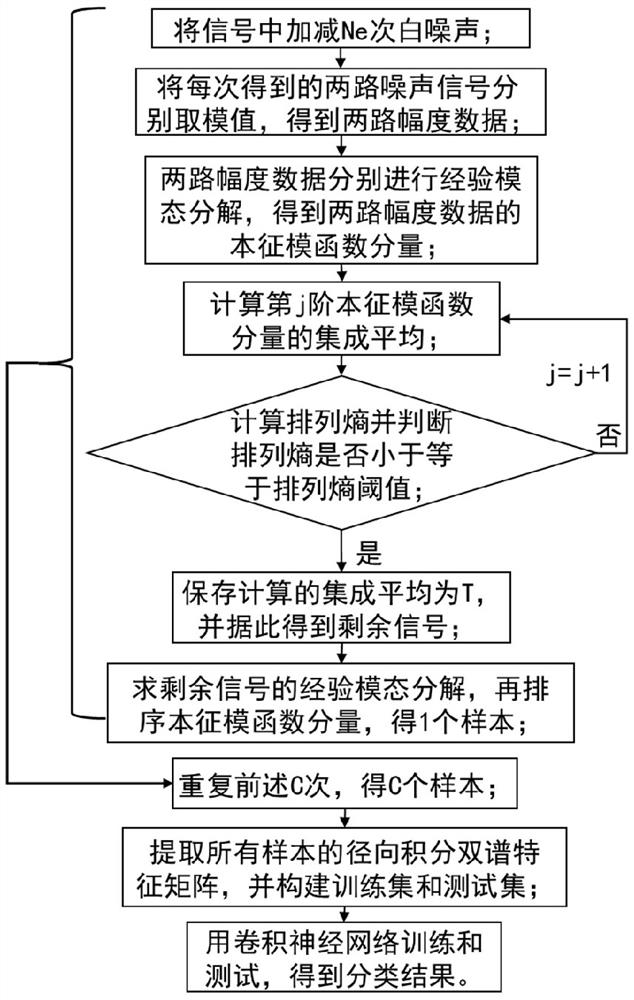


Examples
Embodiment 1
[0057] The wireless communication system on which the signal classification and identification method is based includes a transmitter, a receiver and a radio frequency device. The transmitter includes a baseband modulation module, an up-conversion module and an antenna; the radio frequency equipment includes an energy collection module, a signal processing module, a logic circuit module and a transmission module;
[0058] The baseband modulation module in the transmitter is connected with the up-conversion module, and the up-conversion module is connected with the antenna; in the radio frequency equipment, the logic circuit module is connected with the energy collection module, the signal processing module and the sending module;
[0059] The baseband modulation module modulates the baseband signal to obtain a modulated symbol; the up-conversion module up-converts the modulated symbol to obtain a radio frequency signal, and the antenna sends the radio frequency signal; the ener...
Embodiment 2
[0136] Further, in order to verify the effectiveness of this method, a public dataset is used:
[0137]
[0138]The data in the 2.4GHz Indoor Channel Measurement data set in , which contains the S21 measurement values of 10 frequency sweeps, each sweep contains 601 frequency points, the interval between each frequency point is 0.167MHz, covering the 2.4GHz center frequency 100MHz bandwidth . The method first uses the improved EEMD to process the signal, decomposes the original signal, and retains the relatively important signal components. Compared with the existing classification algorithms based on EMD and bispectral decomposition, the amount of data is reduced, thereby saving the time occupied by subsequent bispectral analysis. At the same time, compared with EMD, the improved EEMD suppresses the mode to a certain extent. Obfuscation reduces reconstruction error. However, the machine learning classification method based on bispectral decomposition + PCA + EMD first p...
PUM
 Login to View More
 Abstract
Description
Claims
Application Information
 Login to View More