[0003] At present, static mixers are generally used for mixing liquids and liquids. For liquid-liquid mixing, this mixing method can be mixed uniformly, online, and continuously; however, for colloid-colloid, colloid-liquid mixing systems, if this static If the mixer is used for online mixing, a high-pressure pump or
plunger pump with higher pressure must be selected, which puts higher requirements on equipment and pipelines, and consumes more energy. It is easy to
cause blockage of the mixer and pipelines, especially for For paste-like viscous materials, it is more difficult; therefore, in-line,
continuous mixing cannot be guaranteed
For this reason, materials of this nature are generally mixed with other batch mixers such as tank mixers, shear bar mixers, double-arm kneading mixers, or online continuous mixers with high power and low mixing efficiency. mix
[0004] The structure of the tank changing mixer is relatively simple, and the cost is relatively low. It has been widely used in some discontinuous mixing processes, such as in the paint production process; another example is the use of high-load planetary tank changing mixers in the production of
solid rocket fuel; although The can-changing mixer has the advantages of tight sealing, etc., but this kind of equipment has the
disadvantage of discontinuity and cannot be used for continuous industrial production
[0005] Another example is fixed tank mixer, shear bar mixer, double arm kneading mixer, etc. all belong to the above-mentioned discontinuous mixer, although they have their own advantages in their respective application fields, but for colloids (especially paste-like viscous Materials) for continuous on-line production, these devices are not applicable
Moreover, some equipment consumes a lot of power, and there are problems such as
wasting energy.
[0006] Of course, there are also some continuous online mixing equipment in colloid mixing, such as single-screw extruder, double-screw extruder, Rietz extruder, Baker Perkins compound kneader, etc. These equipment mainly transport and knead the colloid, and also include There is a
mixing effect, but it is not mainly based on mixing, and there are no other functions such as crushing and homogenization. When the particle size of the
raw material is uneven, it is impossible to ensure that the mixed material is uniform; and some equipment consumes a lot of power, and there is a waste of energy, etc. question
[0007] CN1111166A is a glue mixer, which belongs to an online
static mixer similar to a screw. The mixing rod is long, and the blades on the rod are four straight blades. The rotation speed of the mixing rod is limited, and the
viscosity is generally 1. Glue with better fluidity, for example,
resorcinol phenolic glue, phenolic glue,
urine formaldehyde resin glue, etc. have better mixing properties; if you mix a
slurry with a high
viscosity, you have to use a higher pressure
high pressure Pumps or
plunger pumps, which put forward higher requirements for equipment and pipelines, and consume more energy; it is also easy to
cause blockage of pipelines and mixer mixtures
[0008] Both CN1076885A and CN1134684A are similar in structure, and belong to plasticizing and plasticizing multi-screw
continuous mixing mixers. This structure uses twin screws, mainly a kind of kneading and mixing
machine. Research, the thread, spacing, and shape of the thread on the screw change with the direction of the axis, and the screw is divided into a material metering section, a homogenizing section, and a mixing section. This equipment is suitable for those particularly viscous materials with low
water content. However, it is not suitable for the mixing of several colloids
[0009] CN1307935A is a kind of shearing, striking and hole ultrafine
pulverizer, which is composed of stator (fixed ring) and rotor (moving ring). The gap between each stator and rotor is the same, and the angle of each layer of teeth is the same. However, the material moves from the inner center to the outer during the mixing and crushing process, and the material will become finer and finer. If the gap between each stator and the rotor is the same, the working efficiency of the teeth on the outer layer will decrease during the mixing and crushing process of the material. Can not give full play to the role of the outer teeth


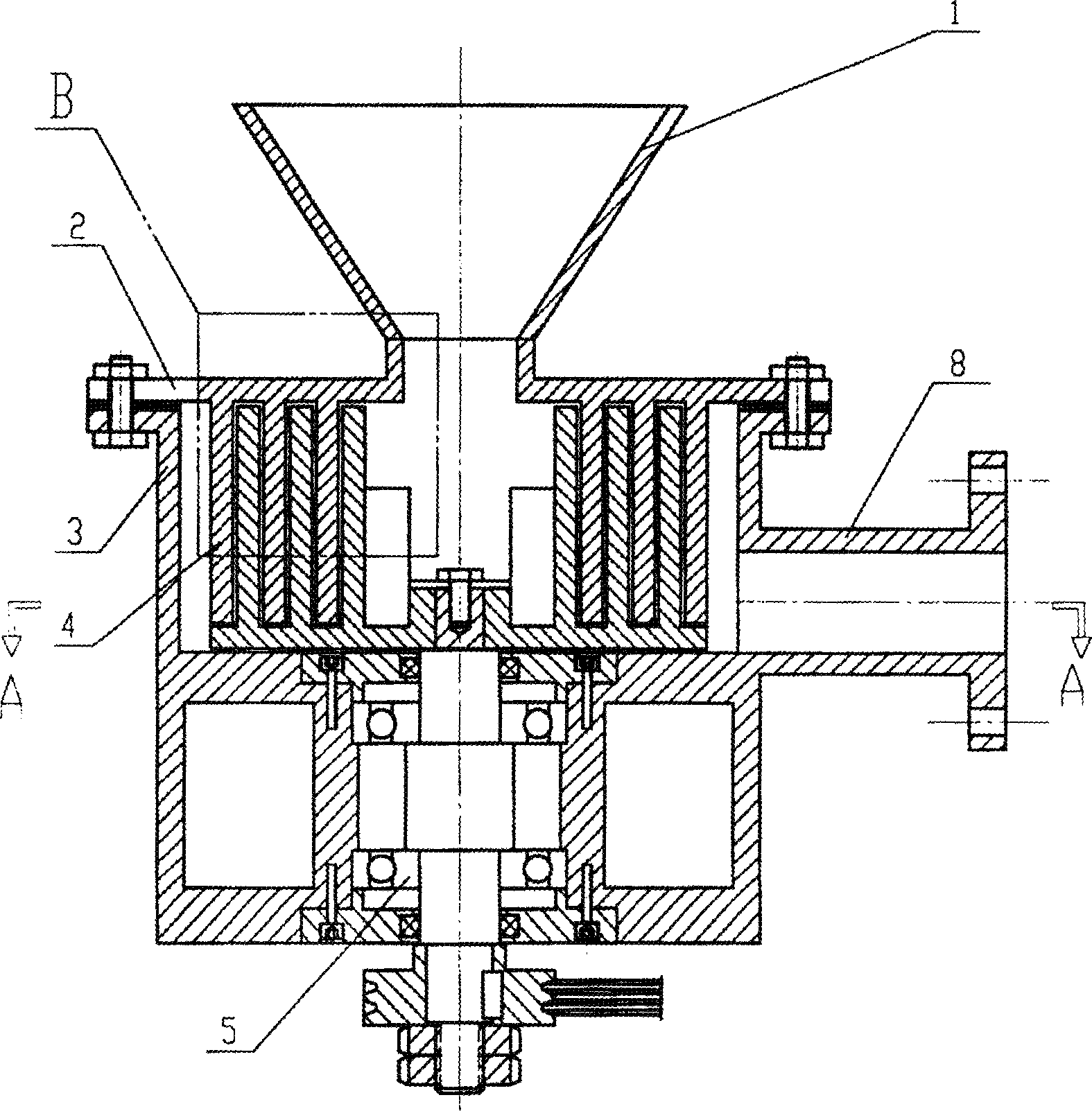
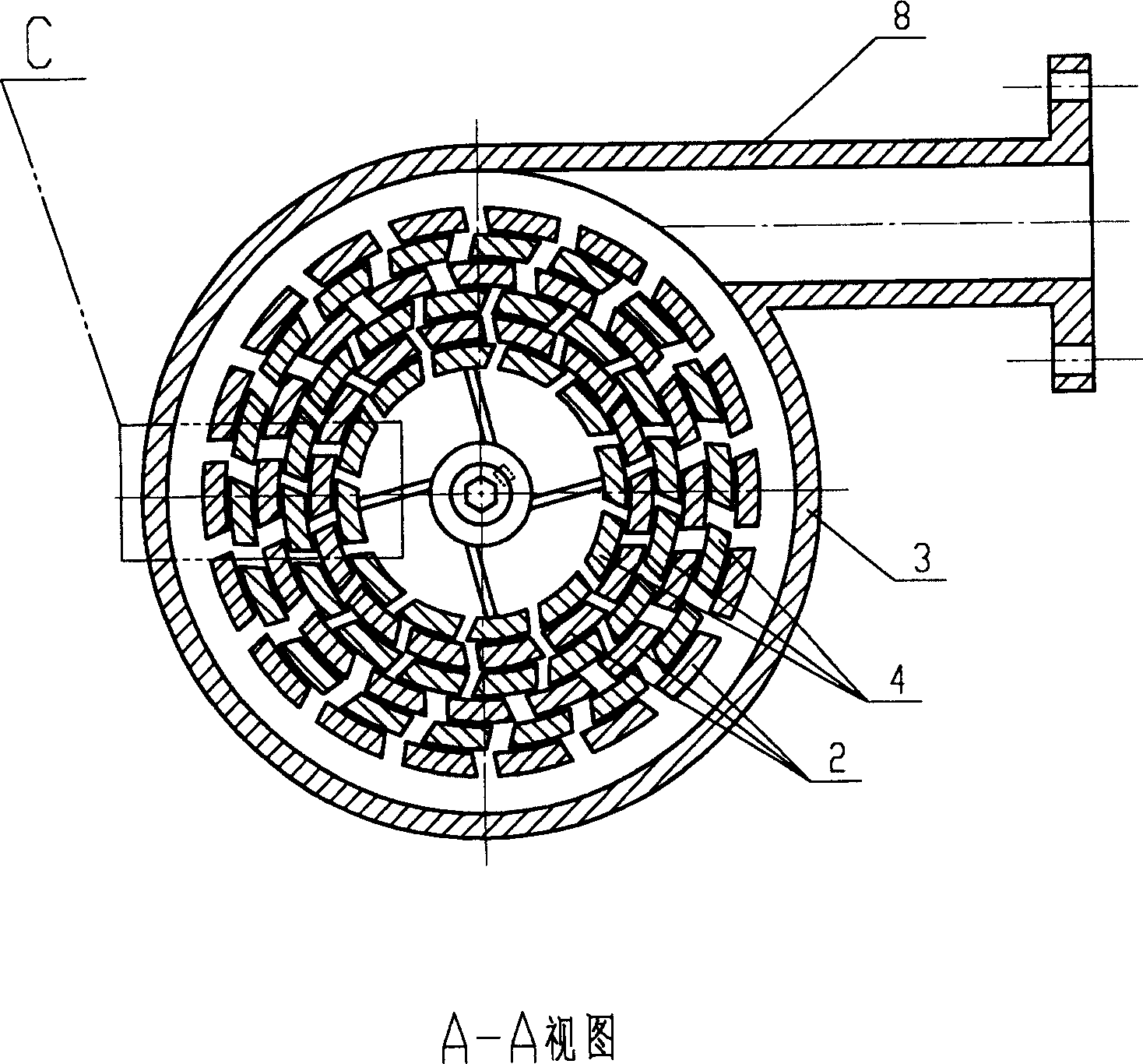
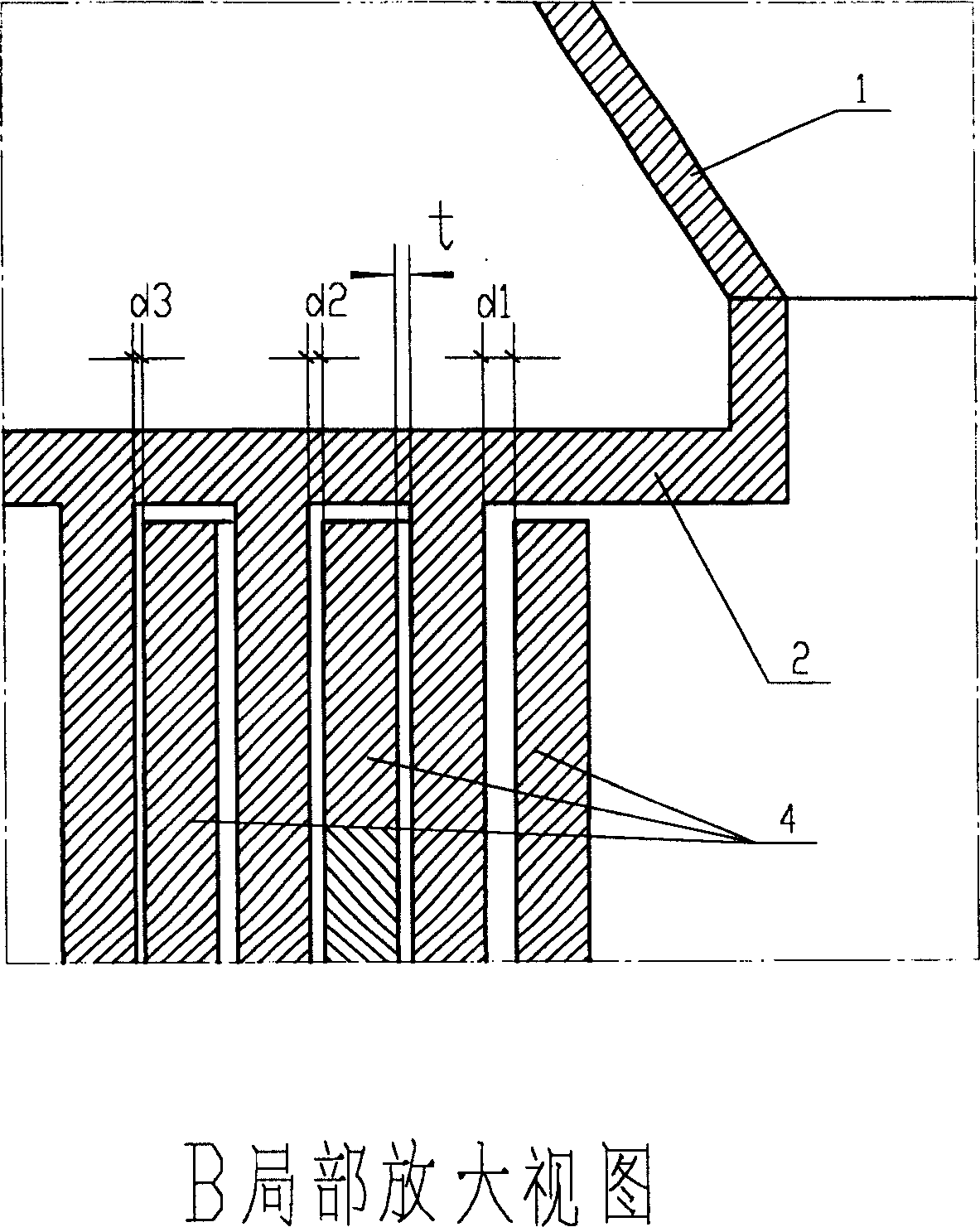
 Login to View More
  Login to View More