Method for making lattice holographic rainbow optically-variable image
A production method, plain surface technology, applied in the direction of instruments, etc., can solve problems such as difficulty in meeting application requirements and inlaying other images, and achieve the effect of easy acquisition and lower technical requirements
- Summary
- Abstract
- Description
- Claims
- Application Information
AI Technical Summary
Problems solved by technology
Method used
Image



Examples
Embodiment 1
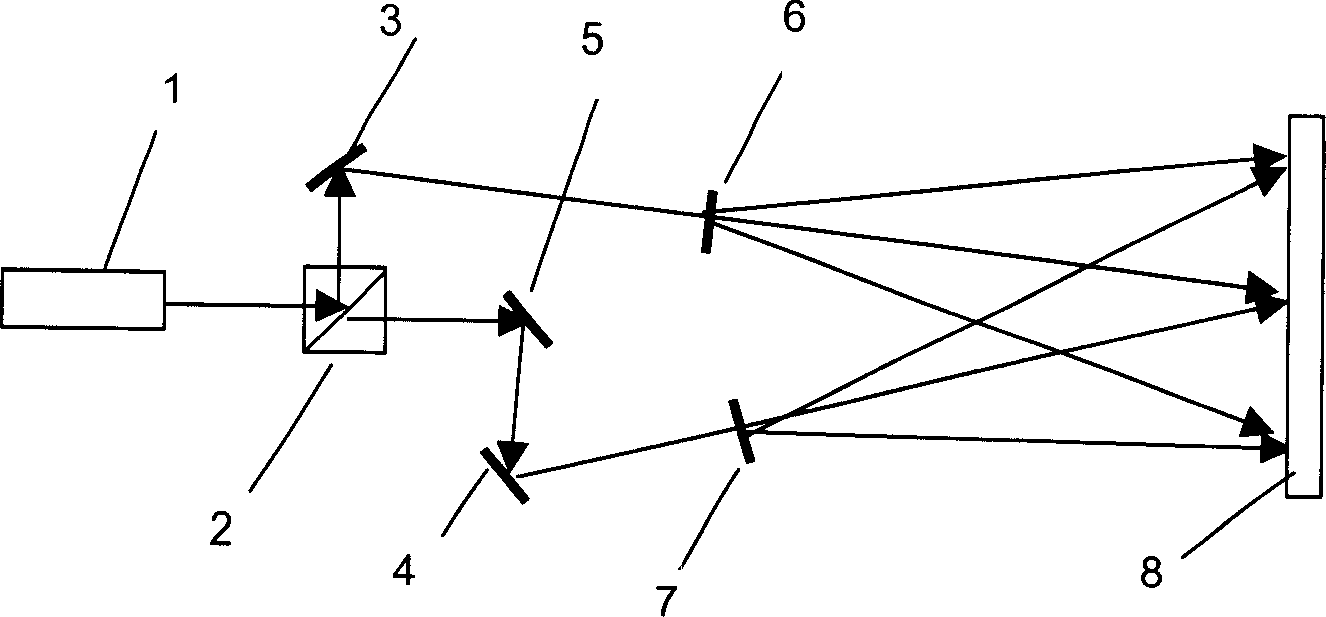
[0046] Example one: see attached Figure 4 Attached Picture 10 As shown, a method for making a lattice plain rainbow light-variable image includes the following steps:
[0047] (1) Prepare an optical element with orthogonal light spot output, the effective area of which is no less than 5mm×5mm and no more than 15mm×15mm. The orthogonal light spot output refers to the four orthogonal light spot diffraction terms ( 1,0)(-1,0)(0,1)(0,-1);
[0048] (2) Construct a 4F optical system, the light emitted by the laser light source is treated as incident light after collimation processing and diaphragm, the recording material is placed on the image plane position of the 4F optical system, and the optical element obtained in step (1) is placed in its transformation On the plane, as a beam splitting element, the incident light is divided into four beams. After the lens is formed into an image, an interference fringe unit is formed on the surface of the recording material. The front focal l...
Embodiment 2
[0060] Embodiment 2: A method for making a rainbow light variable image of a lattice plain surface, including the following steps:
[0061] (1) Prepare an optical element with orthogonal light spot output, the effective area of which is no less than 5mm×5mm and no more than 15mm×15mm. The orthogonal light spot output refers to the four orthogonal light spot diffraction terms ( 1,0)(-1,0)(0,1)(0,-1);
[0062] (2) Construct a 4F optical system, the light emitted by the laser light source is treated as incident light after collimation processing and diaphragm, the recording material is placed on the image plane position of the 4F optical system, and the optical element obtained in step (1) is placed in its transformation On the plane, as a beam splitting element, the incident light is divided into four beams. After the lens is formed into an image, an interference fringe unit is formed on the surface of the recording material. The front focal length of the 4F optical system is grea...
PUM
| Property | Measurement | Unit |
|---|---|---|
| Coherence length | aaaaa | aaaaa |
Abstract
Description
Claims
Application Information
 Login to View More