
Automatically identifying and quantitatively detecting method for high alkalinity sintered ore main minerals
A technology for automatic identification and sintering of ore, which is applied in special data processing applications, instruments, electrical digital data processing, etc., and can solve problems such as uncertainty of crystal structure parameters of solid solution minerals.
- Summary
- Abstract
- Description
- Claims
- Application Information
AI Technical Summary
Problems solved by technology
Method used
Image

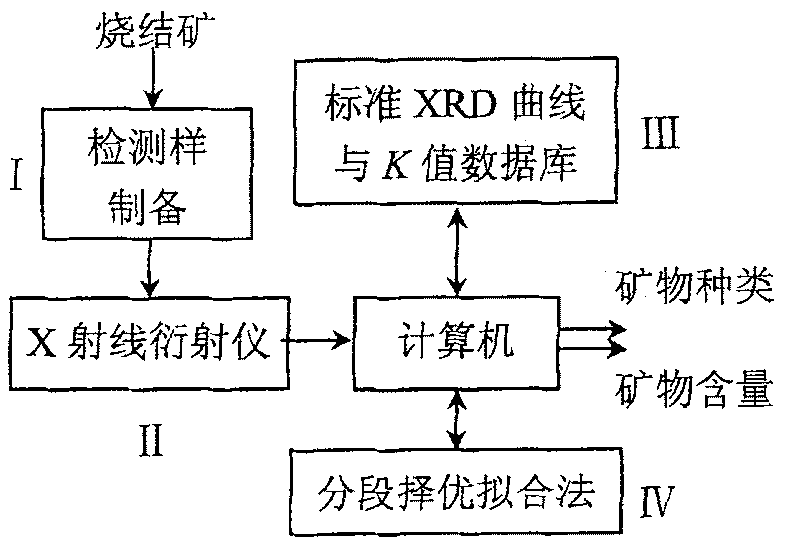
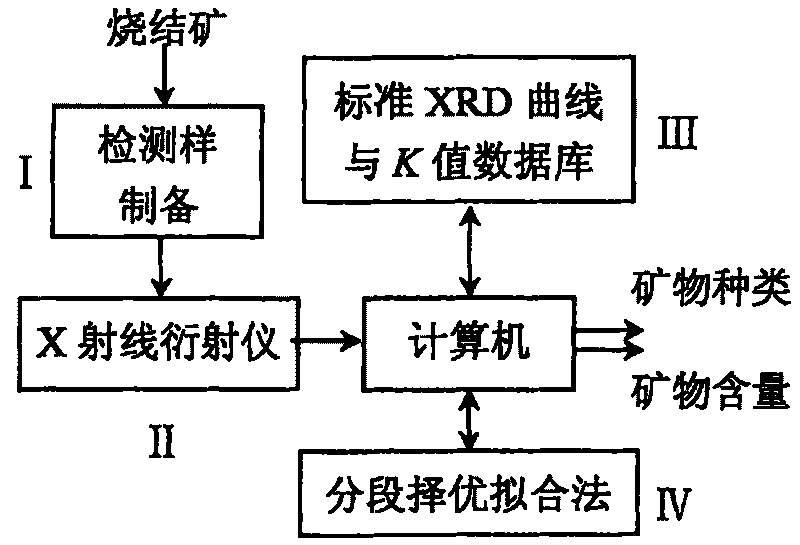
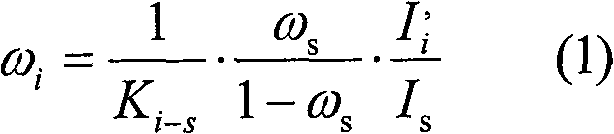
Examples
example 1
[0015] Example 1: The prepared hematite, magnetite and quaternary calcium ferrite (Ca 5 Si 2 Fe 16 al 2 o 36 , simplified into cf(4)) minerals, ground to a particle size of less than 0.050mm, adding 10% TiO 2 As a reference substance, the different proportions are shown in Table 1 and mixed thoroughly. Then, X-ray diffraction was performed on the mixed sample in the range of 15-65° at a scanning speed of 2° / min on an M21X X-ray diffractometer. Open the X-ray diffraction quantitative analysis software, then select qualitative analysis, give the possible mineral types and corresponding error indexes, and the minerals corresponding to each diffraction peak, finally, determine the type of reference material, perform quantitative calculation and give The calculated results show that the absolute error is within ±1.80%.
[0016] Table 1
[0017]
example 2
[0019] The high-alkalinity sintered ore of Baosteel in May 2005 was used for quantitative analysis by X-ray diffraction. Its chemical composition is shown in Table 2. Through peak comparison and diffraction analysis, it can be seen that the minerals in the sintered ore include hematite and magnetite. ore and calcium ferrite. Using this method to carry out mineral quantitative analysis results, the three contents are 54.91%, 19.24% and 25.83% respectively.
[0020] Table 2
[0021]
[0022] The mineral detection of each of the above samples, from the beginning of the diffraction experiment on the X-ray diffractometer to the qualitative and quantitative process on the computer, was completed within 30 minutes.
PUM
 Login to View More
 Abstract
Description
Claims
Application Information
 Login to View More