Unlock instant, AI-driven research and patent intelligence for your innovation.

Hash table-based mask length computation for longest prefix match caching

a mask and prefix technology, applied in the field of digital information transmission, can solve the problems of high power consumption and heat dissipation, the complexity of the circuitry required to implement such solutions and the difficulty in reducing the number of hash lookups

Active Publication Date: 2019-12-24
MELLANOX TECHNOLOGIES LTD
View PDF20 Cites 2 Cited by
  • Summary
  • Abstract
  • Description
  • Claims
  • Application Information

AI Technical Summary

Benefits of technology

This approach enhances routing efficiency by minimizing the number of cache misses and reducing memory requirements, achieving a higher cache hit rate compared to exact match caching methods while maintaining efficient access to routing information without the complexity of large mask lengths.

Problems solved by technology

Searching the routing table for the LPM is a bottleneck in routing throughput.
However, the circuitry required to implement such solutions becomes complex.
Moreover, the increasing amount of internet traffic and demands for reduced latency have resulted in relatively costly router circuitry having high power consumption and heat dissipation.
However, TCAM memory, while reducing the number of hash lookups, is expensive.
It is well known that traffic in networks in general and on the Internet in particular is not uniformly distributed.
However, for prefixes that have longer compatible prefixes, caching can cause a “cache hiding” problem unless all the longer compatible prefixes have also been cached.
However, this is complex to implement, particularly eviction from the cache.
However, a direct implementation of the scheme is impractical because there may be prefixes up to / 32 in the table.

Method used

the structure of the environmentally friendly knitted fabric provided by the present invention; figure 2 Flow chart of the yarn wrapping machine for environmentally friendly knitted fabrics and storage devices; image 3 Is the parameter map of the yarn covering machine
View more

Image

Smart Image Click on the blue labels to locate them in the text.
Viewing Examples
Smart Image
  • Hash table-based mask length computation for longest prefix match caching
  • Hash table-based mask length computation for longest prefix match caching
  • Hash table-based mask length computation for longest prefix match caching

Examples

Experimental program
Comparison scheme
Effect test

first embodiment

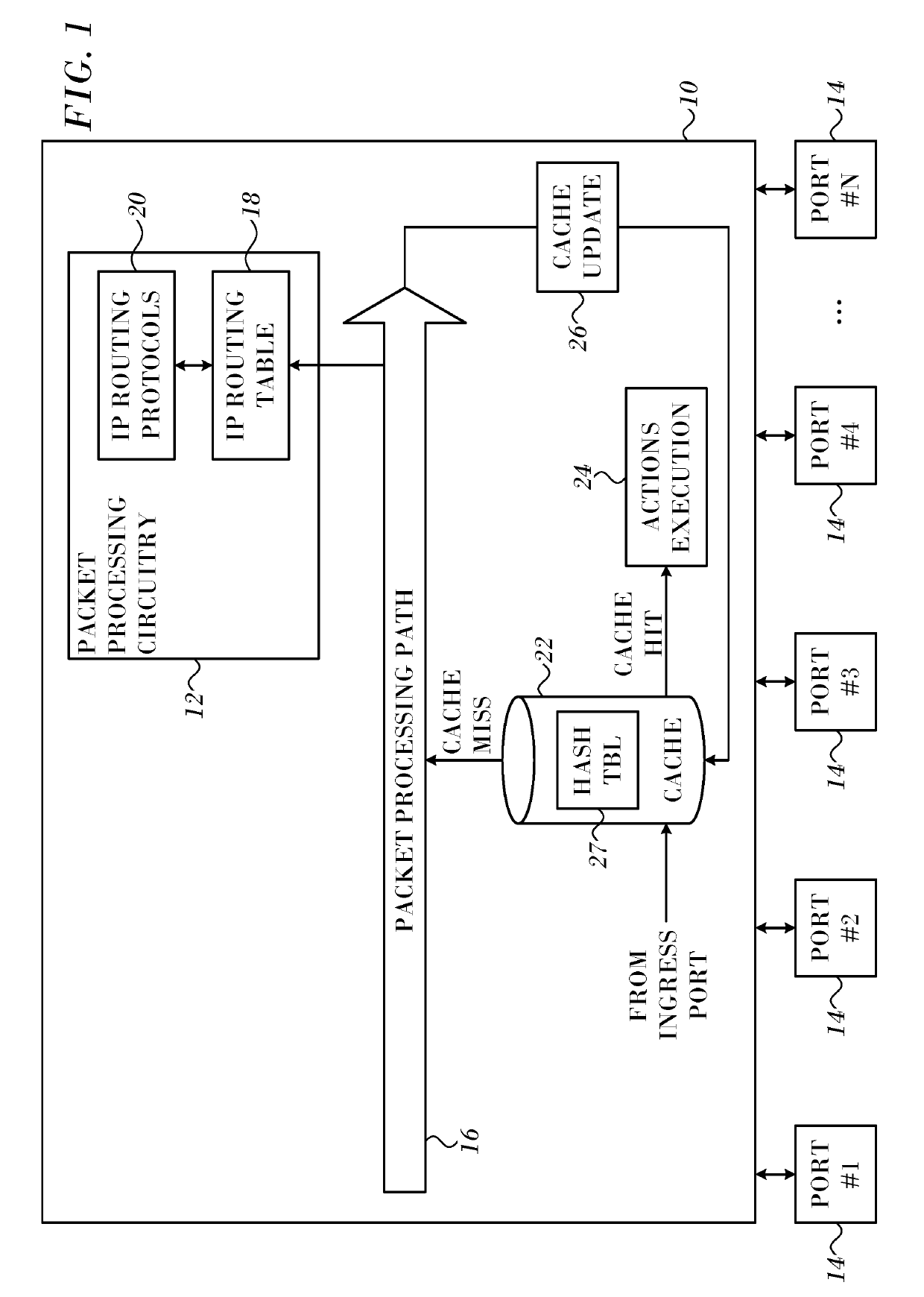
[0065]In embodiments of the invention a hash table is formed by S entries that can hold an integer number that determines the length of a mask to be used for caching. Incoming elements are mapped to a position in the table using a hash function h(x), where x is the LPM field masked with an initial mask M. The value stored in the table at that position is the mask length for caching. The hash table is filled with all the prefixes that exist in a set of rules being evaluated.

[0066]When a prefix p has a length lp that is larger than M, we simply apply the mask to the prefix to obtain pm and compute h(mp). Then we access the hash table and read position h(mp). If the value stored at that entry table is smaller than the length Lp, then we write Lp into the entry, replacing the previous entry.

[0067]When the prefix p has a length 1p shorter than M, it is expanded to length M by creating 2(M-Lp) prefixes of length M and the previous procedure is applied to each of those expanded prefixes us...

example 1

[0082]

TABLE 5Position Mask Masked (Hash LengthRoutewith / 3Value)to Use138.100.17.0 / 24100324138.100.17.23 / 32100332138.100.18.0 / 24100324144.0.0.0 / 81003 8

[0083]

TABLE 6PositionValue1020332 4050607080

[0084]This example illustrates the operation of the hash table scheme described above. Routing table 5 has the same routing information as Table 4. An initial mask is set at M=3. The hash table shown in Table 6 has eight positions and is populated by the procedure of FIG. 3 as applied to the entries in Table 5.

[0085]Assume that a packet arrives with destination IP 130.100.14.67. The mask M=3 is applied to obtain binary 100. Applying the hash function results in an access of row 3 in Table 6. A mask length of 32 is retrieved from the second column to access the cache of prefixes. It will now be evident that all IPs that start with binary 100 need to be cached with a mask of 32 bits. On the other hand, all the IP addresses that map to the other positions on the table can be mapped with a zero ...

example 2

[0086]In this example an initial mask M=4 is used. The routing information of the previous example is shown in Table 7. However the hash values are different. The populated hash table is shown in Table 8.

[0087]

TABLE 7Position Mask Masked(HashLengthRoutewith / 4Value)to Use138.100.17.0 / 241000524138.100.17.23 / 321000532138.100.18.0 / 241000524144.0.0.0 / 810012 8

[0088]

TABLE 8PositionValue10283040532 607080

[0089]At least some of the mask lengths (Value) in Table 8 are larger than in Table 6, which indicates that selecting the value of the initial mask M is not straightforward.

Insertions and Deletions.

[0090]Insertion and deletion of rules is supported by the proposed hash tables, e.g., Tables 6, 8. To add a rule, we simply need to apply the initial mask, perform the hash, read the value on the hash table entry, and if the length of the prefix is longer than the read value, replace the value field in the hash table with the length of the prefix.

[0091]To remove a rule, the process is more compl...

the structure of the environmentally friendly knitted fabric provided by the present invention; figure 2 Flow chart of the yarn wrapping machine for environmentally friendly knitted fabrics and storage devices; image 3 Is the parameter map of the yarn covering machine
Login to View More

PUM

No PUM Login to View More

Abstract

A data packet is received in a network element. The network element has a cache memory in which cache entries represent a portion of addresses stored in a main memory, The destination address and the cache entries each comprise a binary number. A hash function is applied to the masked destination address to access a hash table. When the number of most significant bits corresponding to the value in the hash table in one of the cache entries and in the destination address are identical, routing information for the packet is retrieved from the cache entry.

Description

COPYRIGHT NOTICE[0001]A portion of the disclosure of this patent document contains material that is subject to copyright protection. The copyright owner has no objection to the facsimile reproduction by anyone of the patent document or the patent disclosure, as it appears in the Patent and Trademark Office patent file or records, but otherwise reserves all copyright rights whatsoever.BACKGROUND OF THE INVENTION1. Field of the Invention[0002]This invention relates to transmission of digital information. More particularly, this invention relates to cache operations in the routing of packets in data switching networks.2. Description of the Related Art[0003]The meanings of certain acronyms and abbreviations used herein are given in Table 1.[0004]TABLE 1Acronyms and AbbreviationsDIPDestination Internet Protocol AddressDRAMDynamic Random Access MemoryHCAHost Channel AdapterIPInternet ProtocolIPv4Internet Protocol Version 4LPMLongest Prefix MatchMSBMost Signficant BitsNICNetwork Interface ...

Claims

the structure of the environmentally friendly knitted fabric provided by the present invention; figure 2 Flow chart of the yarn wrapping machine for environmentally friendly knitted fabrics and storage devices; image 3 Is the parameter map of the yarn covering machine
Login to View More

Application Information

Patent Timeline
no application Login to View More
Patent Type & Authority Patents(United States)
IPC IPC(8): G06F12/08G06F12/0864H04L12/747H04L12/743H04L12/745H04L45/748
CPCH04L45/7453H04L45/748G06F12/0864H04L45/742G06F2212/154
Inventor LEVY, GILKFIR, AVIVPONTARELLI, SALVATOREREVIRIEGO, PEDRO
Owner MELLANOX TECHNOLOGIES LTD