Supercharge Your Innovation With Domain-Expert AI Agents!

Efficient lock-free multi-word compare-and-swap

a lock-free, multi-word technology, applied in the field of concurrent programming, can solve the problems of prohibitively high cost of instrumented access to shared memory, inability to compare and match words, and inability to solve cas-based algorithms, etc., to achieve efficient extension, eliminate major sources of complexity and overhead, and improve efficiency

Active Publication Date: 2020-11-03
ORACLE INT CORP
View PDF7 Cites 1 Cited by
  • Summary
  • Abstract
  • Description
  • Claims
  • Application Information

AI Technical Summary

Benefits of technology

This approach significantly improves efficiency by eliminating costly synchronization steps and enabling efficient atomic updates of multiple memory locations, particularly in non-volatile byte-addressable memories, while maintaining performance-sensitive operations.

Problems solved by technology

CAS, however, operates only on a single memory word whereas many concurrent algorithms require atomic modification of multiple words.
These operations, however, are fairly inefficient.
MCAS operations based on transactional memories encounter overheads and shortcomings associated with those specific memories such as the lack of non-blocking progress guarantees and prohibitively high cost of instrumented access to shared memory, while direct constructions of MCAS using CAS primitives require at least three CAS operations per word modified by MCAS and / or require expensive atomic instructions when reading from those words.
Furthermore, CAS-based algorithms are challenged by the emerging domain of byte-addressable non-volatile memory.
Thus, inefficiencies in CAS-based algorithms are compounded when non-volatile memories are considered.
This release process, however, requires expensive synchronization with other MCAS operations in progress using atomic update primitives.

Method used

the structure of the environmentally friendly knitted fabric provided by the present invention; figure 2 Flow chart of the yarn wrapping machine for environmentally friendly knitted fabrics and storage devices; image 3 Is the parameter map of the yarn covering machine
View more

Image

Smart Image Click on the blue labels to locate them in the text.
Viewing Examples
Smart Image
  • Efficient lock-free multi-word compare-and-swap
  • Efficient lock-free multi-word compare-and-swap
  • Efficient lock-free multi-word compare-and-swap

Examples

Experimental program
Comparison scheme
Effect test

Embodiment Construction

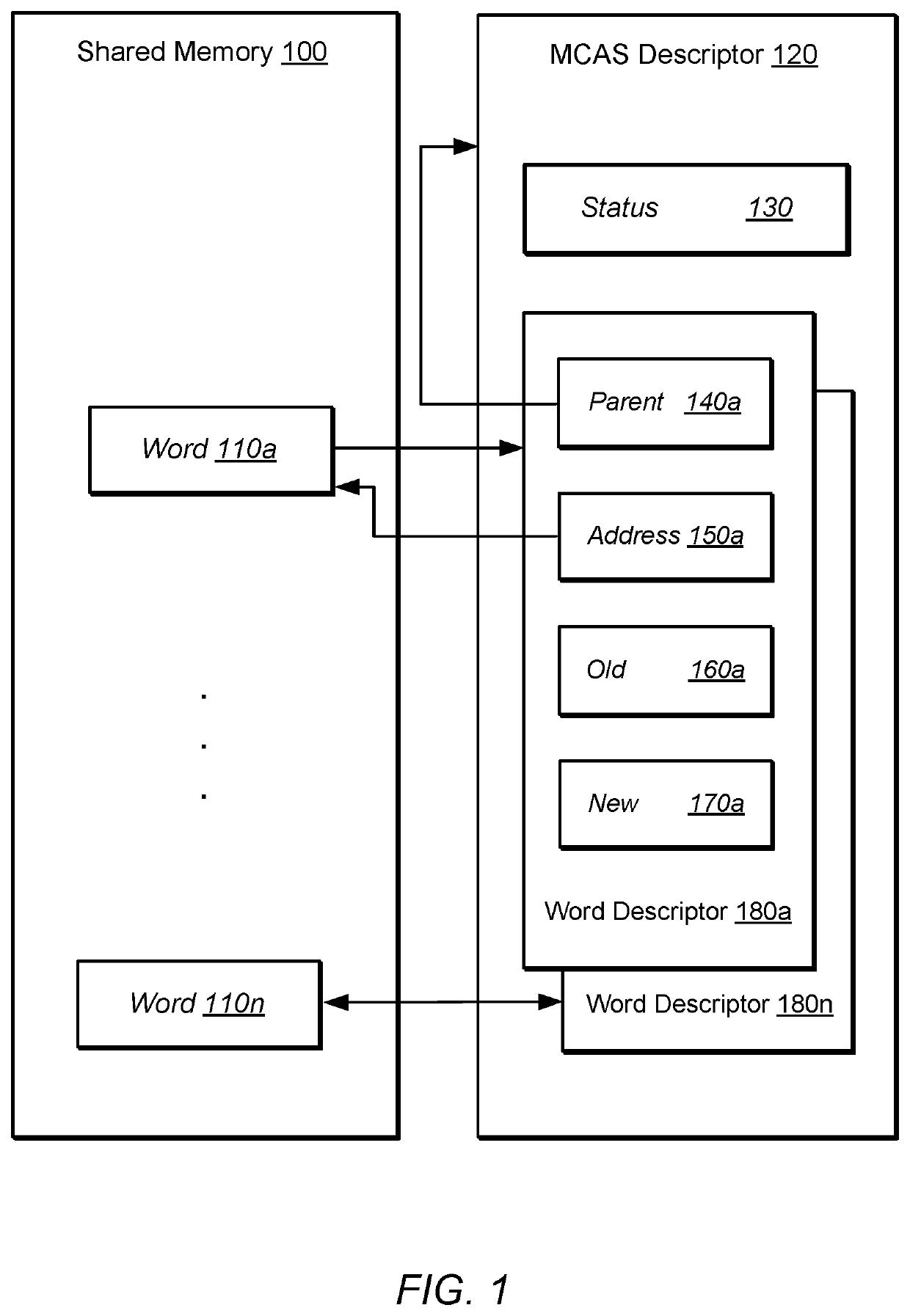
[0023]A CAS primitive may operate using three provided arguments, an address of a memory location, and old value, and a new value. The CAS primitive may first read the value stored in the memory location, then compare it to the provided old value and write the new value to the memory location if and only if the value stored in the memory location matches the provided old value. The CAS primitive may then complete by returning the successful result only if the comparison matches and the new value is written. This sequences of steps is performed atomically, resulting in a value in memory that is always predictable and consistent with the result returned from the CAS primitive.

[0024]An MCAS operation may operate in a manner similar to a CAS primitive while supporting the atomic updating of multiple memory locations. Various embodiments of MCAS operations, therefore, may receive a list of memory locations along with respective old and new values, they may load current values of all memo...

the structure of the environmentally friendly knitted fabric provided by the present invention; figure 2 Flow chart of the yarn wrapping machine for environmentally friendly knitted fabrics and storage devices; image 3 Is the parameter map of the yarn covering machine
Login to View More

PUM

No PUM Login to View More

Abstract

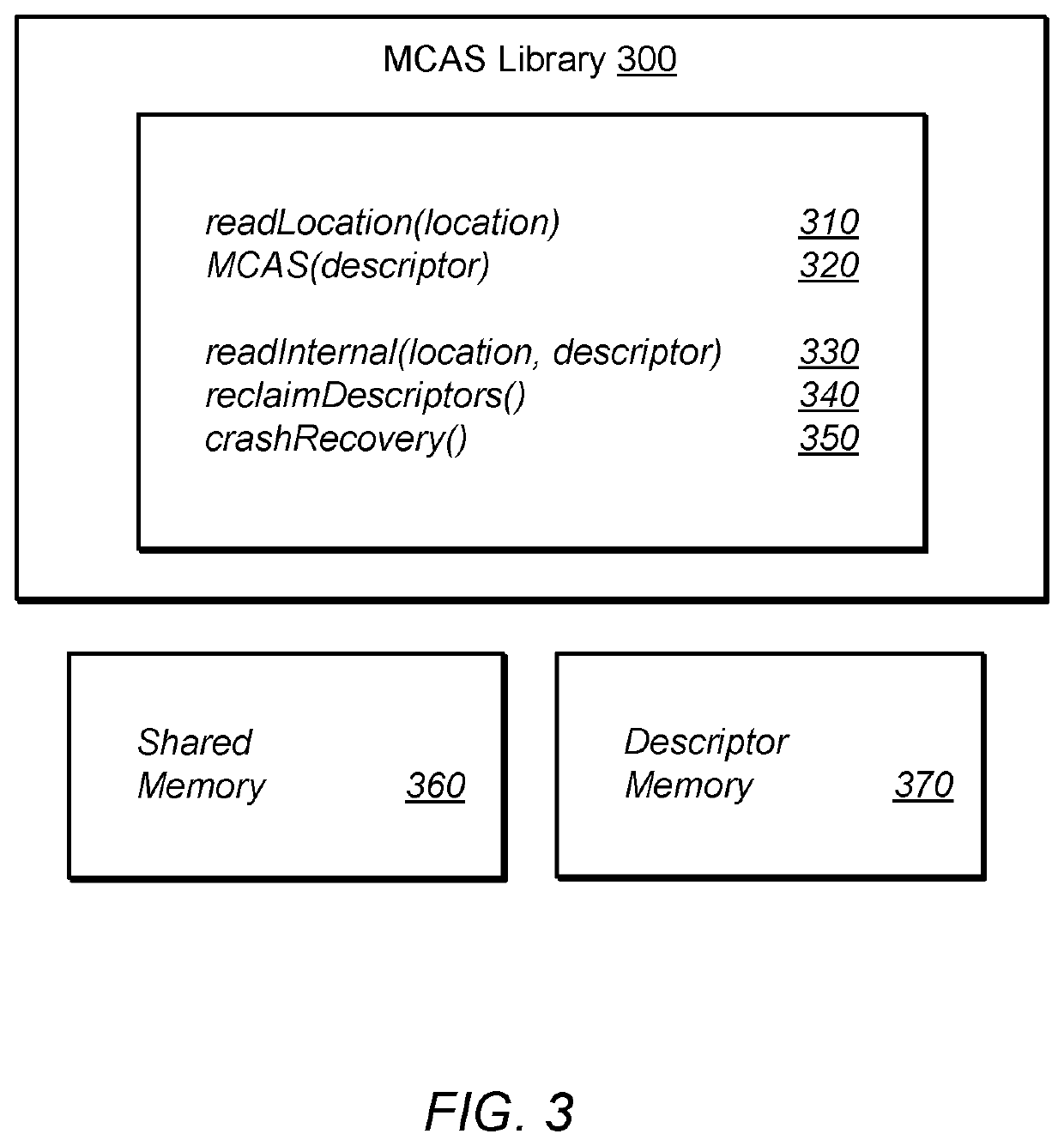
A computer comprising one or more processors and memory may implement an atomic compare and swap (CAS) operation on multiple data elements. Each data element has a corresponding descriptor which includes a new value and a reference to a controlling descriptor for the CAS operation. The controlling descriptor includes a status value which indicates whether the CAS operation is in progress or has completed. The operation first allocates memory locations of the data elements by writing addresses of respective descriptors to the memory locations using CAS instructions. The operation then writes successful status to the status value of the controlling descriptor to indicate that the respective memory locations are no longer allocated. The operation then returns an indicator of successful completion without atomically updating the memory locations with the new values. Extensions are further described to implement CAS operations in non-volatile random access memories.

Description

BACKGROUND[0001]This application claims benefit of priority to U.S. Provisional Patent Application No. 62 / 670,573 filed May 11, 2018 and titled “Efficient Lock-Free Multi-Word Compare and Swap,” which is hereby incorporated by reference in its entirety.FIELD OF THE DISCLOSURE[0002]This disclosure relates generally to concurrent programming, and more particularly to systems and methods for performing lock-free atomic updates to multiple data elements.DESCRIPTION OF THE RELATED ART[0003]Compare-and-swap (CAS) is a foundational primitive used pervasively in concurrent algorithms in shared memory systems. In particular, it is used extensively in non-blocking algorithms to deliver scalable performance on multicore systems. CAS conditionally updates a memory word such that a new value is written if and only if the old value in that word matches an expected value. Variations of this primitive instruction are provided in nearly every modern processor architecture.[0004]CAS, however, operate...

Claims

the structure of the environmentally friendly knitted fabric provided by the present invention; figure 2 Flow chart of the yarn wrapping machine for environmentally friendly knitted fabrics and storage devices; image 3 Is the parameter map of the yarn covering machine
Login to View More

Application Information

Patent Timeline
no application Login to View More
Patent Type & Authority Patents(United States)
IPC IPC(8): G06F9/30G06F12/0804
CPCG06F12/0804G06F9/30032G06F9/30021G06F2212/1032G06F9/3004
Inventor MARATHE, VIRENDRA J.KOGAN, ALEXZABLOTCHI, MIHAIL-IGOR
Owner ORACLE INT CORP
Features
  • R&D
  • Intellectual Property
  • Life Sciences
  • Materials
  • Tech Scout
Why Patsnap Eureka
  • Unparalleled Data Quality
  • Higher Quality Content
  • 60% Fewer Hallucinations
Social media
Patsnap Eureka Blog
Learn More