Fabric, multilayer structured fabric, and fiber product
a technology of structured fabric and fiber, applied in the field of fabric, multi-layered cloth, textile products, can solve the problems of unsatisfactory cloths in terms of flame retardancy and heat insulation
- Summary
- Abstract
- Description
- Claims
- Application Information
AI Technical Summary
Benefits of technology
Problems solved by technology
Method used
Image

Examples
example 1
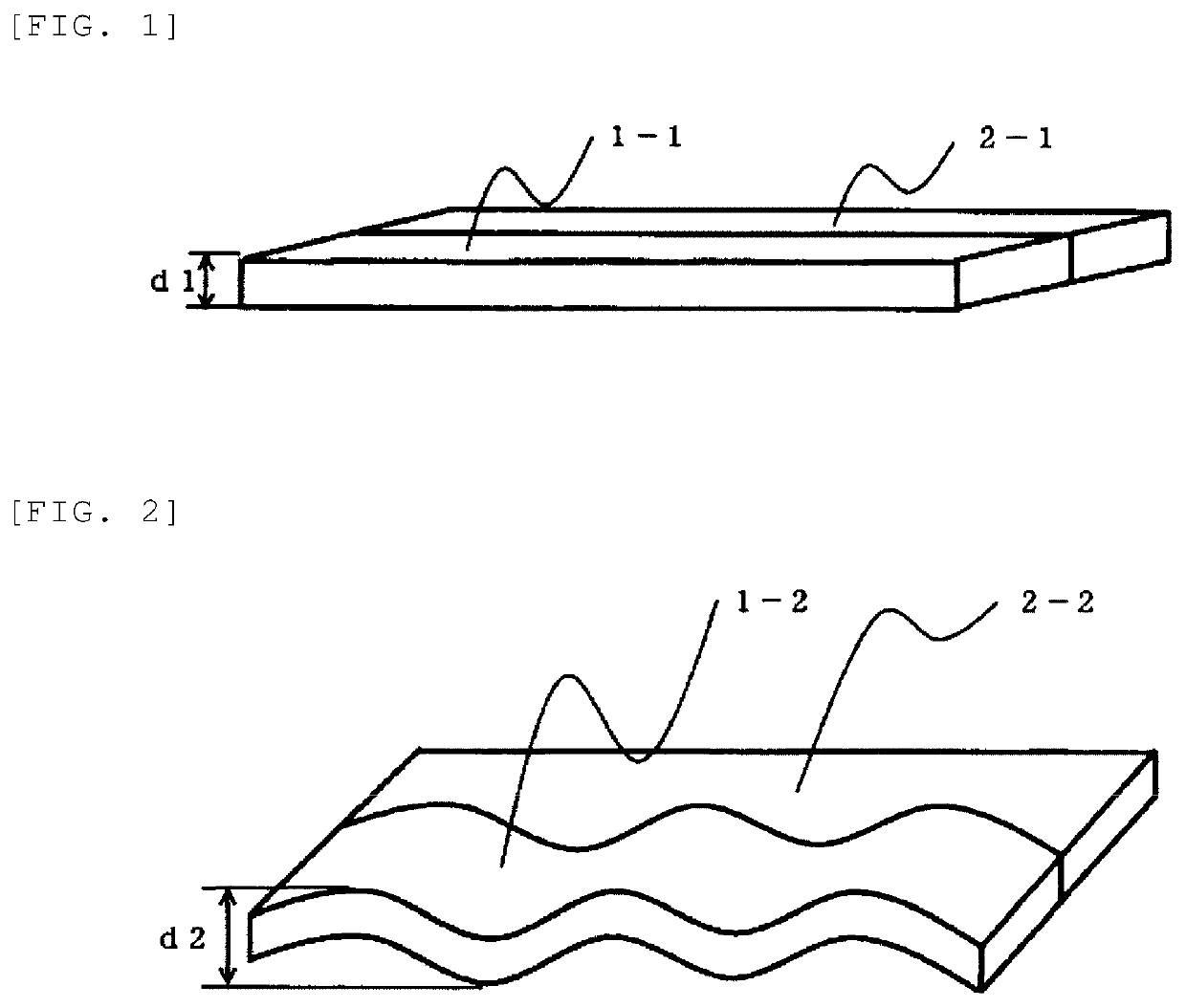
[0073]A spun yarn (No. 40 count / two-ply yarn) composed of a meta-aramid fiber (MA) and a para-aramid fiber (PA) each in the form of staple fibers (each fiber length: 51 mm) blend-spun in a weight ratio of MA / PA=95 / 5 was used as a warp-direction yarn and a weft-direction yarn A, while a spun yarn (No. 40 count / two-ply yarn) composed only of PA was used as a weft-direction yarn B. With a rapier weaving machine, a woven fabric (plain weave structure) having a weight per unit of 70 g / m2 was formed changing the weft-direction yarn A and the weft-direction yarn B at intervals of 20 mm. Subsequently, scouring was performed in the usual manner, the meta-aramid fiber was dyed, and then the fabric was heat-set to give a cloth.
[0074]The dry thermal shrinkage rates of the MA / PA spun yarn (yarn A having a high thermal shrinkage rate) and the PA spun yarn (yarn B having a low thermal shrinkage rate) were 30% and 0%, respectively, and HAB was 30%.
[0075]The obtained cloth was subjected to a dry-hea...
example 2
[0077]A spun yarn (No. 40 count / two-ply yarn) composed of a meta-aramid fiber (MA) and a para-aramid fiber (PA) each in the form of staple fibers (each fiber length: 51 mm) blend-spun in a weight ratio of MA / PA=95 / 5 was used as a warp yarn and a weft yarn A, while a spun yarn (No. 40 count / two-ply yarn) composed only of PA was used as a weft yarn B. With a rapier weaving machine, a woven fabric (plain weave structure) of 70 g / m2 was formed changing the weft yarn A and the weft yarn B at intervals of 10 mm. Subsequently, scouring was performed in the usual manner, the meta-aramid fiber was dyed, and then the fabric was heat-set to give a cloth.
[0078]The dry thermal shrinkage rates of the MA / PA spun yarn and the PA spun yarn were 30% and 0%, respectively, and HAB was 30%.
[0079]The obtained cloth was subjected to a dry-heat treatment at 300° C. for 5 minutes. As a result, a relief structure was developed in the weft direction, and the thickness difference was 2.0 mm. In addition, the a...
example 3
[0081]A spun yarn (No. 40 count / two-ply yarn) composed of a meta-aramid fiber (MA) and a para-aramid fiber (PA) each in the form of staple fibers (each fiber length: 51 mm) blend-spun in a weight ratio of MA / PA=95 / 5 was used as a warp-direction yarn and a weft-direction yarn A, while a spun yarn (No. 40 count / two-ply yarn) composed only of PA was used as a weft-direction yarn B. With a rapier weaving machine, a woven fabric (plain weave structure) having a weight per unit of 70 g / m2 was formed changing the weft-direction yarn A and the weft-direction yarn B at intervals of 20 mm. Subsequently, scouring was performed in the usual manner, the meta-aramid fiber was dyed, and then the fabric was heat-set to give a cloth.
[0082]The dry thermal shrinkage rates of the MA / PA spun yarn (yarn A having a high thermal shrinkage rate) and the PA spun yarn (yarn B having a low thermal shrinkage rate) were 30% and 0%, respectively, and HAB was 30%.
[0083]On one side of the obtained cloth, a breathab...
PUM
| Property | Measurement | Unit |
|---|---|---|
| diameter | aaaaa | aaaaa |
| temperature | aaaaa | aaaaa |
| size | aaaaa | aaaaa |
Abstract
Description
Claims
Application Information
 Login to View More
 - R&D
- Intellectual Property
- Life Sciences
- Materials
- Tech Scout
- Unparalleled Data Quality
- Higher Quality Content
- 60% Fewer Hallucinations
Browse by: Latest US Patents, China's latest patents, Technical Efficacy Thesaurus, Application Domain, Technology Topic, Popular Technical Reports.
© 2025 PatSnap. All rights reserved.Legal|Privacy policy|Modern Slavery Act Transparency Statement|Sitemap|About US| Contact US: help@patsnap.com