Process and apparatus for removing polymer material from a gas-solids olefin polymerization reactor
a gas-solids olefin and polymerization reactor technology, applied in chemical apparatus and processes, chemical/physical processes, etc., can solve the problems of increasing operating costs, waste flaring, and quality problems of the resulting polymer powder, and achieve the effect of significantly reducing the amount of entrained gas mixture in the polymer powder
- Summary
- Abstract
- Description
- Claims
- Application Information
AI Technical Summary
Benefits of technology
Problems solved by technology
Method used
Image


Examples
example 1
Reference
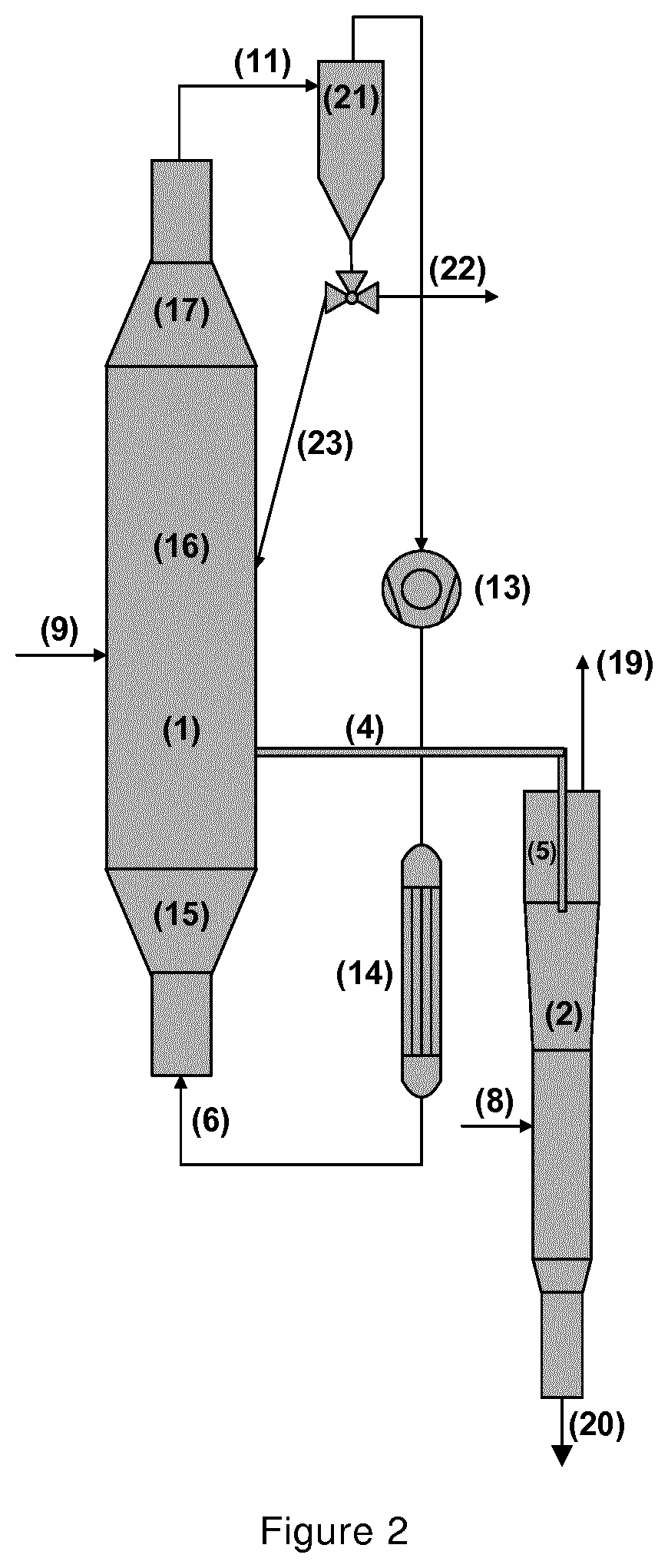
[0150]In this example, the powder surface in the outlet vessel is established at the lower end of a dip tube that extends from the feed pipe into the outlet vessel. The diameter of the dip tube was equal to 50 mm and the distance between the top part of the outlet vessel (i.e., end of the feed pipe) and the dip tube lower end was equal to 400 mm. The employment of the dip tube was majorly contributed in establishing a settled powder bed in the outlet vessel with constant height during the unit operation without disturbances / oscillations (i.e., periodical emptying and filling of the outlet vessel). The polymer powder flow was selected to be 200 Kg / h and the distance between the powder surface and the barrier gas injection point was 130 mm while the distance between the barrier gas injection point and the outlet vessel outlet was 500 mm. The barrier gas flow rate was set to be equal to the gases that are entrained by the polymer material (˜120 l / h). The barrier efficiency (it...
example 2
Reference
[0151]In this example, the same outlet vessel configuration and powder flow as in Example 1 were selected. The distance between the powder surface and the barrier gas injection point was 460 mm while the distance between the barrier gas injection point and the outlet vessel outlet was 170 mm. The barrier gas flow rate was set to be equal to the gases that are entrained by the polymer material (˜120 l / h). The barrier efficiency (it determines the percentage of the entrained gases that can be displaced by the barrier gas) was measured equal to be equal to 35%.
example 3
Inventive
[0152]In this example, the same outlet vessel configuration and powder flow as in Example were selected. The distance between the powder surface and the barrier gas injection point was 230 mm while the distance between the barrier gas injection point and the outlet vessel outlet was 400 mm. The barrier gas flow rate was set to be equal to the gases that are entrained by the polymer material (˜120 l / h). The barrier efficiency (it determines the percentage of the entrained gases that can be displaced by the barrier gas) was measured to be equal to 98%.
PUM
| Property | Measurement | Unit |
|---|---|---|
| velocity | aaaaa | aaaaa |
| particle size | aaaaa | aaaaa |
| particle size | aaaaa | aaaaa |
Abstract
Description
Claims
Application Information
 Login to View More
 - R&D
- Intellectual Property
- Life Sciences
- Materials
- Tech Scout
- Unparalleled Data Quality
- Higher Quality Content
- 60% Fewer Hallucinations
Browse by: Latest US Patents, China's latest patents, Technical Efficacy Thesaurus, Application Domain, Technology Topic, Popular Technical Reports.
© 2025 PatSnap. All rights reserved.Legal|Privacy policy|Modern Slavery Act Transparency Statement|Sitemap|About US| Contact US: help@patsnap.com