If then there is an event of loss or injury that might have been prevented had the system been functioning properly and to its full capacity, the owner may be confronted with a claim difficult to defend.
Although parking garages provide a valuable benefit and highly desirable or necessary service to the public by offering parking facilities for vehicles of members of the public, they may nevertheless present risk to members of the visiting public.
But even parking garages so equipped may be increasingly subject to risk of auto thefts and auto burglaries when these garages are located adjacent to quick escape routes such as freeway on-ramps or major thoroughfares.
Yet, even in a small system, it is difficult or impossible for one such person to watch the same scene or scenes continuously.
After a few minutes of the same view, what may be termed attention fatigue sets in.
In a large CCTV system having hundreds of cameras, the fatigue factor is extreme for security personnel who must observe a correspondingly large number of display monitors.
In such a system, presenting one view per minute on a display monitors will not allow operators to detect quickly occurring events such as purse snatching.
Even if
resultant high costs of such
staffing are sustainable, security personnel cannot practically be expected to maintain a satisfactorily high level of attention for adequate incidence discernment, because such personnel are presented on the display monitors with some 11,520 individual scenes to evaluate during each 8-hour shift.
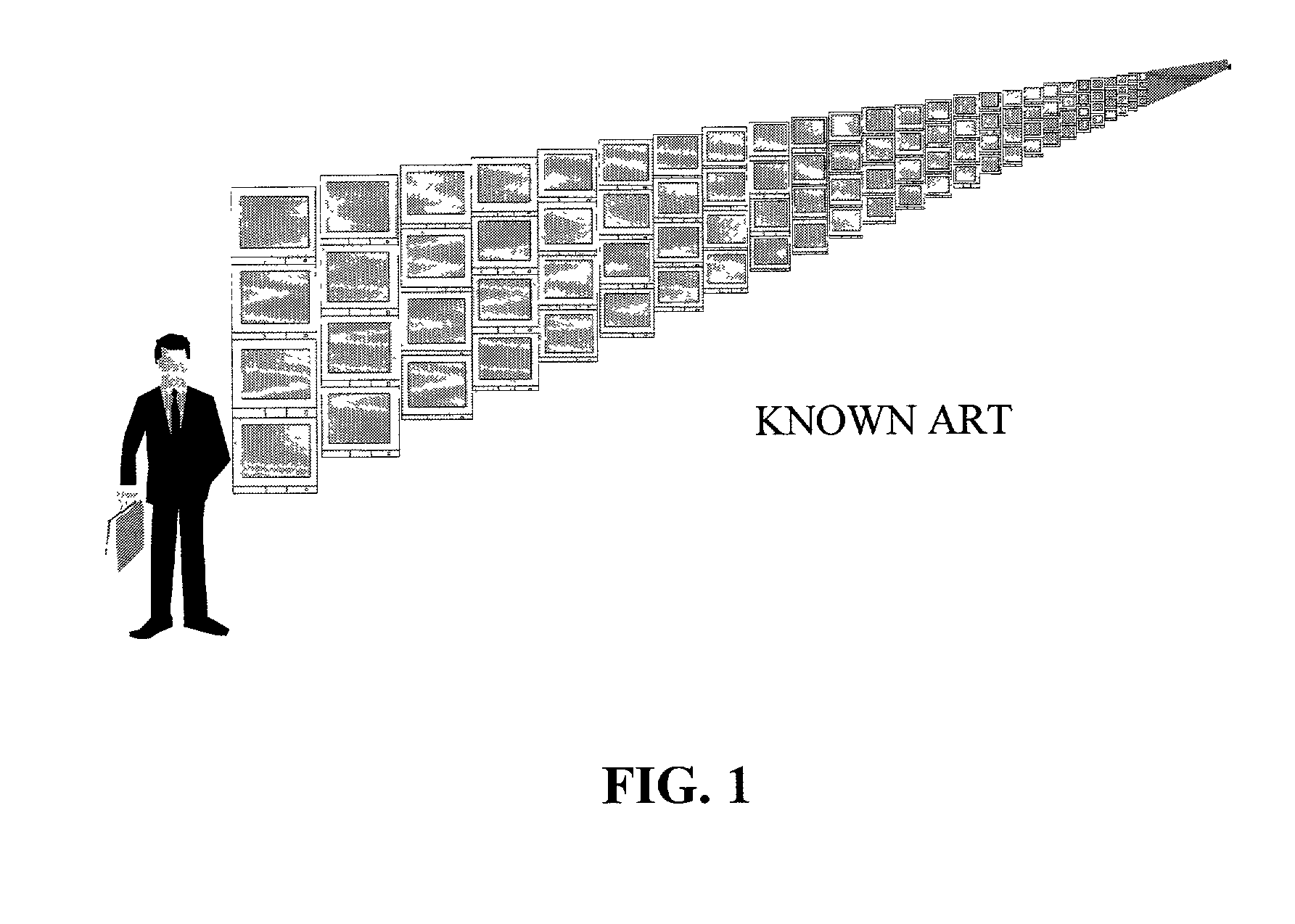
However, if such a wall of monitors 137 feet in length were to be employed, it is improbable that any crime event or other incident would be seen.
Although the human figure is not drawn to scale, the operating viewing situation or requirements for such a wall of monitors can easily be visualized, and will readily be realized as being impractical for a large quantity of monitors.
Even if the security budget will allow for
payment of 30 salaries for operating personnel, the monitoring task would drive these operators to extreme attention fatigue within any given shift.
As the number of cameras in the proposed system was postulated to grow, the
weakness of simple
motion detection could become apparent.
Commercially available motion detectors for such a system are found to be unable to distinguish a person from a vehicle.
About six operators would be required to be on duty during the day, and the repetitive presentation of views caused by movement of a
single vehicle past multiple cameras would cause extreme boredom and resulting lack of attention.
However, the known art does not fully address the need for intelligent camera selection based on a plurality of inputs for decreasing operator load and fatigue.
Additionally, the known art does not control CCTV switching for operator viewing.



 Login to View More
  Login to View More