
Device for testing electrical characteristics of chips
- Summary
- Abstract
- Description
- Claims
- Application Information
AI Technical Summary
Problems solved by technology
Method used
Image

Examples
Embodiment Construction
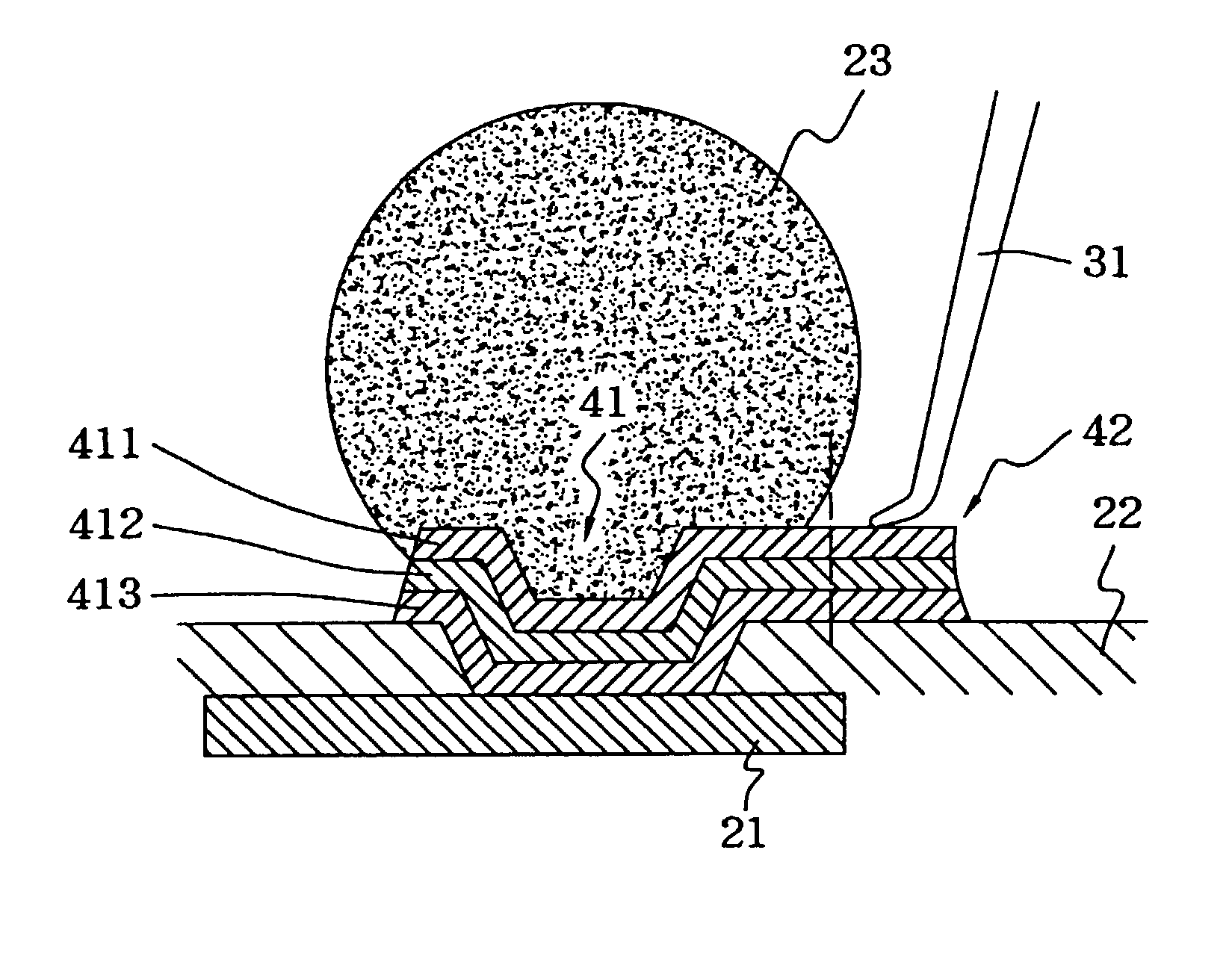
[0020] FIG. 4 is the schematic diagram of the bump bumped on the UBM according to the invention, wherein there is a UBM 41 provided between the bump 23 and the bonding pad 21, which includes an adhesion layer 413, a barrier layer 412 and a wetting layer 411. The UBM 41 is provided with an extension area 42, which laterally extends from the bottommost bump 23. And the area of the extension area 414 is enough for the probe 31 to conduct the test operation, including sufficient contact area for the head of the probe 31 and tolerable area to ensure the probe 31 will not touch the bump 23 while traveling. Furthermore, the extension area 42 is at least formed from one side of the UBM 41, and may be at four sides, which depends on the test requirement. In other words, when the photo mask being designed, it is considered that the extension area 42 covered with photoresist would not be removed during etching process. Because the extension area 42 and the bonding pad 21 are electrically conne...
PUM
 Login to View More
 Abstract
Description
Claims
Application Information
 Login to View More