Integrated optimization and control using modular model predictive controller

a model predictive controller and integrated technology, applied in the direction of electrical programme control, program control, instruments, etc., can solve the problems of exacerbated problems, lack of robustness of mpc for sustained improvement of process operation profitability under changing conditions, and difficulty in adjusting the parameters of the process, so as to facilitate the integration, optimize the overall profitability of operation, and maintain the overall stability of the process

a model predictive controller and integrated technology, applied in the direction of electrical programme control, program control, instruments, etc., can solve the problems of exacerbated problems, lack of robustness of mpc for sustained improvement of process operation profitability under changing conditions, and difficulty in adjusting the parameters of the process, so as to facilitate the integration, optimize the overall profitability of operation, and maintain the overall stability of the process

US20050075738A1Inactive Publication Date: 2005-04-07ATTARWALA FAKHRUDDIN T

Image

Smart Image Click on the blue labels to locate them in the text.
Viewing Examples
Smart Image
  • Integrated optimization and control using modular model predictive controller
  • Integrated optimization and control using modular model predictive controller
  • Integrated optimization and control using modular model predictive controller

Examples

Experimental program
Comparison scheme
Effect test

case study 1

match, No Feed Forward Variation Change of Constraints: This case study demonstrates the basic performance difference between MPC and MX-MPC in that the latter achieves the same overall steady state with minimal violation of the controlled variable constraints. Notice the response of the profit value in both the cases. In case of MX-MPC, the response is well behaved with little overshoot while keeping all of the controlled variables within their respective limits.

The first response shown in the results is from MX-MPC. The remaining results are from MPC runs in which the tuning was varied to match the results from MX-MPC run. As shown, after five changes to the tuning, MPC does not match as well with the results of MPC. In conclusion, performance of MPC cannot be matched to performance of MX-MPC by simply changing its tuning.

case study 2

match, With Feed Forward Variation No Change of Constraints: This case study demonstrates the improved performance of MX-MPC to feed forward variable variation as compared to MPC. The underlying tuning is same in both the cases except for the additional constraints and controlled variable for MX-MPC. Performance of MPC is shown first, followed by performance of MX-MPC in the results are presented in FIG. 10-12.

case study 3

study 2 with lower frequency of feed forward variable Variation: This case study demonstrates that while MPC's performance degrades considerably requiring retuning whereas MX-MPC's performance practically remains unchanged. This proves that MX-MPC posses more robust towards feed forward variable variation than MPC.

the structure of the environmentally friendly knitted fabric provided by the present invention; figure 2 Flow chart of the yarn wrapping machine for environmentally friendly knitted fabrics and storage devices; image 3 Is the parameter map of the yarn covering machine
Login to View More

PUM

No PUM Login to View More

Abstract

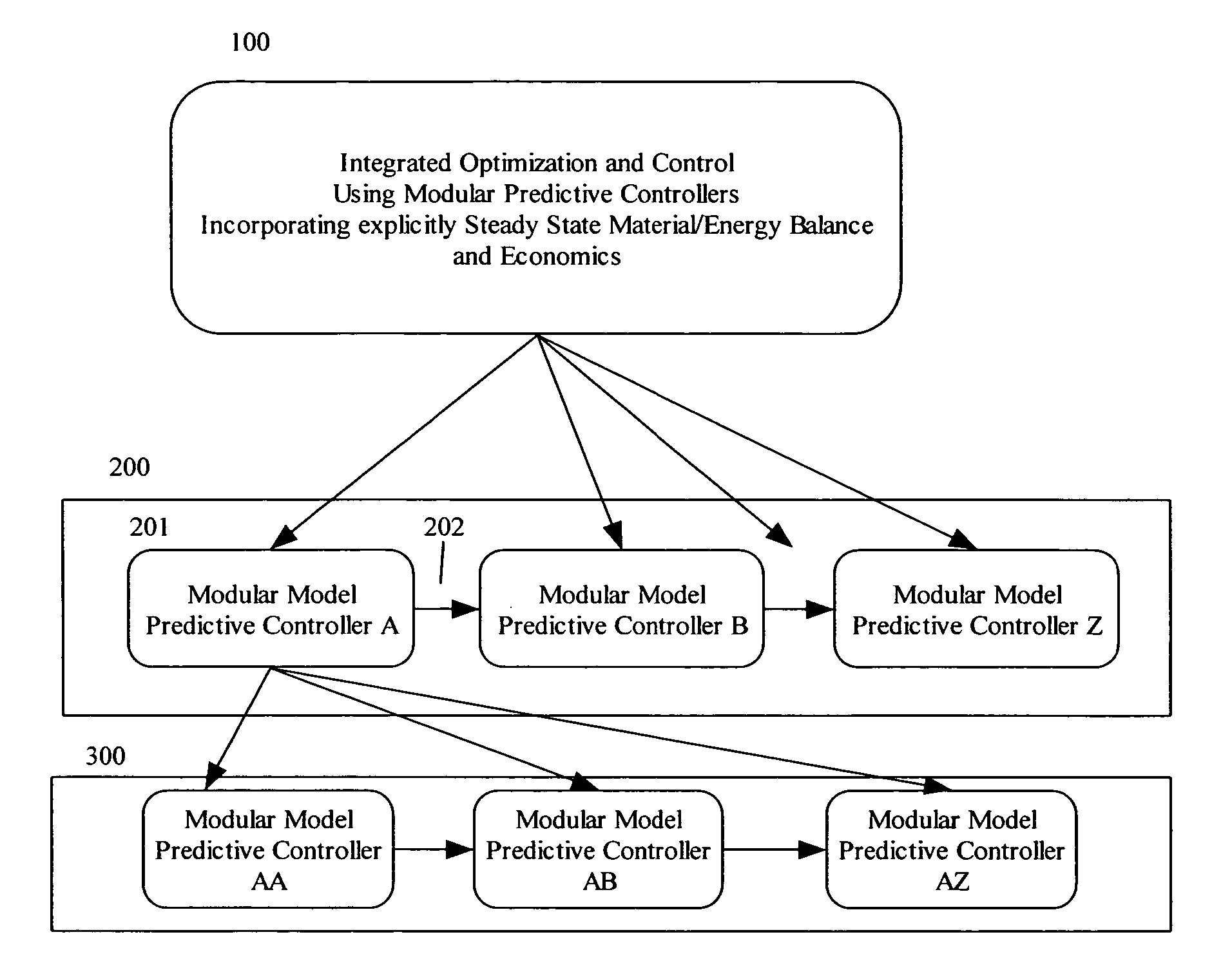
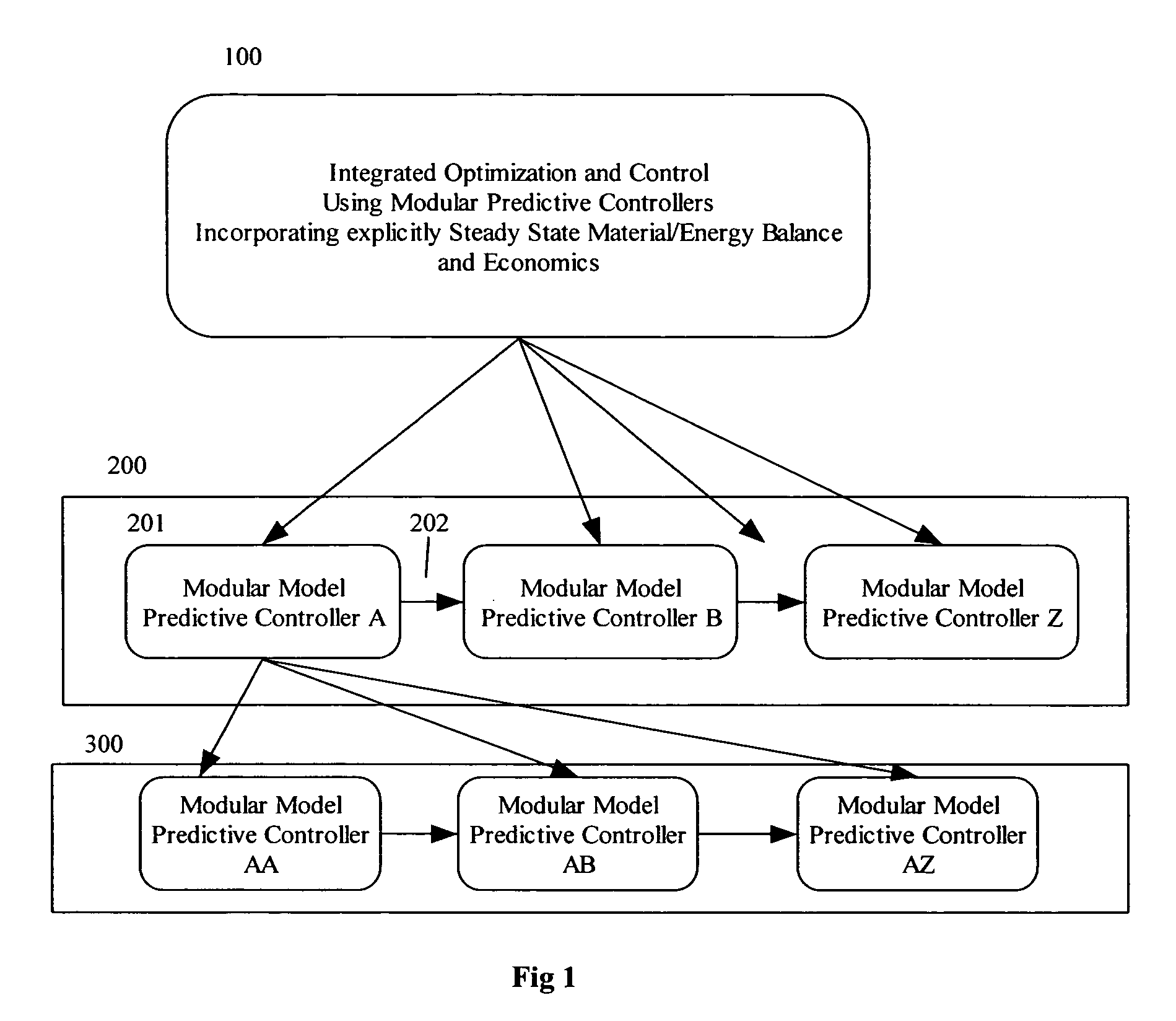
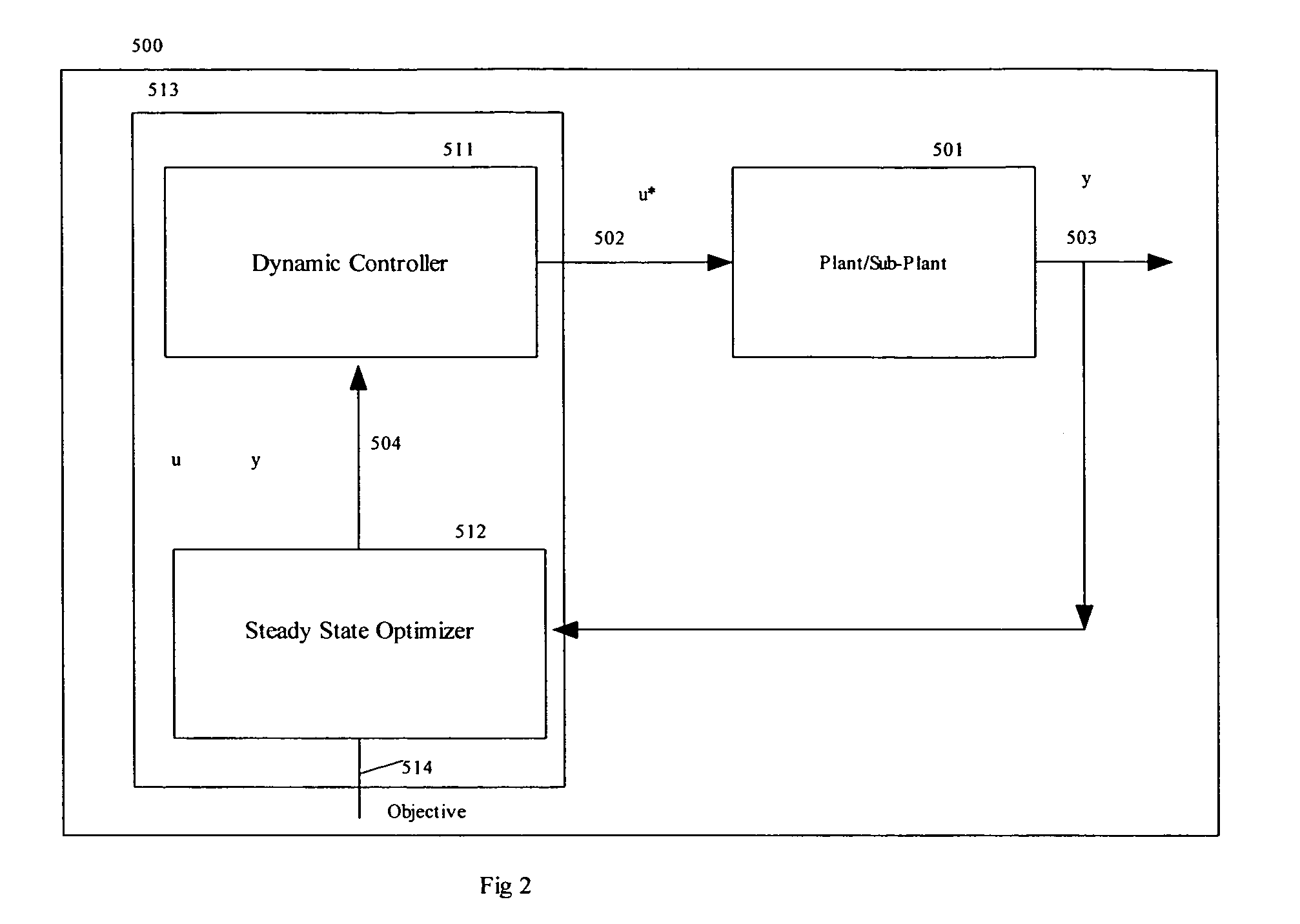
A modular formulation of model predictive controller is proposed by this invention (400). The modular formulation offers a robust model predictive controller with unified method of tuning. Explicit use of material and energy balance provides stable and robust performance (412). Use of economic based tuning offers a unified tuning method (411). The unified tuning method establishes consistency of control actions resulting from the steady state optimization and the dynamic control (400). Further, a method for formulating and tuning integrated optimization and control using multiple modular model predictive controllers is presented in this invention (100). The method incorporates a direct and explicit method of integration of a number of modular model predictive controllers. The integration of the modular controllers is achieved seamlessly without requiring any further tuning adjustments (200). The resulting integrated system of multiple modular predictive controllers performs robustly, permitting each of the modular model predictive controllers to perform its role in the context of the state of operation of rest of the system. The proposed integration can be made to include lower level modular controllers or at same level controllers or both (300).

Description

CROSS REFERENCE TO RELATED APPLICATIONS Not Applicable FEDERALLY SPONSORED REASEARCH Not Applicable SEQUENCE LISTING OR PROGRAM Not Applicable BACKGROUND 1. Field of Invention This invention relates to the field of real time optimization and control using Model Predictive Controller. More particularly, the present invention relates to integration of model predictive controllers for a large process unit, its sub-processes including regulatory controllers for robust performance. 2. Description of Prior Art Model Predictive Control has been applied to a wide range of processes, to a simple unit operation to plant unit operation involving multiple unit operations. However, quality of performance of Model Predictive Controller (MPC) as practiced in the art varies considerably with the size of its application; tuning and design can take considerable engineering effort. As practiced in the art, tuning of a MPC is a trial and error endeavor that works well under a narrow and defined...

Claims

the structure of the environmentally friendly knitted fabric provided by the present invention; figure 2 Flow chart of the yarn wrapping machine for environmentally friendly knitted fabrics and storage devices; image 3 Is the parameter map of the yarn covering machine
Login to View More

Application Information

Patent Timeline
07 Apr 2005
Publication
US20050075738A1
IPC
G05B13/04
CPC
G05B13/048; G05B13/04
Inventors
ATTARWALA, FAKHRUDDIN T.