

Method and apparatus for sealing and re-sealing an annular vessel opening
a technology for annular openings and sealing methods, applied in the field of sealing mechanisms, can solve the problems of many limitations related to use-ability and convenience in manufacturing, inability to adjust the seal strength, and mechanically dependent parts often bend or otherwise lose usefulness
- Summary
- Abstract
- Description
- Claims
- Application Information
AI Technical Summary
Benefits of technology
Problems solved by technology
Method used
Image

Examples
Embodiment Construction
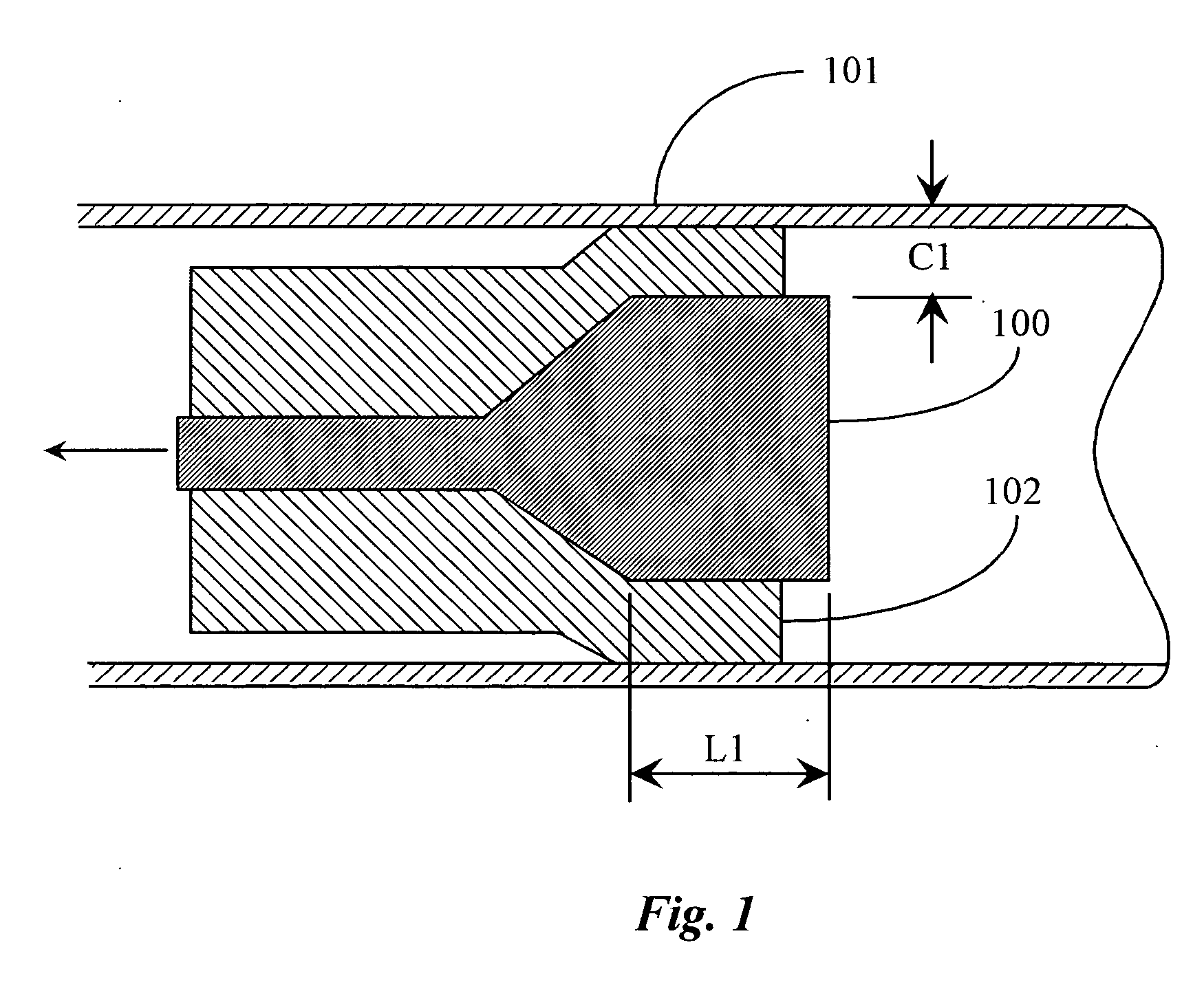
[0034]FIG. 1 is a block diagram illustrating a sealing principle applied by a device of the present invention in an annular opening of a vessel according to an embodiment of the present invention. As was described with respect to the background section of this specification, prior-art sealing methods for sealing an annular opening of a bottle or vessel are limited by mechanical frailty and stringent dimensional concerns. A device for sealing annular openings according to an embodiment of the present invention, also termed herein a stopper assembly by the inventor, uses a rubber sleeve or, in some variations, a rubber socket 102, to form a peripheral seal around the inner wall of a vessel opening 101, such as a bottle neck. To affect a strong seal, a principle of forced flare-out of the sleeve is practiced using an axially motivated tapered stem 100.
[0035] Sleeve 102 is an elastic rubber-like material that is pliable under force but reverts to its natural and original shape in the a...
PUM
| Property | Measurement | Unit |
|---|---|---|
| elastic | aaaaa | aaaaa |
| seal strength | aaaaa | aaaaa |
| internal pressure | aaaaa | aaaaa |
Abstract
Description
Claims
Application Information
 Login to View More