
Electric vehicle
a technology of electric vehicles and motors, applied in the direction of relays, battery/fuel cell control arrangements, electric devices, etc., can solve the problems of contact welding, and inability to perform the function of interrupting electric power, so as to reduce the number of winding turns, reduce the diameter of the winding, and the effect of the same impact resistan
- Summary
- Abstract
- Description
- Claims
- Application Information
AI Technical Summary
Benefits of technology
Problems solved by technology
Method used
Image

Examples
Embodiment Construction
[0023] Hereinafter, preferred embodiments of the present invention will be described with reference to the drawings, taking a hybrid electric vehicle (HEV) as an example.
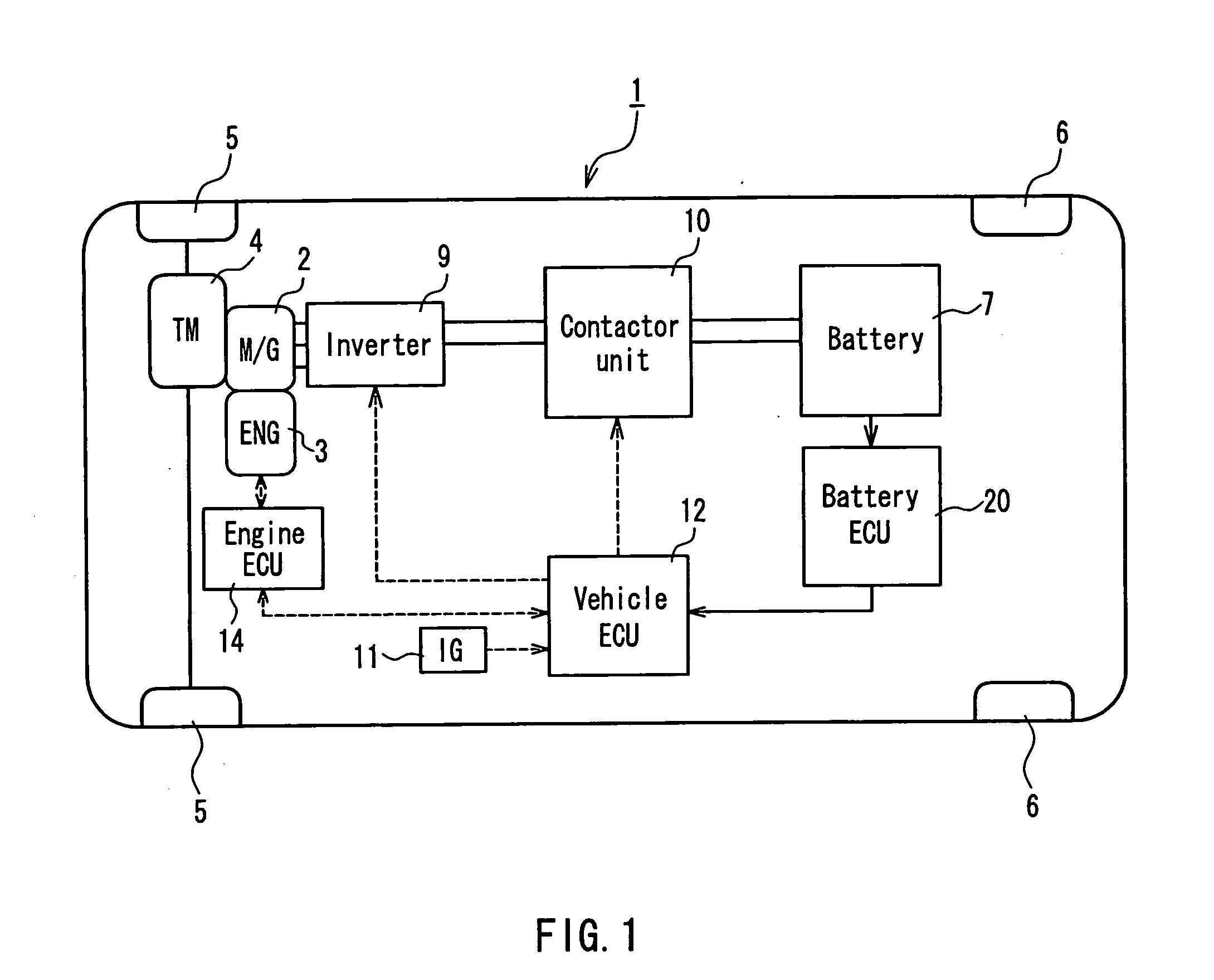
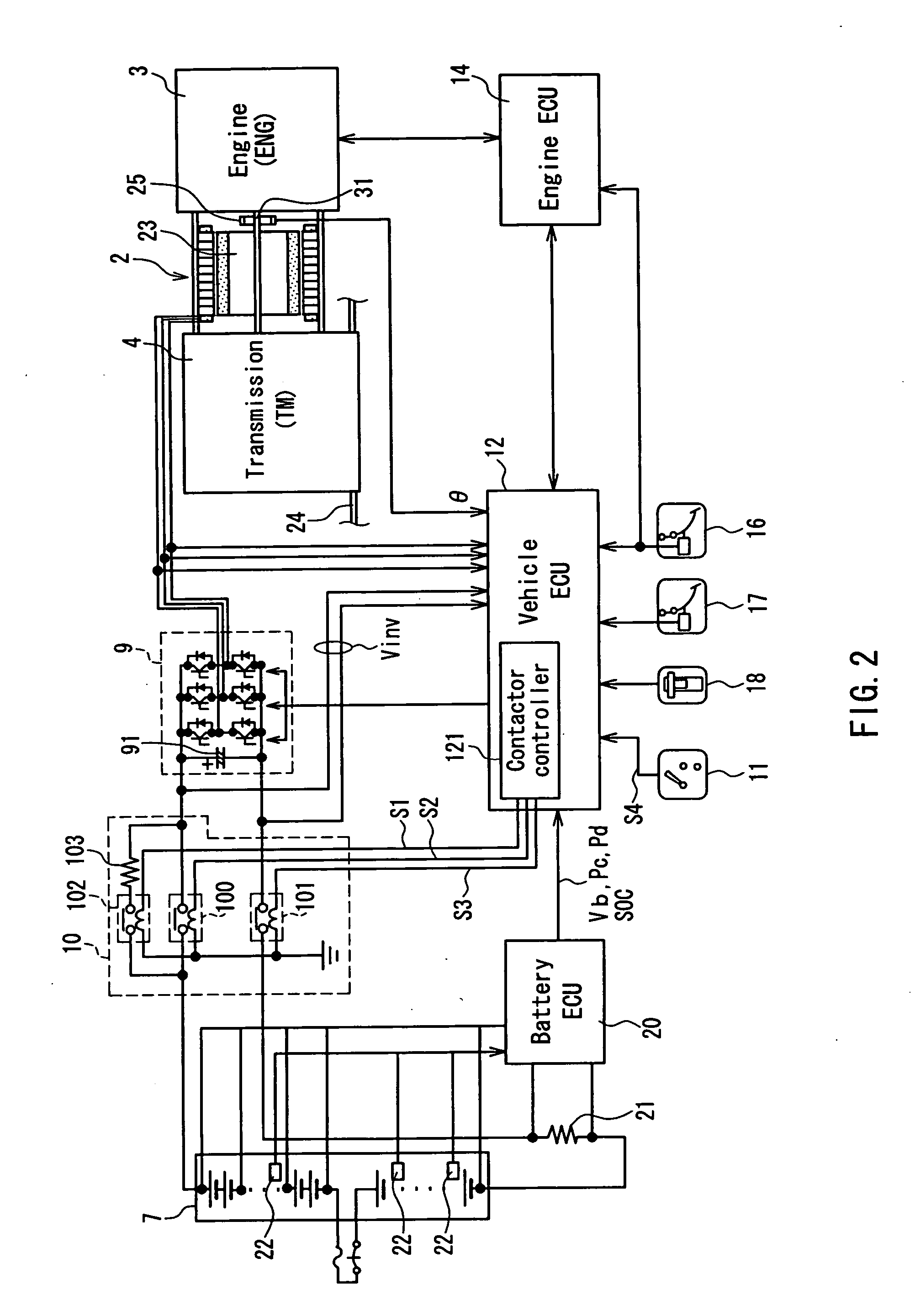
[0024]FIG. 1 is a diagram showing the overall configuration of a HEV serving as the electric vehicle according to an embodiment of the present invention. In FIG. 1, the HEV 1 has a pair of left and right front wheels 5 and 5, which are driving wheels, to which an output of a motor generator (M / G) 2 or an engine (ENG) 3 is transmitted via a transmission (TM) 4, and a pair of left and right rear wheels 6 and 6. A battery pack 7 that is mounted at the rear of the HEV 1 and that outputs, for example, a voltage of 360 V is connected to the motor generator 2 via a contactor unit 10 and an inverter 9. ON / OFF signals of an ignition key switch (IG) 11 are supplied to a vehicle electronic control unit (hereinafter, abbreviated as “vehicle ECU”) 12, and the vehicle ECU 12 controls the contactor unit 10, the inverter 9, and an...
PUM
 Login to View More
 Abstract
Description
Claims
Application Information
 Login to View More