Unlike audio that can be easily encoded, streamed and stored with currently-available encoding standards and storage technologies, streaming video requires a very high streaming bandwidth, typically on the order of 3-8 Mbits / sec, and places a tremendous load on the video servers and associated system resources that are used to deliver the video to the end
consumer.
Such a system tends to be very costly and does not usually meet the strict cost constraints placed by commercial VoD systems.
There is also the potential for failure of one board to cause total failure of the
video server.
Further, as the system grows, the cost of computational power decreases, and the processor boards required to update the system may be outdated by the time a
system administrator is prepared to grow the
video server.
Shared storage devices connected to the
fiber such as
fiber-channel switches, switch adapters, disks that are
fiber-channel capable, etc., are additional cost components and add complexity to the
scalability of the network.
While an improvement over the single-
server model with multiple processor boards, this approach still does not solve the
resource management problem of how to effectively balance network bandwidth and connection overhead.
Because the storage devices are typically connected to the fiber through a fiber channel switch, the VoD system can only provide videos stored in the storage devices at the limited bandwidth available from the storage devices to the switch.
As a result, popular videos that are accessed frequently need to be copied to memory for faster access, thereby
wasting system resources and restricting the ability of the VoD system to
handle very large video files or too many users.
Additionally, currently-available prior-art VoD systems are not capable of handling large scale real-time streaming and ingest requests that often occur when a large number of users with various usage patterns have access to the systems.
When large scale demands are placed in those systems, they may fail entirely or cause multiple users to have their requests interrupted.
Those systems may also not be able to
handle usage spikes, unanticipated flash floods, or a large number of requests for the same content.
In short, currently-available VoD systems do not easily scale its streaming and storage capacities without presenting load balancing or failure problems.
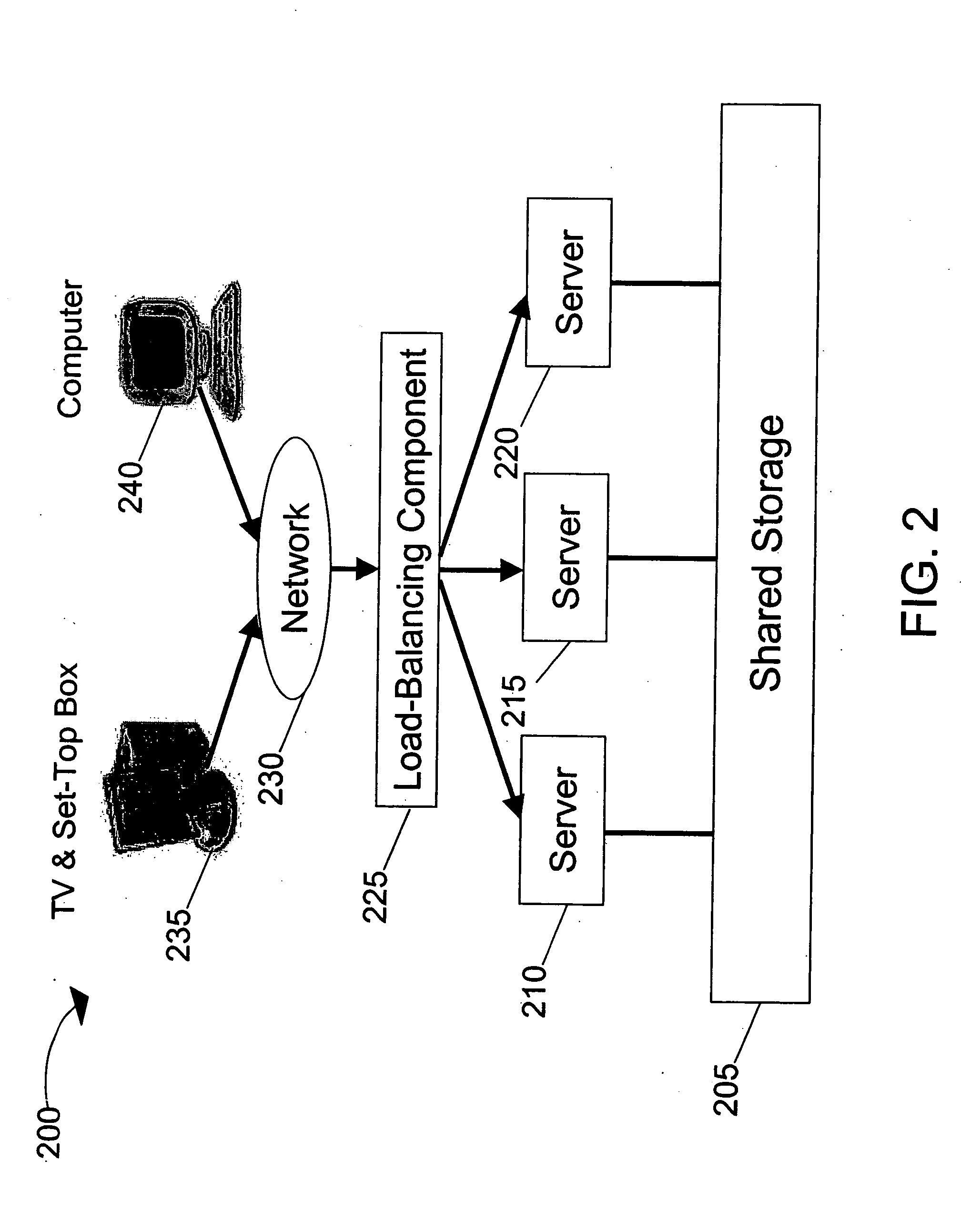
However, because all of the content needs to be stored in shared storage subsystem 205, storage expansion is not very granular and storage costs can be high, especially for clusters designed for high streaming
throughput.
Further, components of the system can independently fail without affecting the total system availability.
While an improvement over the shared
storage model, the direct attach
storage model still does not solve all of the problems generated with usage spikes or when large amounts of content need to be ingested into and streamed from the system in real-time.
For example, an unanticipated flashflood may cause content to be unavailable for
brief periods.
Such requirements present architectural and load balancing challenges that cannot be overcome with the currently-available shared storage and direct attach storage models and their associated load balancing algorithms.


 Login to View More
  Login to View More