Software performance analysis using data mining

a software performance and data mining technology, applied in the field of software performance analysis, can solve the problems of not providing any indication of how the function was called during program execution, difficult to see any “hot spots” of program resources, etc., and achieve the effect of better understanding of commonality and better sense of function cos

US20050283765A1Active Publication Date: 2005-12-22APPLE INC
9 Cites 51 Cited by

Patent Information

Authority / Receiving Office
US · United States
Current Assignee / Owner
Publication Date
2005-12-22

Smart Images

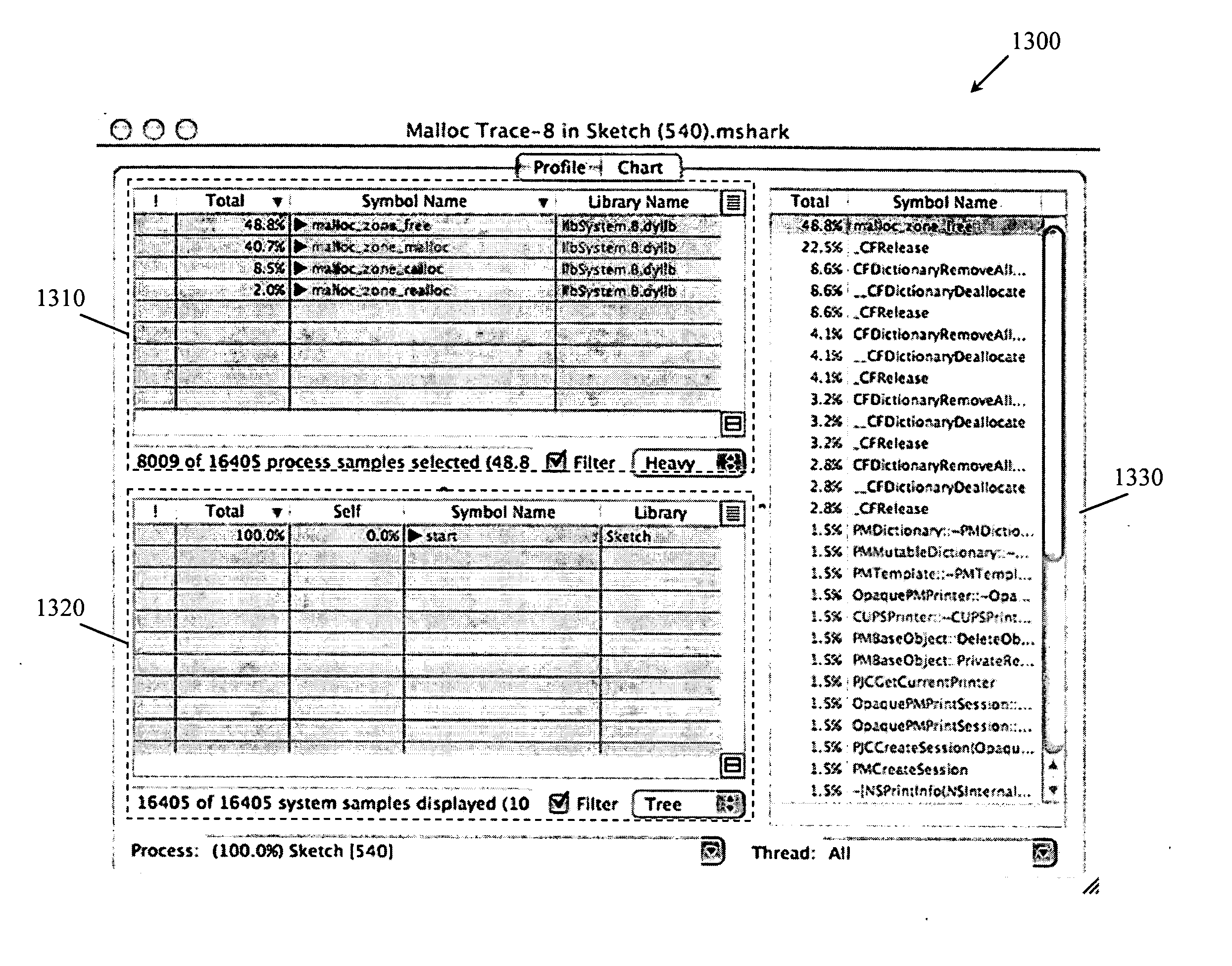
  • Figure 1
    Figure 1
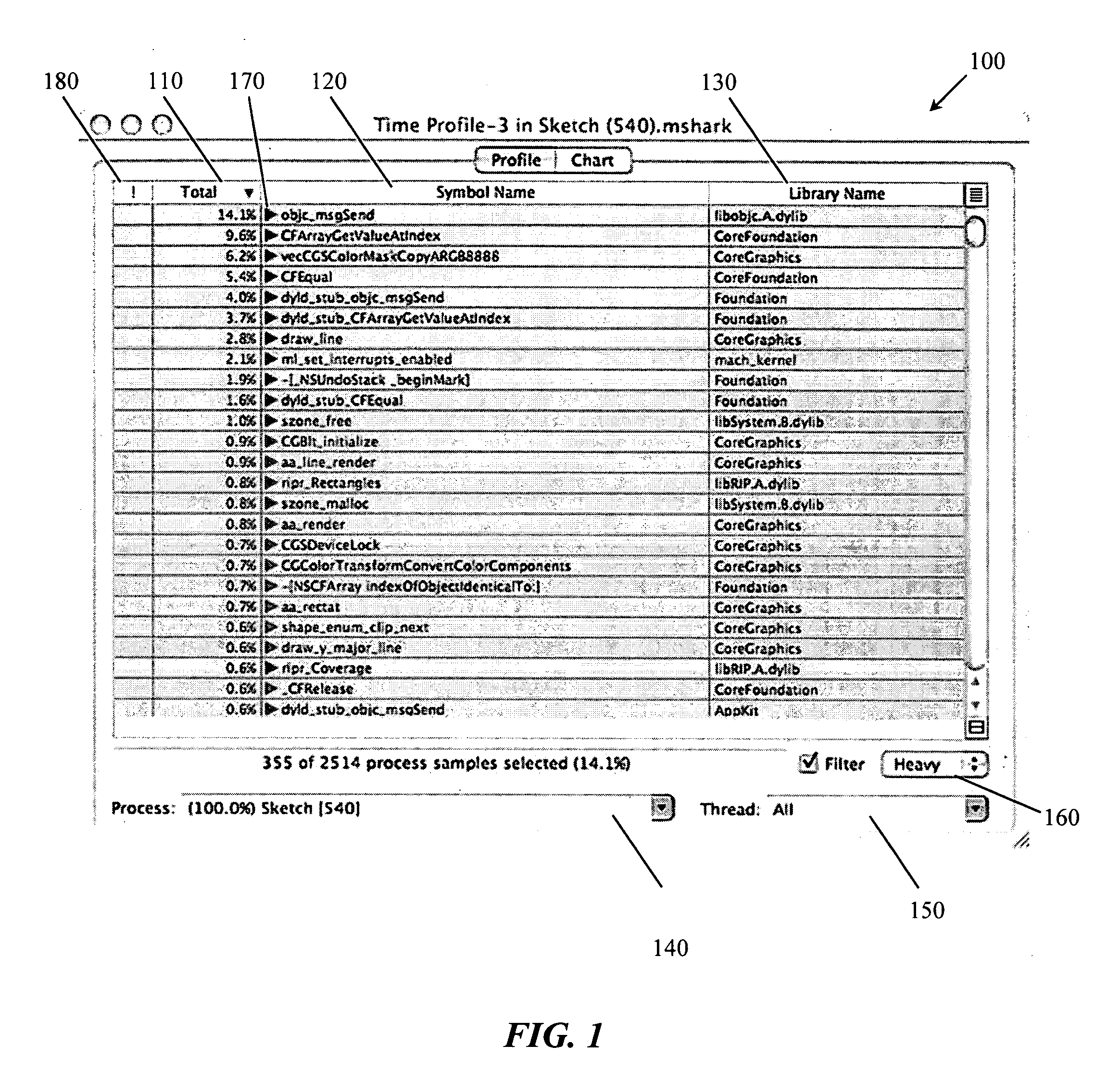
  • Figure 2
    Figure 2
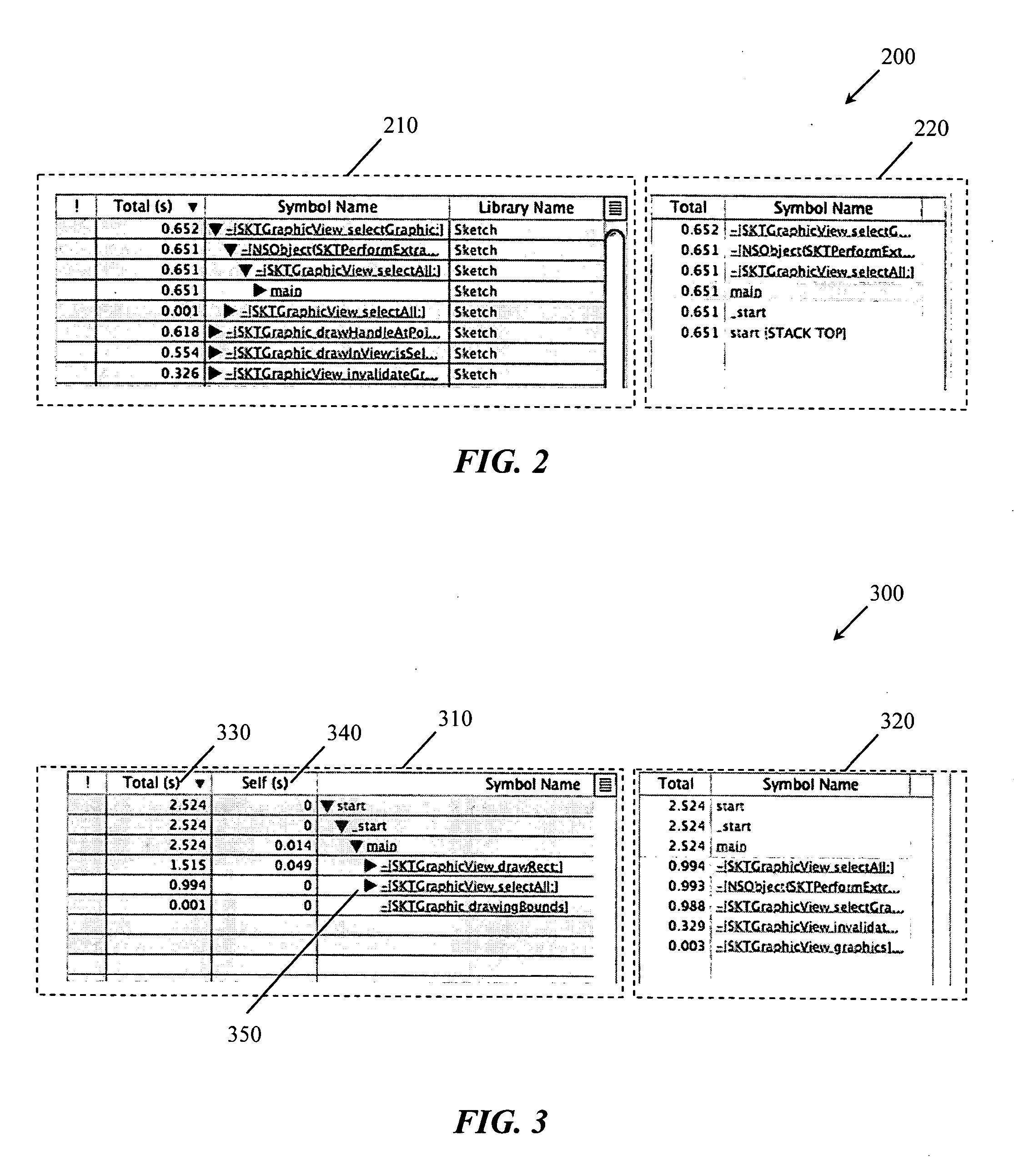
  • Figure 3
    Figure 3
Patent Text Reader

Abstract

A system, method, and computer program for analyzing code execution and software performance characteristics are disclosed. Samples of code during run-time can be displayed as both a top-down tree of calls from a particular function and a bottom-up tree of calls to the particular function. Data mining techniques, including filtering and focusing, remove code that is not of interest and display code that is more relevant to performance analysis. In particular, functions contained in libraries such as system libraries can be stripped from view. The cost associated with an excluded function can be propagated to a calling function, in either the top-down or bottom-up tree. The principles of the present invention can find particular usefulness with respect to analyzing crashlogs.
Need to check novelty before this filing date? Find Prior Art

Description

BACKGROUND OF THE INVENTION

[0001] 1. Field of the Invention

[0002] The present invention relates generally to analyzing software performance, and more particularly, to a system, method, and program for analyzing code execution in order to analyze and improve software performance by rapidly identifying of areas of code based on cost and use, and which may be candidates for optimization.

[0003] 2. Related Art

[0004] Performance is an important aspect of software design. If an application does not perform well, users will not likely want to use that application. Performance is a subjective term referring to the general way in which something operates. Performance may include how efficiently system resources (e.g., CPU, memory, and hard disk drive) are used. There are aspects of performance, including but not limited to speed, memory footprint, memory turnover, memory usage, file-system usage, etc., that can be measured. Improving on these measurements increases the efficiency of the s...

Examples

Embodiment Construction

[0025] When processes are running on a computer system, the processes and the system's CPU and memory can be “sampled” when various events occur at runtime. Samples may be taken, for example, based on a specified time interval (time-based sampling). Samples may also be taken based on a specified function call (function call sampling). For example, samples may be taken based on a memory allocation call (memory allocation sampling). Samples may also be taken based on a cross-library call. Samples may also be taken based on a specified hardware or operating system (“OS”) event such as a cache miss or instruction stall, etc. (event sampling). In addition, CPU performance counters can be used to trigger samples. Memory controller performance counters can also be used to trigger samples. Processor interface bus counters may also be used to trigger samples. OS performance counters pertaining to virtual memory behavior (e.g., page faults, zero-fill faults, and copy-on-write faults, etc.), s...