

Arrangement for remote-controlled release of active ingredients
a technology of remote control and active ingredients, which is applied in the direction of capsule delivery, pharmaceutical delivery mechanism, medical devices, etc., can solve the problems of limited alternating field output that can be converted into heat, risk that the toxically acting content comes into contact with the body tissue, and limited reliable release function
- Summary
- Abstract
- Description
- Claims
- Application Information
AI Technical Summary
Benefits of technology
Problems solved by technology
Method used
Image

Examples
Embodiment Construction
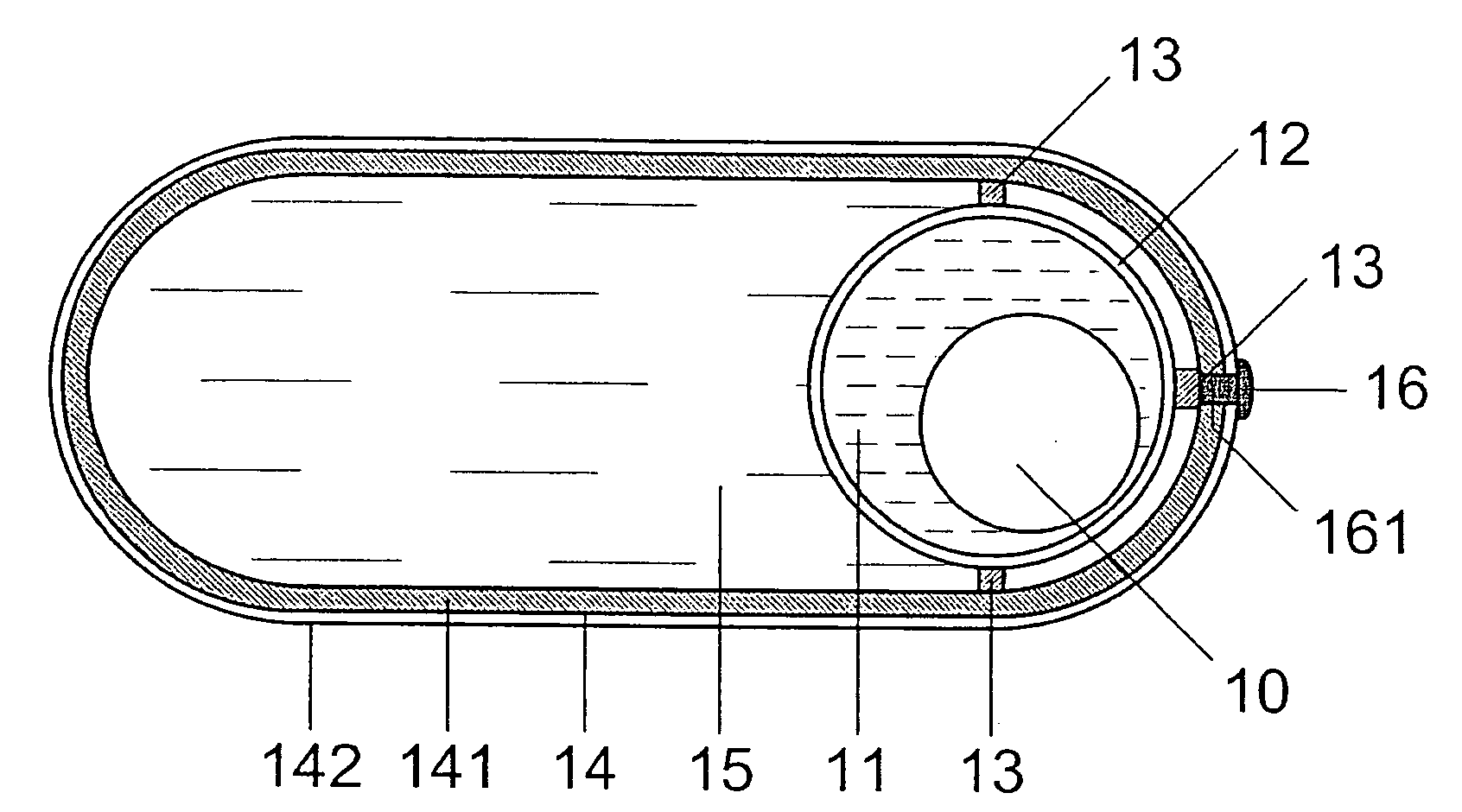
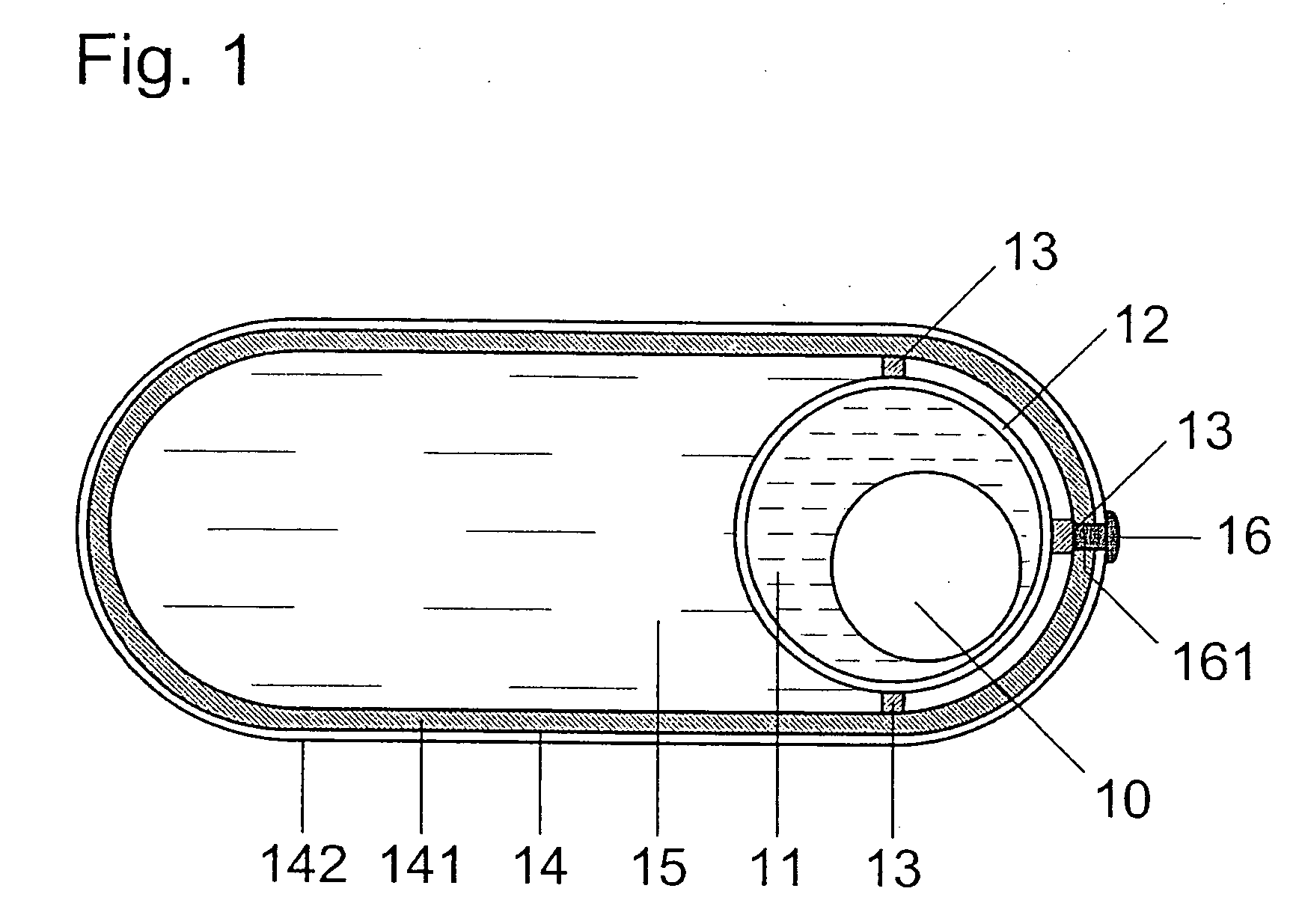
[0016] In FIG. 1, spherical rotor 10 with a diameter (Φ) of 5 mm is arranged in waterless fluid 11 of low viscosity in such a way that it can freely swim. Rotor 10, being a permanent-magnetic body, consists of about 50 Vol % Fe3O4 with a coercive force of HC>>30 kA / m and of about 50 Vol % gelatin. It is also possible to use g-Fe2O3 instead of Fe3O4 and another atoxic, water-soluble substance (e.g. sugar) instead of gelatin. Fluid 11 is a silicone oil with a viscosity of h=(1 . . . 10)×10−3 N×s / m2. Edible oil with a low viscosity can also be used instead of silicone oil. Fluid 11 is included in hollow sphere 12 which is manufactured from hard gelatin or another atoxic, water-soluble substance, e.g. sugar, and has an inner diameter of Φi=7.6 mm and an outer diameter of Φa=8.0 mm.
[0017] Hollow sphere 12, which can consist of two or more closely connected parts, is firmly linked to an oval or longish capsule 14 via holders 13 and is supported in said capsule that is filled with suitabl...
PUM
 Login to View More
 Abstract
Description
Claims
Application Information
 Login to View More