Because passive tags do not have a durable power source, they do not include active
semiconductor circuitry and must therefore maintain data and state information statically within its
embedded memory.
In addition, passive tags have an essentially unlimited
life span, while the
life span of active tags is typically limited by the lifetime of the internal battery, which in some implementations may be replaceable.
However, the conventional RFID systems described above have a number of drawbacks.
For an RFID system that includes a single RFID reader, the penetration ability of the reader is typically limited by the reader's maximum transmit power.
It may therefore be virtually impossible to infer the actual interrogation zone of the reader directly from the reader's transmission and reception settings and the transmission / reception capabilities of the tags.
Moreover, the interrogation zone of an RFID reader often fails to match the space that needs to be monitored in the RFID application.
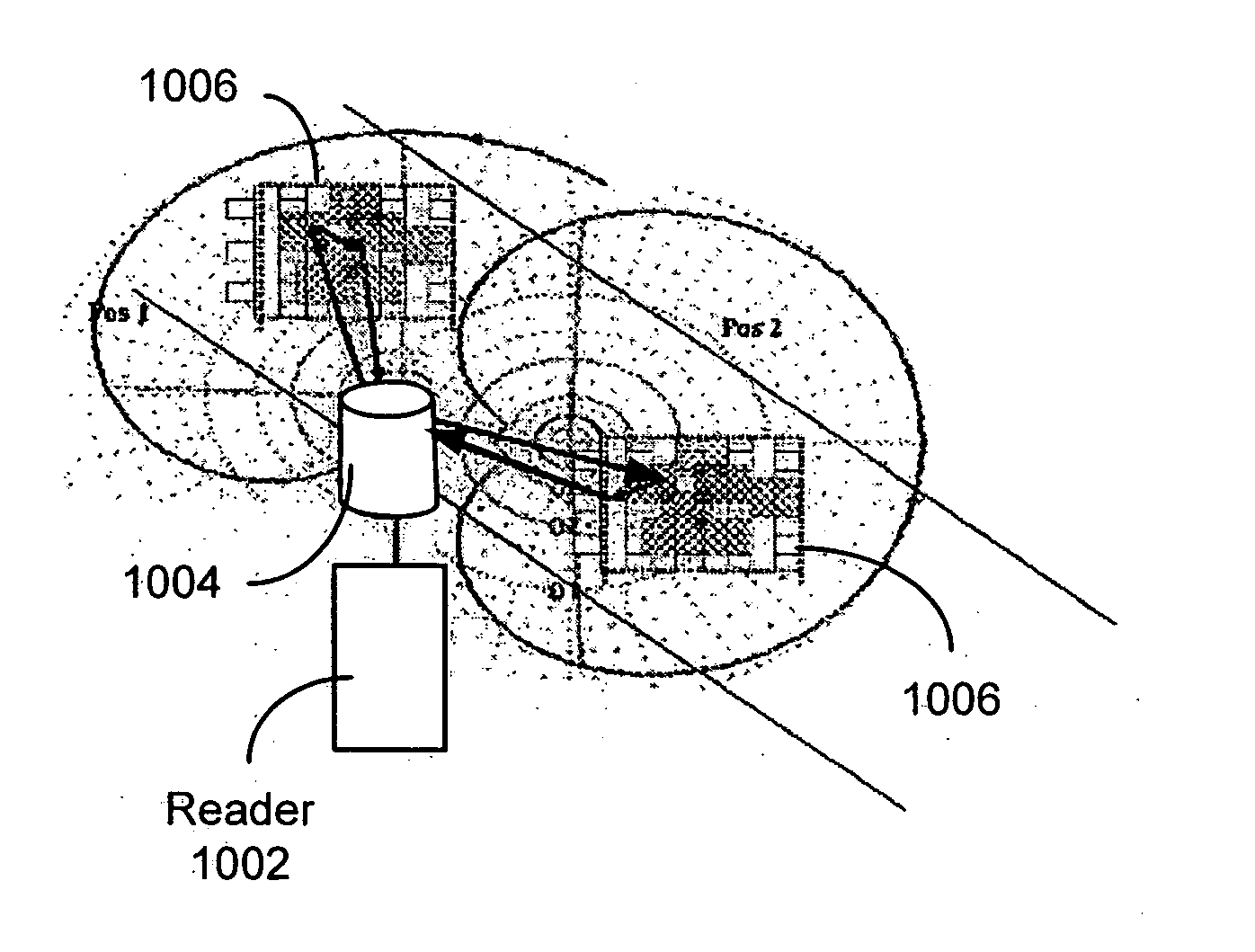
In addition, the conventional RFID system employing a single RFID reader is generally incapable of determining the location and / or direction of a moving RFID tag with precision.
For example, in the event an RFID tag is attached to a
forklift truck at a warehouse storage facility, a single RFID reader may be unable to determine whether the forklift is leaving or entering the facility at it passes the reader, which may be disposed at a dock bay.
Conventional RFID systems that employ multiple RFID readers also have drawbacks.
However, such dense deployments of RFID readers are problematic due to RF interference and potentially conflicting channel assignments of the readers.
Significant RF interference may also occur when readers operate on adjacent channels.
Even if multiple readers operate on channels sufficiently far apart to avoid reader-to-reader interference, reader-to-tag interference may still occur since RFID tags are
broadband devices capable of receiving RF transmissions from more than one reader at a time, which can confuse the tag circuitry.
In addition, when multiple RFID readers are deployed within a conventional RFID system, the system is typically incapable of successfully coordinating the operation of the readers.
Further, each of the multiple readers is limited in time and frequency usage to the transaction paradigms typically employed by conventional standalone readers.
For example, each reader may only have access to its own information, and may therefore be unable to react to events detected by the other readers within the system.
As a result, the multiple readers are generally incapable of managing the large amount of potentially redundant information collected by the readers from the same group of tags within the same environment over an extended period of time.
Further, such conventional systems are generally unable to discriminate between significant events and essentially meaningless movements of items and / or individuals within the RFID environment.
Moreover, such conventional systems are generally incapable of keeping track of the various locations and functions of the many readers deployed within the environment, and assuring that all of the readers within the system are properly maintained and operational.


 Login to View More
  Login to View More