Unlock instant, AI-driven research and patent intelligence for your innovation.

Differential clock transmission apparatus, differential clock sending apparatus, differential clock receiving apparatus and differential clock transmission method

Inactive Publication Date: 2006-06-01
FUJITSU LTD
View PDF4 Cites 4 Cited by
  • Summary
  • Abstract
  • Description
  • Claims
  • Application Information

AI Technical Summary

Benefits of technology

[0011] In view of the above-identified problem, it is therefore the object of the present invention to provide a differential clock transmission apparatus, a differential clock sending apparatus, a differential clock receiving apparatus and a differential clock transmission method that can reduce duty distortions and phase shifts due to a high frequency long distance transmission.
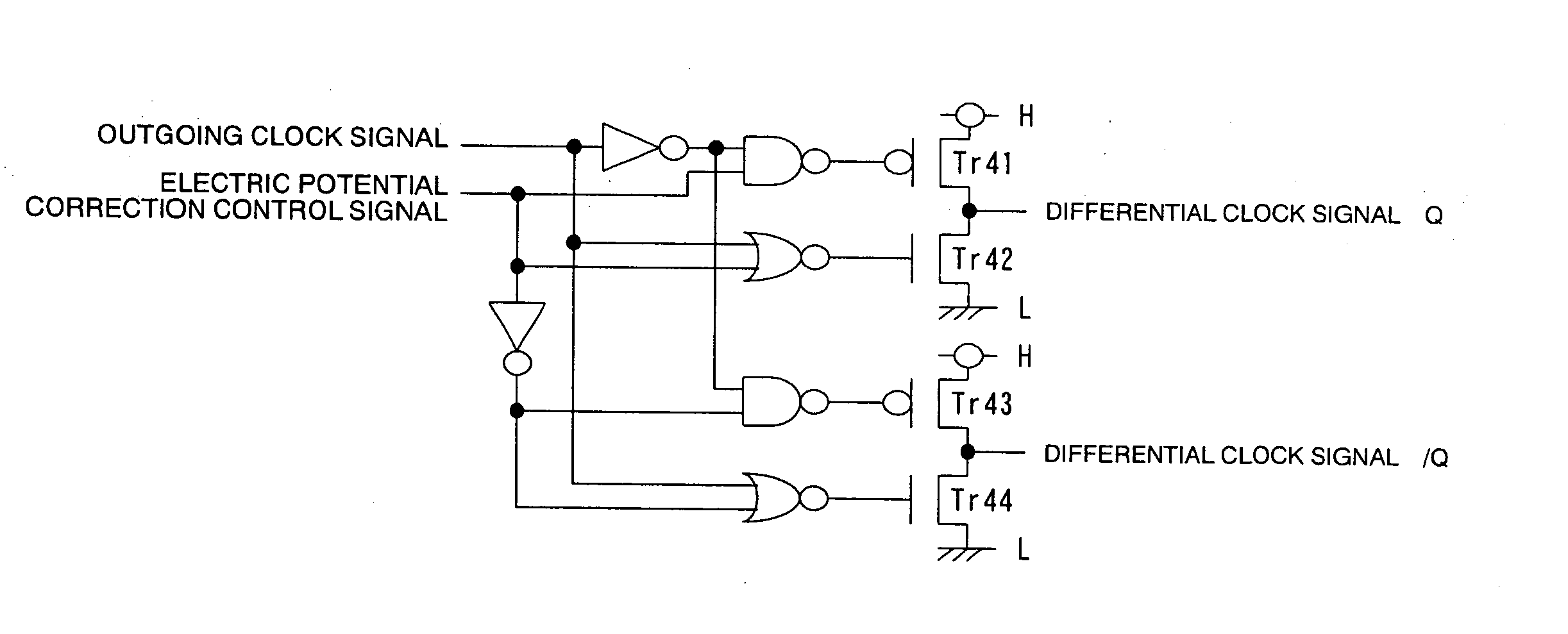
[0012] In an aspect of the present invention, the above object is achieved by providing a differential clock transmission apparatus adapted to convert an outgoing clock signal into a pair of differential clock signals for transmission and also convert a pair of differential clock signals into a single incoming clock signal, the apparatus comprising: a control section that specifies an electric potential correction period that is a predetermined period before utilizing the incoming clock signal; a differential clock sending section that converts a single outgoing clock signal into a pair of differential clock signals; an electric potential correcting section that reduces the potential difference of the pair of differential clock signals within the electric potential correction period; and a differential clock signal receiving section that converts a pair of differential clock signals into a single incoming clock signal.
[0016] In another aspect of the present invention, there is provided a differential clock sending apparatus adapted to convert an outgoing clock signal into a pair of differential clock signals and send them to an outside apparatus, the apparatus comprising: a control section that specifies an electric potential correction period that is a predetermined period before the outside apparatus utilizes the differential clock signals; a differential clock sending section that converts a single outgoing clock signal into a pair of differential clock signals; and an electric potential correcting section that reduces the potential difference of the pair of differential clock signals within the electric potential correction period.
[0018] In a further aspect of the present invention, there is provided a differential clock transmission method adapted to convert an externally input outgoing clock signal into a pair of differential clock signals for transmission and also convert a pair of differential clock signals into a single incoming clock signal, the method comprising: specifying an electric potential correction period that is a predetermined period before utilizing the incoming clock signal; converting a single outgoing clock signal into a pair of differential clock signals; reducing the potential difference of the pair of differential clock signals within the electric potential correction period; and converting a pair of differential clock signals into a single incoming clock signal.
[0019] Preferably, in a differential clock transmission method according to the invention, the electric potential difference is reduced by connecting the signal lines of the pair of differential clock signals during the electric potential correction period.
[0022] Thus, according to the invention, it is possible to stabilize the duty and the phase of the waveform of each of the differential clock signals and avoid problems such as a shifted timing and a lost clock immediately after the start of the clock without increasing the circuit size and the cost.

Problems solved by technology

However, in the case of long distance transmission of a high frequency differential clock, the waveforms of the differential clock signals are attenuated due to a high frequency loss at the time of signal propagation.
Then, the differential clock signals are transposed only shallowly to give rise to duty distortions and phase shifts.
However, the above described known countermeasure technique is accompanied by various problems including high cost, the use of a complex circuit, a large area required for mounting the circuit and so on.

Method used

the structure of the environmentally friendly knitted fabric provided by the present invention; figure 2 Flow chart of the yarn wrapping machine for environmentally friendly knitted fabrics and storage devices; image 3 Is the parameter map of the yarn covering machine
View more

Image

Smart Image Click on the blue labels to locate them in the text.
Viewing Examples
Smart Image
  • Differential clock transmission apparatus, differential clock sending apparatus, differential clock receiving apparatus and differential clock transmission method
  • Differential clock transmission apparatus, differential clock sending apparatus, differential clock receiving apparatus and differential clock transmission method
  • Differential clock transmission apparatus, differential clock sending apparatus, differential clock receiving apparatus and differential clock transmission method

Examples

Experimental program
Comparison scheme
Effect test

first embodiment

[0038] In this embodiment, the signal sending side is adapted to correct electric potentials. FIG. 1 is a schematic block diagram of the first embodiment of differential clock transmission apparatus according to the present invention, showing the configuration thereof. In FIG. 1, the components that are identical with or equivalent to the corresponding ones of FIG. 12 are denoted respectively by the same reference symbols and will not be described here any further. By comparing with the differential clock transmission apparatus of FIG. 12, it will be seen that the differential clock transmission apparatus of FIG. 1 comprises a clock sending side LSI 1 in place of the clock sending side LSI 901 of FIG. 12 and a clock receiving side LSI 2 in place of the clock receiving side LSI 902 of FIG. 12. By comparing with the clock sending side LSI 901 of FIG. 12, it will also be seen that the clock sending side LSI 1 of FIG. 1 additionally has an electric potential correcting section 14 and al...

second embodiment

[0046] In this embodiment, the electric potential correcting operation is conducted by the receiving side to obtain advantages similar to those of the first embodiment. FIG. 7 is a schematic block diagram of the second embodiment of differential clock transmission apparatus according to the invention, showing the configuration thereof. In FIG. 7, the components that are identical with or equivalent to the corresponding ones of FIG. 1 are denoted respectively by the same reference symbols and will not be described here any further. By comparing with the differential clock transmission apparatus of FIG. 1, it will be seen that the differential clock transmission apparatus of FIG. 7 comprises a clock sending side LSI 101 in place of the clock sending side LSI 1 and a clock receiving side LSI 102 in place of the clock receiving side LSI 2.

[0047] By comparing with the clock sending side LSI 1, it will be seen that the clock sending side LSI 101 of FIG. 7 has a sending control section 11...

third embodiment

[0048] In this embodiment, while the electric potential correcting operation is conducted by the sending side, the sending side is so configured as to have both the function of converting an outgoing clock signal into a pair of differential clock signals and the electric potential correcting function to obtain advantages similar to those of the above described embodiments. FIG. 8 is a schematic block diagram of the third embodiment of differential clock transmission apparatus according to the invention, showing the configuration thereof. In FIG. 8, the components that are identical with or equivalent to the corresponding ones of FIG. 1 are denoted respectively by the same reference symbols and will not be described here any further. By comparing with the differential clock transmission apparatus of FIG. 1, it will be seen that the differential clock transmission apparatus of FIG. 8 comprises a clock sending side LSI 201 in place of the clock sending side LSI 1 and a clock receiving ...

the structure of the environmentally friendly knitted fabric provided by the present invention; figure 2 Flow chart of the yarn wrapping machine for environmentally friendly knitted fabrics and storage devices; image 3 Is the parameter map of the yarn covering machine
Login to View More

PUM

No PUM Login to View More

Abstract

A differential clock transmission apparatus is adapted to convert an outgoing clock signal into a pair of differential clock signals for transmission and also convert a pair of differential clock signals into a single incoming clock signal and comprises a sending control section 11 that specifies an electric potential correction period that is a predetermined period before utilizing the incoming clock signal, a differential clock sending section 13 that converts a single outgoing clock signal into a pair of differential clock signals, an electric potential correcting section 14 that reduces the potential difference of the pair of differential clock signals within the electric potential correction period and a differential clock signal receiving section 22 that converts a pair of differential clock signals into a single incoming clock signal.

Description

BACKGROUND OF THE INVENTION [0001] 1. Field of the Invention [0002] This invention relates to a differential clock transmission apparatus, a differential clock sending apparatus, a differential clock receiving apparatus and a differential clock transmission method for transmitting a high frequency clock. [0003] 2. Description of Related Art [0004] Differential clock transmission is used in computer systems using a high frequency clock. Differential clock transmission is an operation of transmitting a pair of differential clock signals showing polarities that are inverted relative to each other by way of a pair of wires. Differential clock transmission is characterized by a strong anti-noise effect. FIG. 12 is a schematic block diagram of a known differential clock transmission apparatus, showing its configuration. Referring to FIG. 12, the illustrated known differential clock transmission apparatus comprises a clock sending side LSI 901 and a clock receiving side LSI 902. The clock ...

Claims

the structure of the environmentally friendly knitted fabric provided by the present invention; figure 2 Flow chart of the yarn wrapping machine for environmentally friendly knitted fabrics and storage devices; image 3 Is the parameter map of the yarn covering machine
Login to View More

Application Information

Patent Timeline
no application Login to View More
IPC IPC(8): G06F1/04
CPCG06F1/10H03K5/003H03K5/151
Inventor MIZUTANI, YASUSHI
Owner FUJITSU LTD