
Display panel, display device equipped with the same, and display device manufacturing method
a technology for display devices and display panels, applied in non-linear optics, instruments, optics, etc., can solve problems such as insufficient removal of shorting interconnections, line defects, and shorting, and achieve the effect of increasing manufacturing costs, easy and precisely measuring the amount of beveling
- Summary
- Abstract
- Description
- Claims
- Application Information
AI Technical Summary
Benefits of technology
Problems solved by technology
Method used
Image

Examples
first preferred embodiment
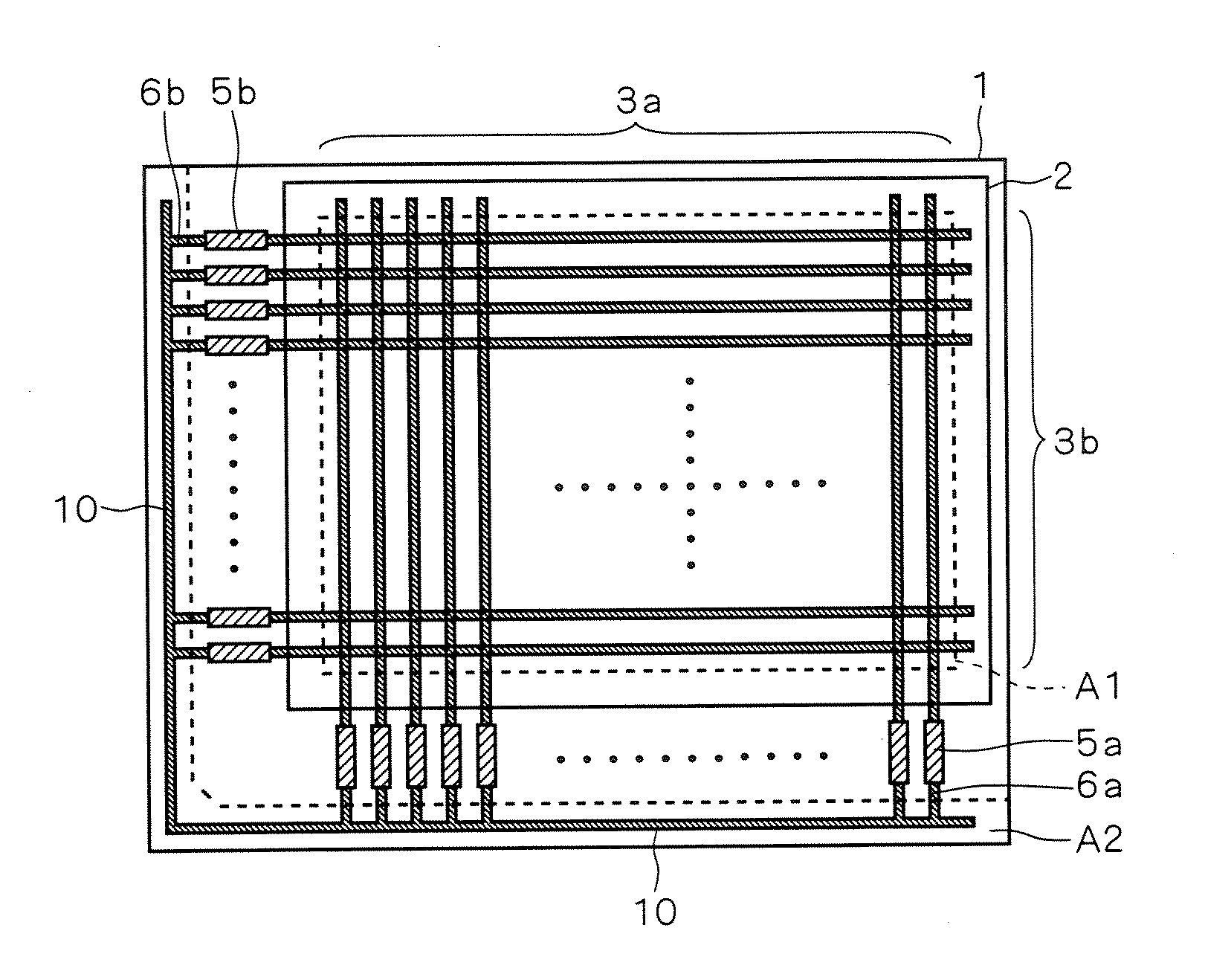
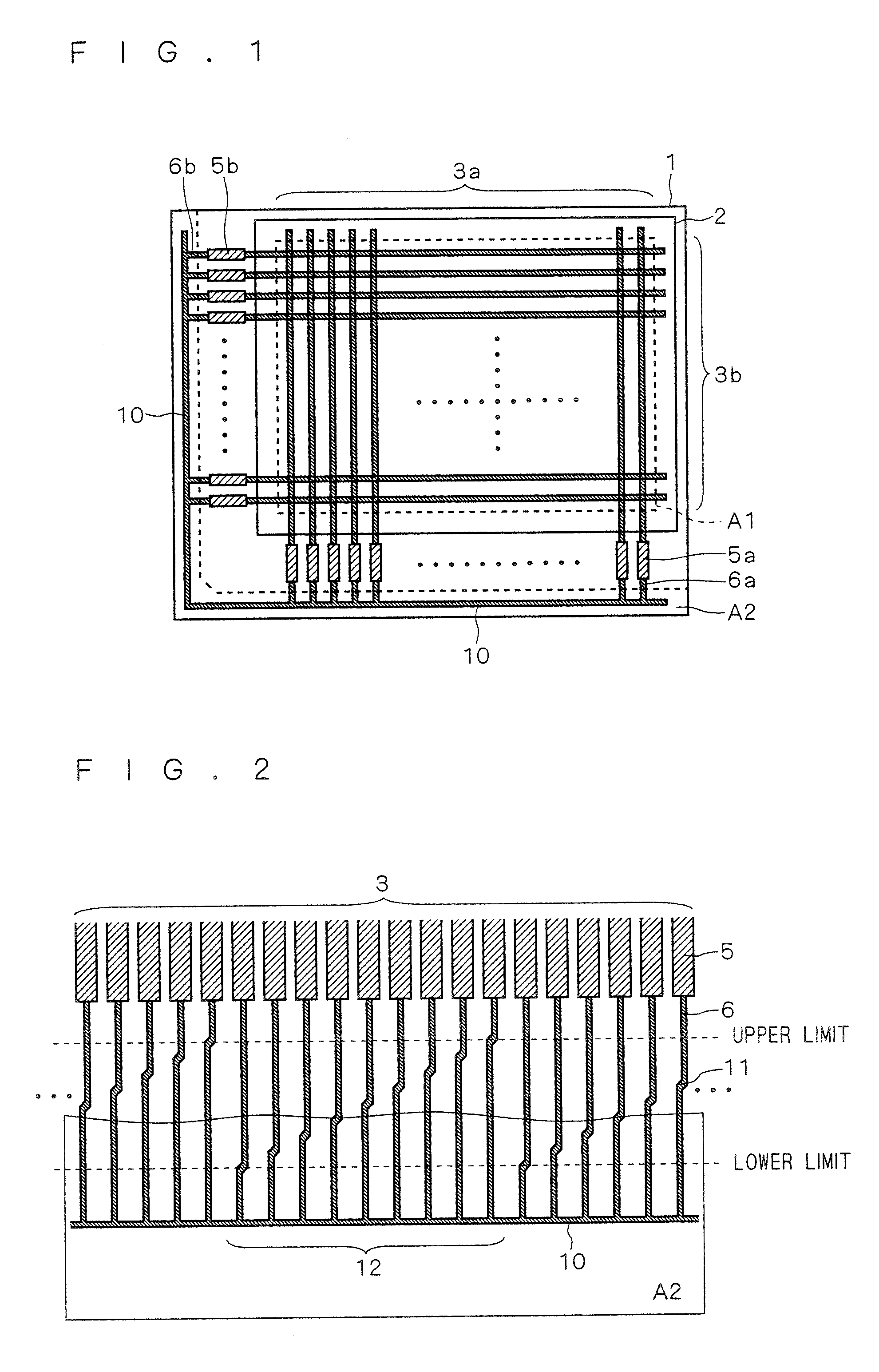
[0023] The structure of a display device according to a preferred embodiment will now be described. The description herein shows a TFT liquid-crystal display device as a display device to which the present invention is applied. FIG. 1 is a plan view of a display panel (liquid-crystal panel) of the display device of the invention. FIG. 1 shows the display panel from which a shorting interconnection has not yet been removed. The beveled area A2 including the shorting interconnection 10 shown in FIG. 1 is removed by beveling when the display panel is attached to the display device (for example, before an image inspection process).
[0024] This display panel includes a first substrate 1 and a second substrate 2 sandwiching liquid crystal as display material. On the first substrate 1, a plurality of parallel signal interconnections 3a and a plurality of parallel scanning interconnections 3b are formed. The signal interconnections 3a and the scanning interconnections 3b are arranged so tha...
second preferred embodiment
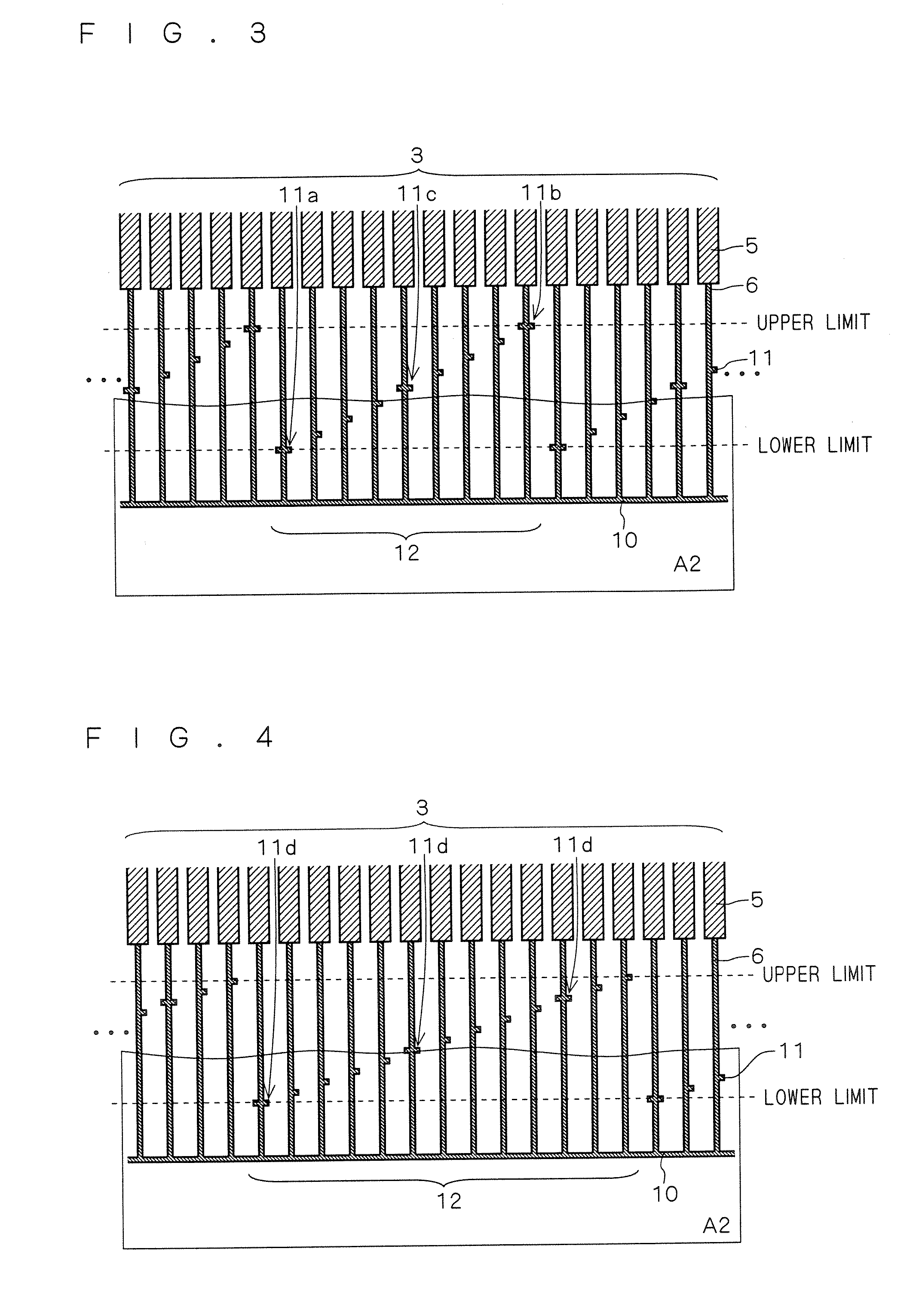
[0042]FIG. 3 is a diagram used to describe the structure of a display device according to a second preferred embodiment of the present invention. FIG. 3 is an enlarged view showing a beveled area A2 and its vicinity along an edge of the display panel. In FIG. 3, the elements having the same functions as those of FIGS. 1 and 2 are shown at the same reference characters. As shown in FIG. 3, the structure of the display device of this preferred embodiment differs from that of the first preferred embodiment (FIG. 2) in the shape of the marks 11. The structures are the same in other respects.
[0043] As shown in FIG. 3, the marks 11 are provided only in the region between the upper limit and lower limit positions of beveling (within a specified range). That is, among the marks 11, the one located in the outermost position on the first substrate 1 (the mark 11a) corresponds to the lower limit position and the innermost one (the mark 11b) corresponds to the upper limit position. In this pre...
third preferred embodiment
[0047]FIG. 4 is a diagram used to describe the structure of a display device according to a third preferred embodiment of the present invention. FIG. 4 is an enlarged view showing a beveled area A2 and its vicinity along an edge of the display panel. In FIG. 4, too, the elements having the same functions as those of FIGS. 1 and 2 are shown at the same reference characters. As shown in FIG. 4, the structure of the display device of this preferred embodiment differs from that of the first preferred embodiment (FIG. 2) in the shape of the marks 11. For convenience of description, the unit cycle pattern 12 of FIG. 4 includes an increased number of, 13, interconnections 3.
[0048] As shown in FIG. 4, the marks 11 are provided only in the region between the upper limit and lower limit positions of beveling (within a specified range). In this preferred embodiment, in the unit cycle pattern 12, marks 11 (marks 11d) of particular interconnections 3 separated by a given number of interconnecti...
PUM
 Login to View More
 Abstract
Description
Claims
Application Information
 Login to View More