
Polymerization catalysts and process for producing bimodal polymers in a single reactor
a polymerization catalyst and polymerization technology, applied in the direction of catalyst activation/preparation, physical/chemical process catalysts, chemical/physical processes, etc., can solve the problems of conventional processes not producing items with high stiffness and high escr, and achieve excellent impact strength, excellent stability, and excellent stability.
- Summary
- Abstract
- Description
- Claims
- Application Information
AI Technical Summary
Benefits of technology
Problems solved by technology
Method used
Image

Examples
example 1
Room Temperature Synthesis of Zr[η-C5H4-(nBu)]Cl3
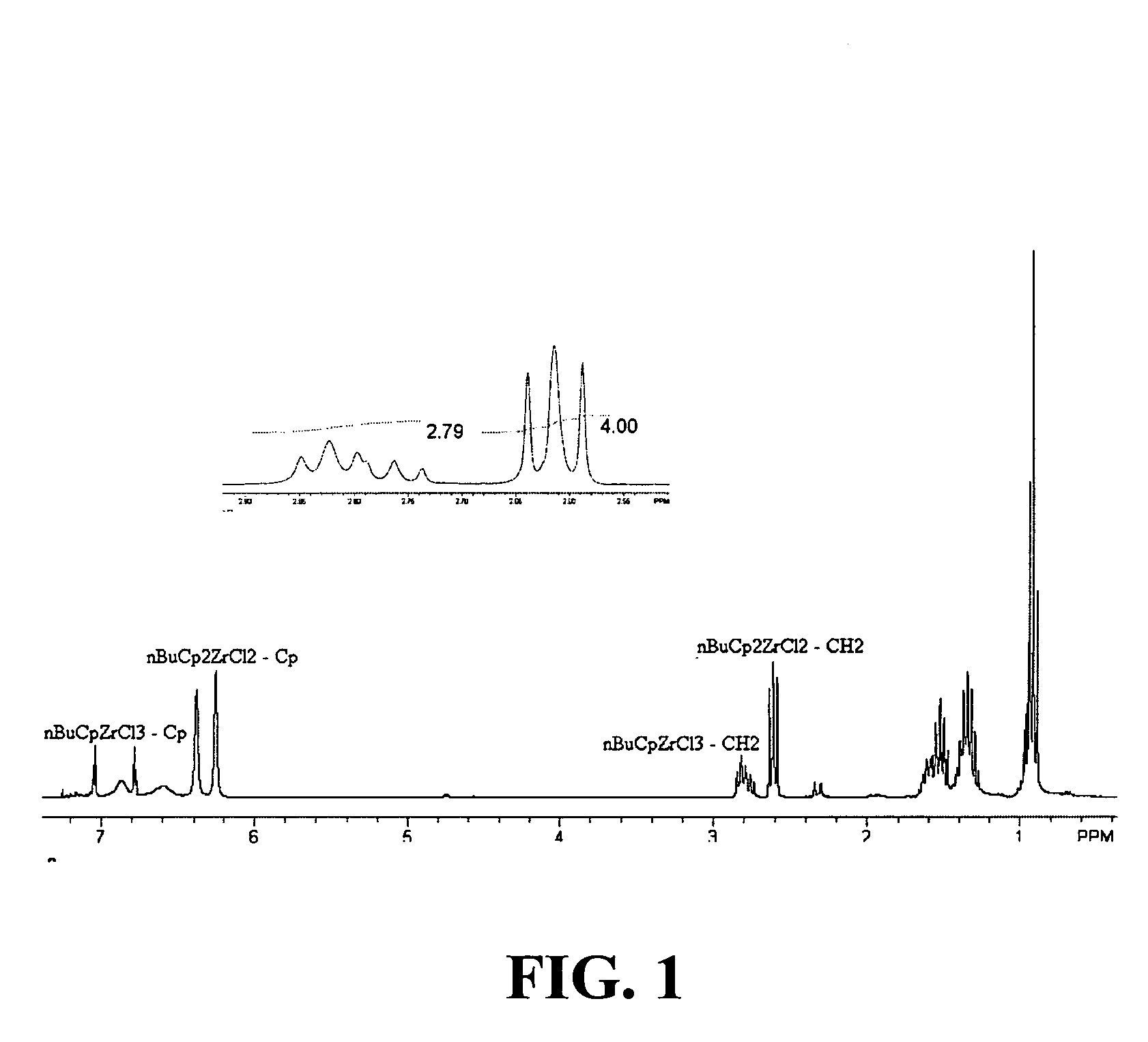
[0201] Zr[η-C5H4-(nBu)]Cl3 was prepared as described in Example 2, except that the refluxing step was omitted. Instead, the (n-BuCp)2ZrCl2 and ZrCl4 mixture was stirred at ambient temperature for 20 hrs. FIG. 1 presents the NMR spectrum for the Zr[η-C5H4-(nBu)]Cl3 formed according to Example 1. The molar ratio obtained for the product Zr[η-C5H4-(nBu)]Cl3 to starting material (n-BuCp)2ZrCl2 was 1.4:1.
example 2
Inventive Preparation of Zr[η-C5H4-(nBu)]Cl3
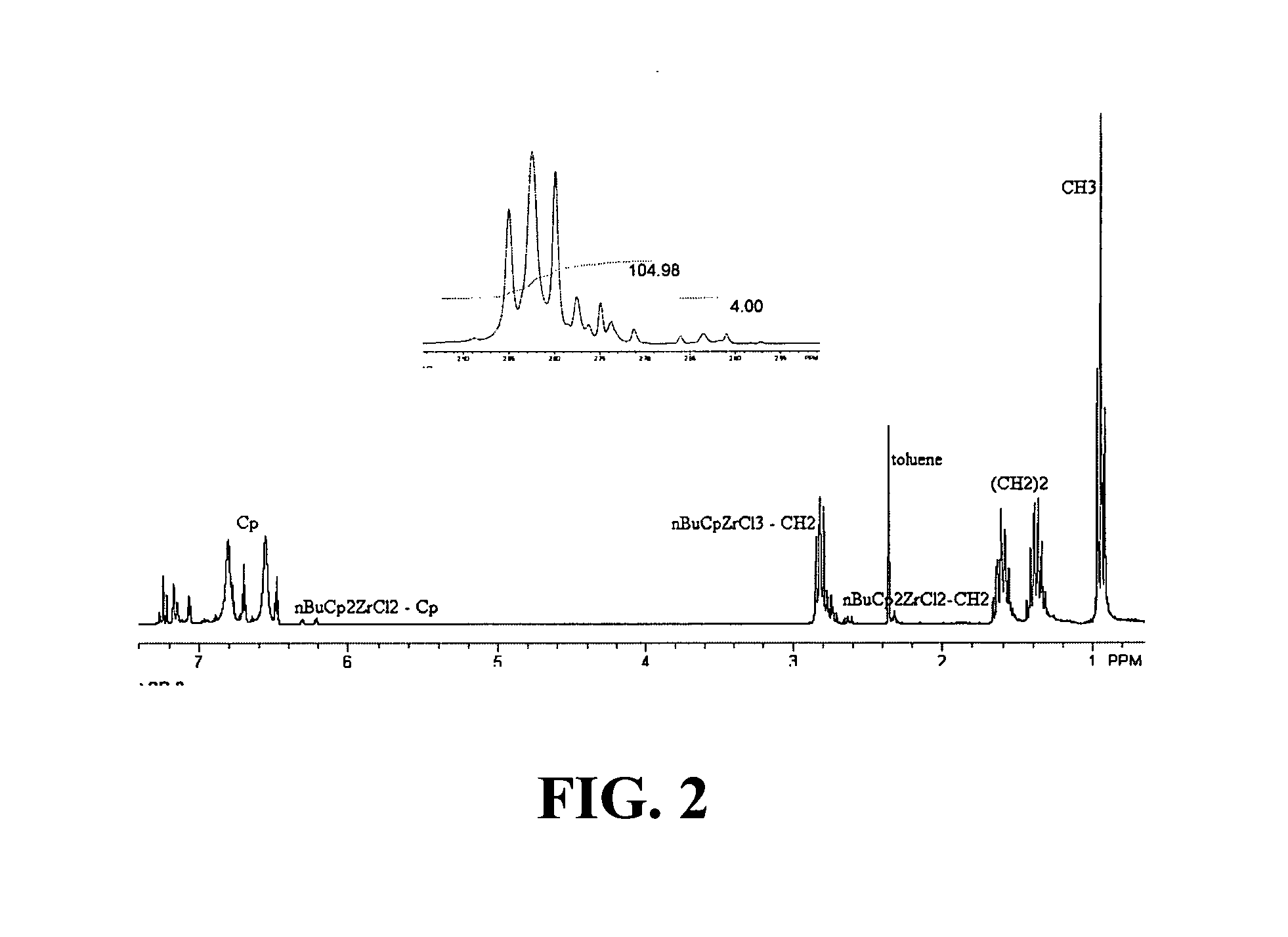
[0202] A 500 mL Schlenk flask was charged with (n-BuCp)2ZrCl2 (20.0 g, 49.4 mmol), ZrCl4 (12.7 g, 54.4 mmol), 300 mL of toluene and a stir bar. The resulting yellow slurry was refluxed under N2 for about 20 h. The dark brown-black reaction mixture was centrifuged to remove excess ZrCi4 and toluene was removed from the filtrate under reduced pressure to obtain a brown-black thick oil. The product was precipitated a couple of times with a CH2Cl2 / pentane mixture and vacuum-dried (0.1 mm, 1 h) to afford the desired product as a brown solid. (27 g, 87%). FIG. 2 presents the NMR spectrum for the Zr[η-C5H4-(nBu)]Cl3 formed according to Example 2. The molar ratio obtained for the product Zr[η-C5H4-(nBu)]Cl3 to starting material (n-BuCp)2ZrCl2 was 52:1. Thus, the method of making Zr[η-C5H4-(nBu)]Cl3 according to the present invention significantly improves the yield and selectivity of the reaction.
example 3
Preparation of Zr[η-C5H3-(nBu, Me)1,3]Cl3
[0203] A 500 mL Schlenk flask was charged with (1,3 Me,nBuCp)2ZrCl2 (20.0 g, 46.2 mmol), ZrCl4 (11.9 g, 50.7 mmol), 200 mL of toluene and a stir bar. Resulting yellow slurry was refluxed under N2 for about 20 h. Dark brown-black reaction mixture was centrifuged to remove excess ZrC4 and toluene was removed from the filtrate under reduced pressure to obtain a brown-black thick oil. The product was precipitated a couple of times with a CH2Cl2 / pentane mixture and vacuum-dried (0.1 mm, 1 h) to afford the desired product as a brown solid. (23 g, 76%). 1H NMR (CDCl3, δ) 0.94 (t, J=7.5 Hz, CH3), 1.62−1.31 (m, CH2(CH2)2CH3), 2.44 (s, CH3), 2.81−2.75 (m, CH2(CH2)2CH3), 6.24 (broad s, 1, C5H4), 6.45 (broad s, 2, C5H4).
PUM
| Property | Measurement | Unit |
|---|---|---|
| Temperature | aaaaa | aaaaa |
| Temperature | aaaaa | aaaaa |
| Time | aaaaa | aaaaa |
Abstract
Description
Claims
Application Information
 Login to View More