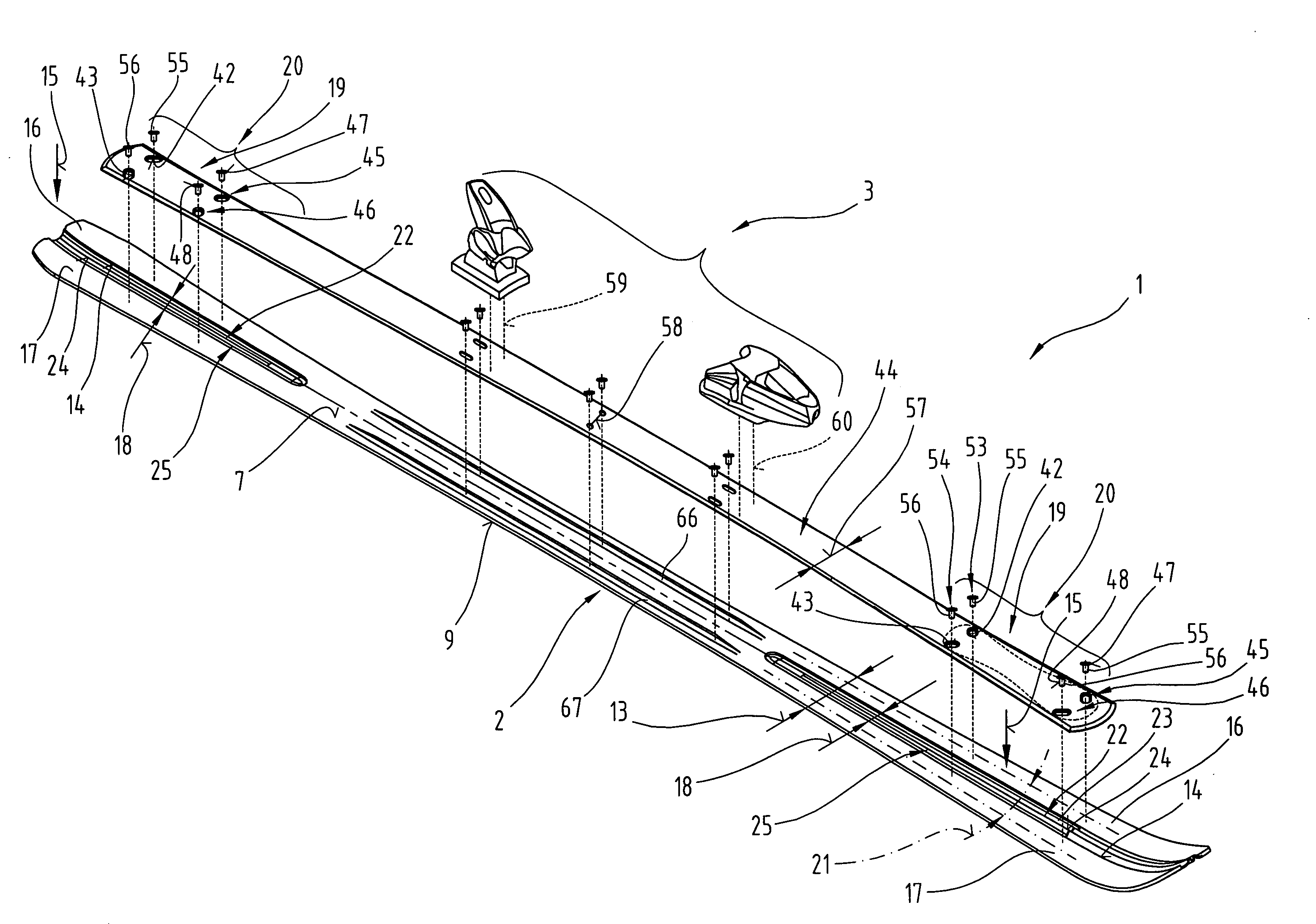
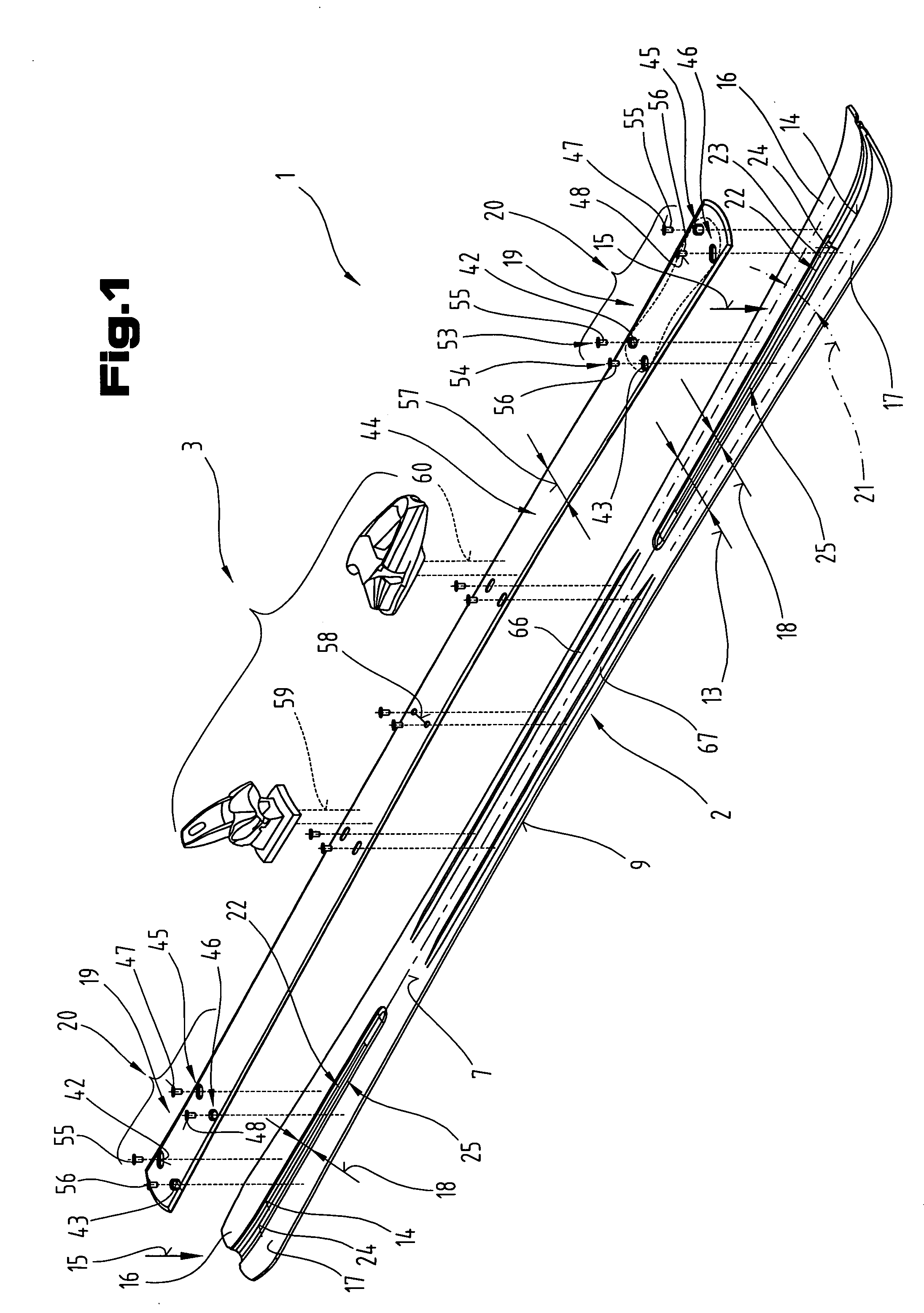
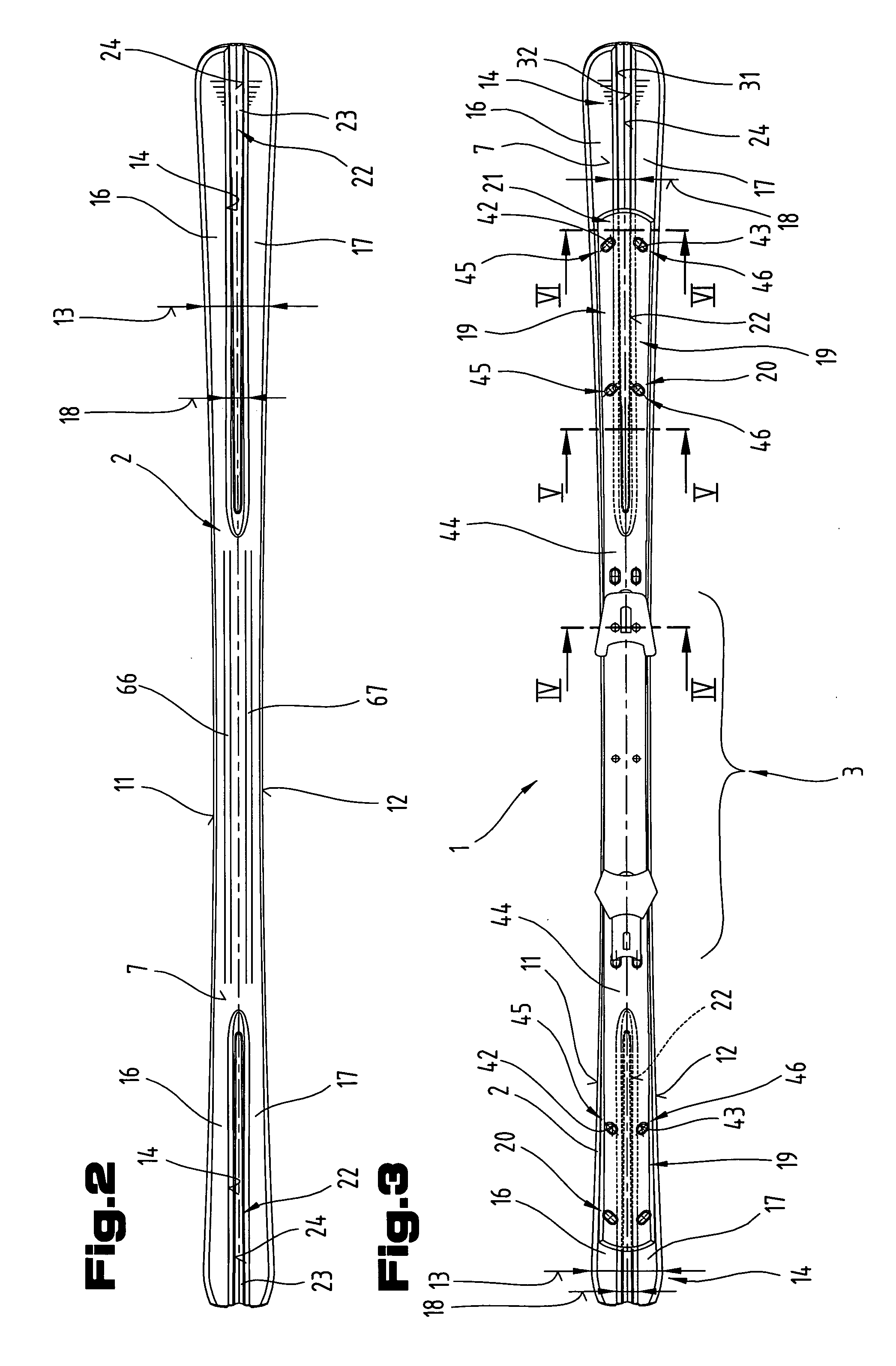
[0019]The underlying objective of this invention is to propose a ski or a snowboard, which has manually adjustable properties and / or travel properties which can be varied as a function of load, and the performance which can be achieved when using such a gliding board body is as high as possible. In particular, the intention is to produce improved turning behavior of a ski or snowboard with a side edge geometry or contour which can be varied.
[0020]This objective is achieved by the invention on the basis of a board-type gliding device incorporating the characterizing features defined in claim 1. The essential aspect is that the ski with a
variable geometry proposed by the invention or the snowboard with a
variable geometry proposed by the invention with a view to varying its travel properties offers significant advantages over board-type gliding devices with a
variable geometry known from the prior art. In particular, a ski or snowboard is obtained, the side edge geometry of which—and hence also its
travel behavior—varies or can be varied to a relatively pronounced degree as a function of the prevailing loads and / or as a function of individual requirements, but the claimed winter sports device nevertheless afford an excellent edge grip and tracking, which is especially important when turning or with a view to starting to turn correctly. In particular, the specified plate-type force-transmitting element imparts to the gliding board body exactly the desired stability or strength to enable
cut or so-called “carved” turns to be made in the
snow as safely and controllably as possible. The claimed board-type gliding device therefore gives the user the requisite, sufficiently high stability and imparts a high
controllability or guiding stability to the gliding device as a whole. Above all, as the load on the gliding device increases during a turning phase, the gliding board body in contact with the ground underneath unexpectedly flexes or virtually kinks, causing the board-type gliding device to suddenly assume a behavior that is difficult to control. In particular, a harmonious or uniform
turning action can be generated within a relatively
high load region of the gliding board body, which also increases personal safety when using the gliding board body proposed by the invention. The specified plate-type force-transmitting element therefore stabilizes the gliding board, the strength or stiffness of which is modified to a pronounced degree in certain portions by the slot, resulting in good
controllability and a conducive guiding behavior whilst nevertheless enabling a relatively wide-
ranging or pronounced change to be achieved in the contour, in other words the lateral shape of the gliding board body. In particular, the plate-type force-transmitting element prevents the gliding board slats
lying on either side of the slot from deviating from one another to an undesirable degree in the direction perpendicular to the running surface facing. The plate-type force-transmitting element also at least does not prevent the gliding board slats
lying on either side of the slot from moving closer to one another or apart from one another as desired or this is even assisted and / or effected by the plate-type force-transmitting element, thereby actively influencing the guiding behavior or degree of directional change when the contour of the ski or snowboard is influenced via the co-operating geometry-influencing means as a function of load.
[0021]As a result of the features defined in claim 2, the stabilizing and at the same time geometry-influencing function of the plate-type force-transmitting element is transmitted to correspondingly extensive longitudinal portions of the gliding board body. In particular, the multi-functional effect, i.e. the geometry-influencing and stabilizing effect, of the plate-type force-transmitting element acts on the gliding board body to a high degree without the need to provide structurally complex features.


 Login to View More
  Login to View More