
Robot with linearly movable support member attaching to gripper
- Summary
- Abstract
- Description
- Claims
- Application Information
AI Technical Summary
Benefits of technology
Problems solved by technology
Method used
Image

Examples
first embodiment
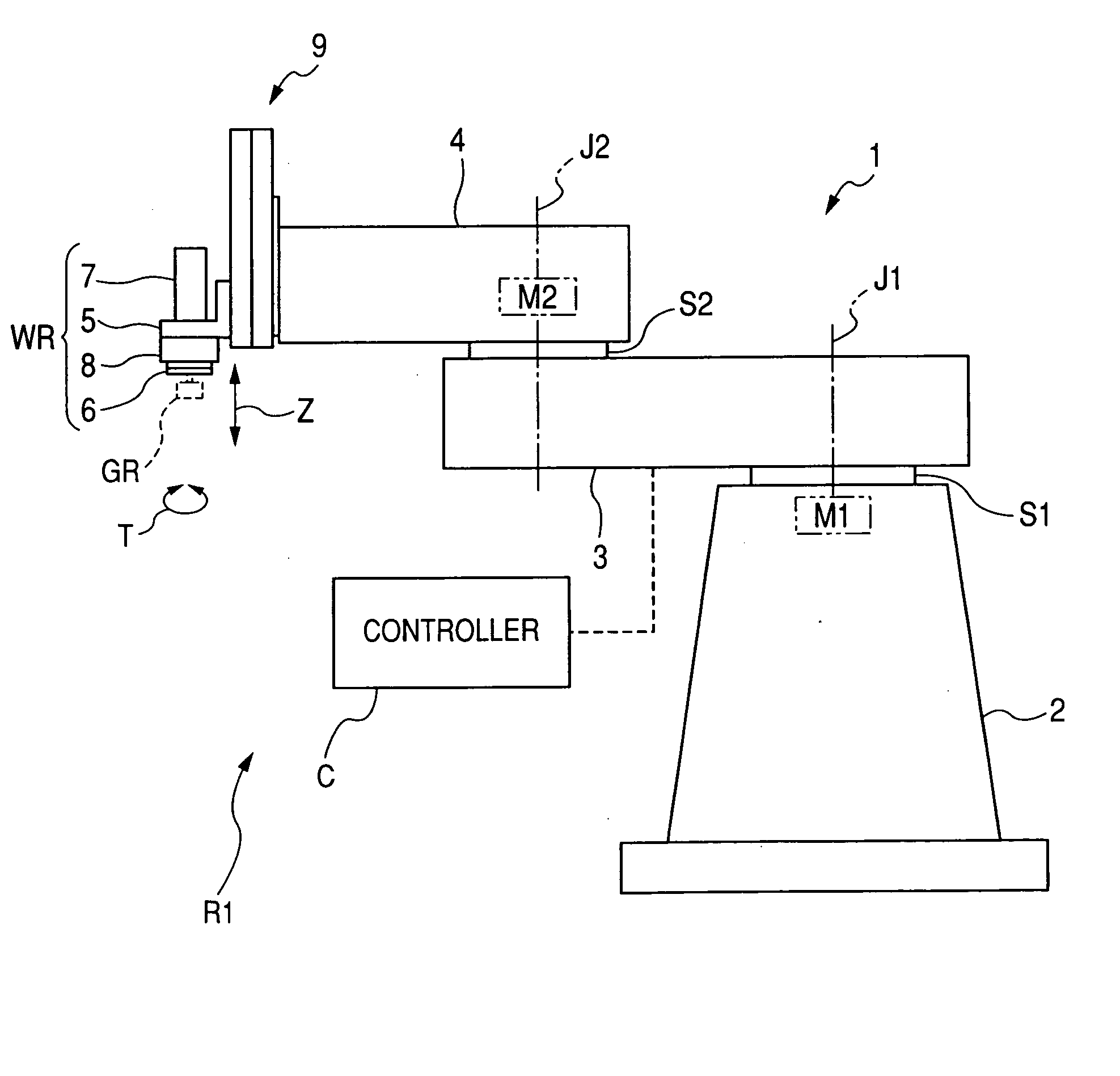
[0029]Referring to FIG. 1, there is illustrated an example of the overall structure of a SCARA robot R1 with four axes of movement according to the first embodiment of the present invention.
[0030]The SCARA robot R1 is equipped with a robot body 1 and a controller C for controlling action of the robot body 1.
[0031]The robot body 1 consists of a base 2 mounted on an installation surface, such as a flooring of a factory. The robot body 1 also consists of a shoulder joint S1, a first arm 3, an elbow joint S2, a second arm 4, a linearly movable support member 9, an elevating member 5, and a wrist unit WR.
[0032]The base 2 has a substantial truncated pyramid or circular truncated cone.
[0033]The shoulder joint S1 has a substantially cylindrical shape and is mounted in a top portion of the base 2 such that a center axis J1 of the shoulder joint S1 is parallel to a vertical axis of the base 2 substantial orthogonal to the installation surface.
[0034]The first arm 3 has one end (proximal end) p...
second embodiment
[0111]A robot according to the second embodiment of the present invention will be described hereinafter. The robot of the second embodiment has substantially the same structure as that of the robot R1 of the first embodiment except for some differences described hereinafter. For this reason, like reference characters are assigned to like parts in the robots according to the first and second embodiments so that descriptions of the parts of the robot of the second embodiment will be omitted or simplified.
[0112]FIG. 6A very schematically illustrates a robot body 1A of the robot according to the second embodiment.
[0113]The robot body 1A is designed such that, when the support member 9 is lowered from its original position, the operating rate of the first platy movable member 14 is substantially the same as that of the second platy movable member 15.
[0114]Specifically, the robot body 1A is provided with a compression coil spring 24 as an example of biasing members. The compression coil s...
third embodiment
[0120]A robot according to the third embodiment of the present invention will be described hereinafter. The robot of the third embodiment has substantially the same structure as that of the robot R1 of the first embodiment except for some differences described hereinafter. For this reason, like reference characters are assigned to like parts in the robots according to the first and third embodiments so that descriptions of the parts of the robot of the third embodiment will be omitted or simplified.
[0121]FIG. 7 schematically illustrates a support member 9A of the robot according to the third embodiment.
[0122]The support member 9A is designed by a single support mechanism 27.
[0123]The single support mechanism 27 is made up of a platy movable member 28 formed with a pair of rail members 29, and two pairs of liner guides 30.
[0124]Each of the liner guides 30 has substantially the same structure as that of the first linear guides 16.
[0125]Blocks 30b of one pair of the liner guides 30 are...
PUM
 Login to View More
 Abstract
Description
Claims
Application Information
 Login to View More