[0013]An object of the present invention is to provide a press forming die assembly in which forming failure is prevented from occurring in the vicinity of a connected portion of a thick sheet portion (or a high rigidity portion) and a
thin sheet portion (or a low rigidity portion). Moreover, according to the press forming die assembly, adjustment of the die assembly requires less time, and the quality of products can be improved in commercial production.
[0016]In view of the above finding, the inventors have found that the forming failure can be prevented by providing another draw bead at a thick sheet portion in a direction intersecting a conventional draw bead. The additional draw bead is provided so that strain occurring at the thick sheet portion in a shrink
flange forming is not transmitted to a
thin sheet portion (so that the rigidity of the
thin sheet portion is sufficiently increased). In this case, the additional draw bead must be extended from the conventional draw bead toward the outside of a draw forming portion. This is because when there is a clearance between the conventional draw bead and the additional draw bead, a blank material is prevented from flowing to the draw forming portion by the clearance. As a result, the sheet thickness of a
ridge line portion in a raised wall of a product surface may be decreased. The above findings are described with reference to a blank material made of sheet materials having different sheet thicknesses. In a blank material made of sheet materials having different rigidities, the portion with higher rigidity corresponds to the thick sheet portion, and the portion with lower rigidity corresponds to the thin sheet portion. Therefore, the above findings can be used for a blank material made of sheet materials having different rigidities.
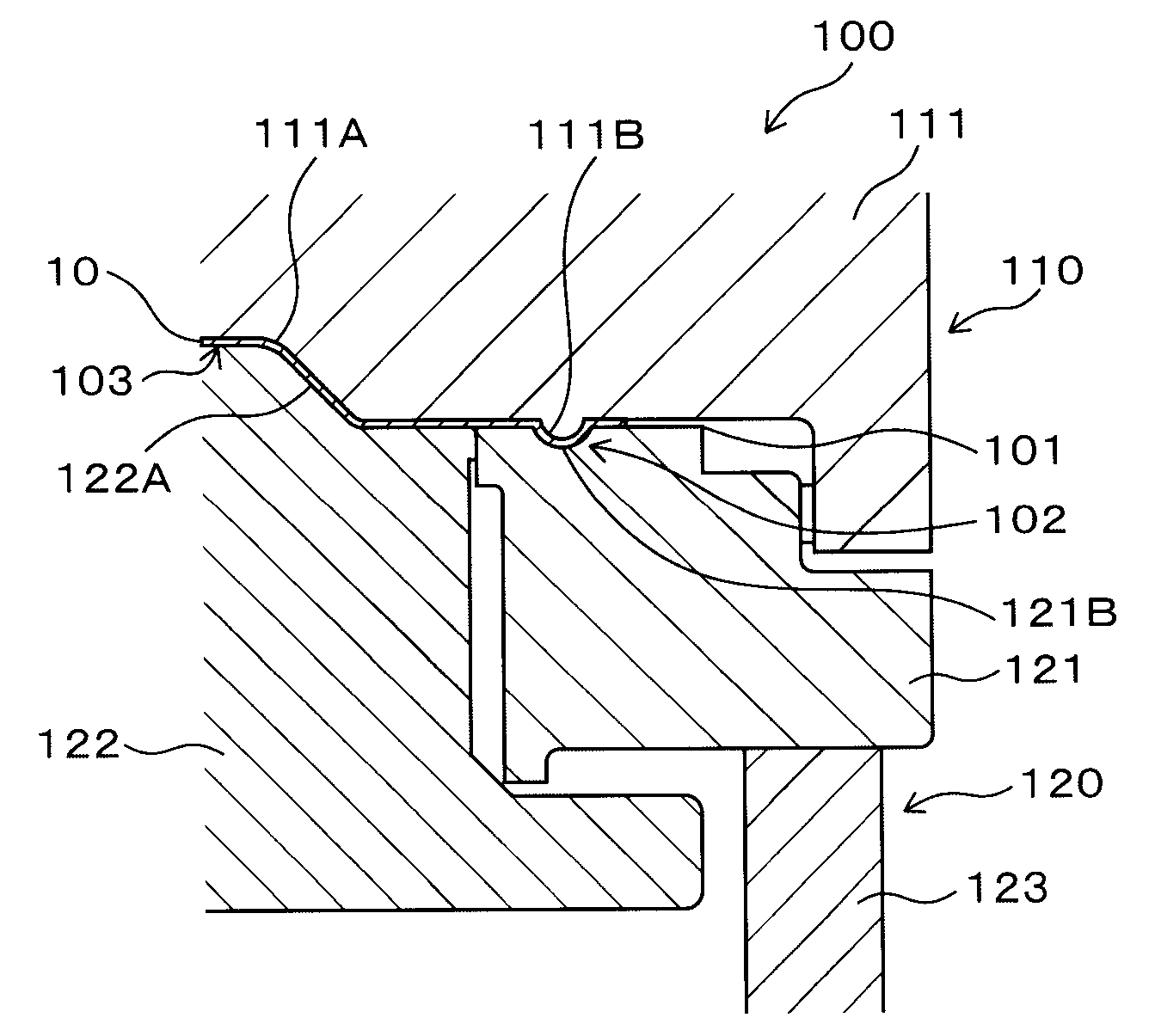
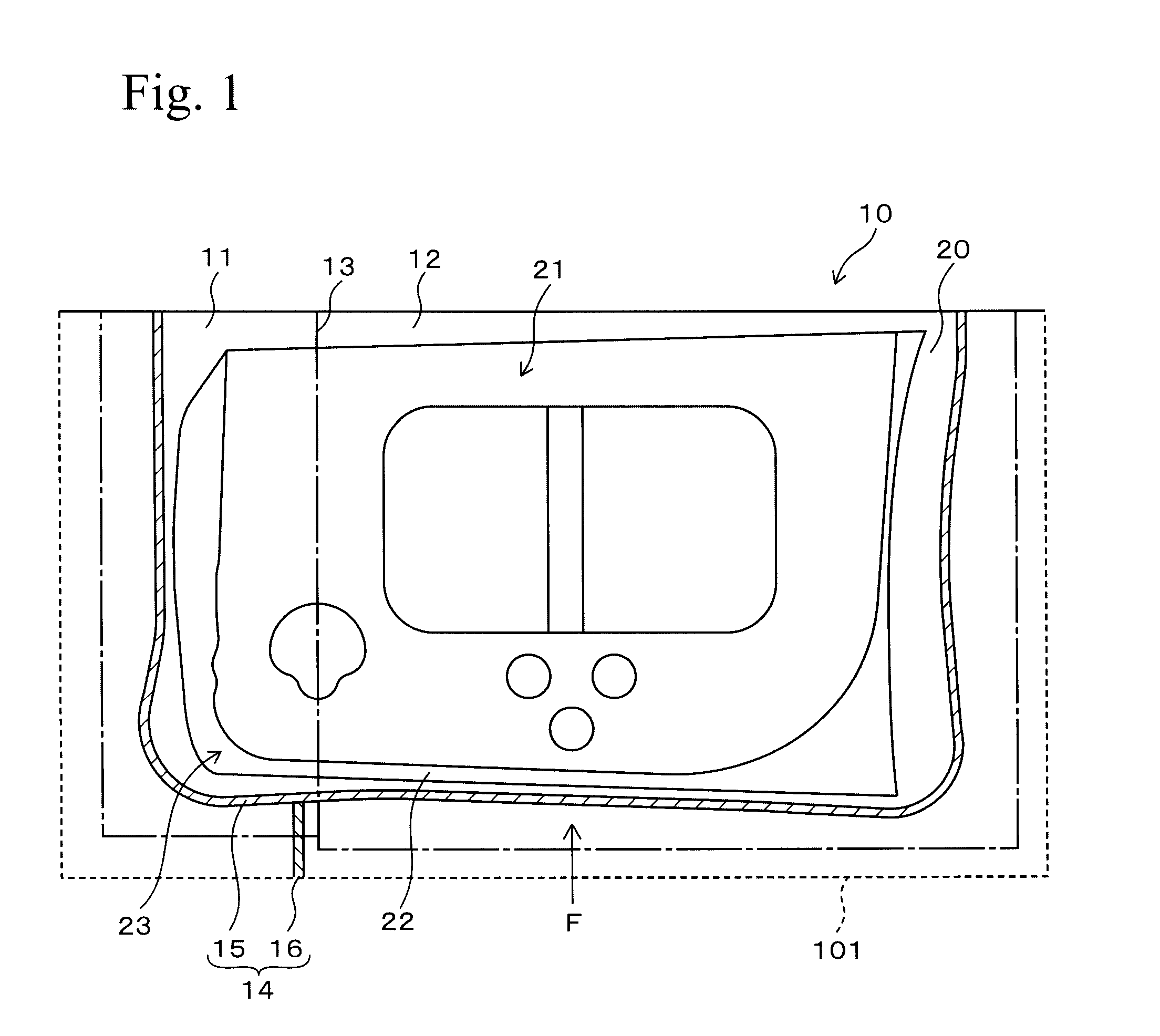
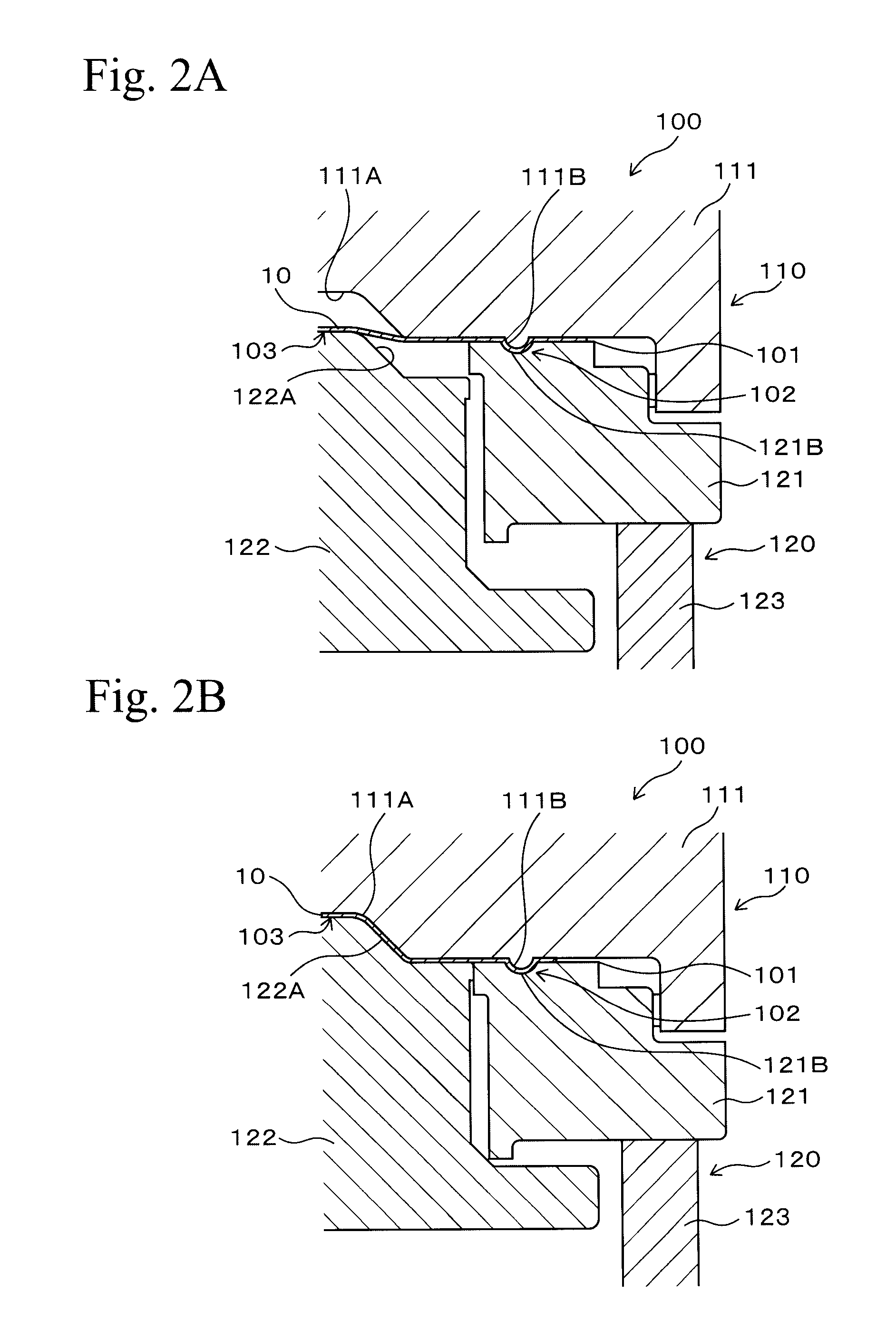
[0018]In the press forming die assembly of the present invention, the second draw bead extends from the first draw bead toward the outside of the draw forming portion in the direction intersecting the first draw bead (that is, in a direction approximately parallel to the flowing direction of the blank material to the draw forming portion). The first draw bead may be formed by a
conventional technique. In general, in shrink
flange forming of a
flange portion of a thick sheet portion, strain occurs according to the shape of a corner of a draw forming portion. In contrast, since the second draw bead of the present invention has the above shape, such strain is not transmitted to a thin sheet portion. Therefore, rotation of the thick sheet portion (movement of the connecting line of the thick sheet portion and the thin sheet portion toward the thin sheet portion) can be prevented, whereby the thick sheet portion will not overlap with the thin sheet portion.
[0019]Accordingly, buckling wrinkling does not occur on the thin sheet portion. Therefore, when a blank material is used for an inner panel of a vehicle door, an end surface of an outer panel can be connected to an inner panel by a hemming process without deteriorating the quality of the outer panel by buckling wrinkling of the inner panel. Moreover, strain is not concentrated at the thin sheet portion, and a sufficient amount of the material flows into the draw forming portion, whereby a crack does not form at a
ridge line portion in a raised wall of a product surface. Furthermore, when a material including a thick sheet portion and a thin sheet portion, which have different sheet thicknesses, is used as a blank material, a die assembly is not passed through by a sharp edge of the thick sheet portion. Therefore, wear of the die assembly can be avoided, and particles due to the wear are not generated, whereby particles are not trapped at the product surface of a panel.
[0022]According to the press forming die assembly of the present invention, the second draw bead can prevent strain from being transmitted to the thin sheet portion, the strain occurring at the thick sheet portion in shrink flange forming. Therefore, the rotation of the thick sheet portion can be prevented, and the thick sheet portion will not overlap the thin sheet portion. Accordingly, forming failure in the vicinity of the connected portion of the thick sheet portion and the thin sheet portion can be prevented. Moreover, the adjustment operation of a die assembly requires less time in trial forming, and the quality of products can be improved in commercial production.


 Login to View More