Engine rotation speed controller for working machine

a technology of rotating speed controller and working machine, which is applied in the direction of electric control, ignition automatic control, speed sensing governor, etc., can solve the problems of difficult to obtain stable controlled effect of the governor mechanism, engine is not provided with the governor mechanism, etc., to reduce the amount of throttle opening, reduce the effect of engine rotation speed and easy creation of control data

US20090101105A1Inactive Publication Date: 2009-04-23HONDA MOTOR CO LTD
3 Cites 11 Cited by

Patent Information

Authority / Receiving Office
US · United States
Patent Type
Applications(United States)
Current Assignee / Owner
Publication Date
2009-04-23
Estimated Expiration
Not applicable · inactive patent

Smart Images

  • Figure 1
    Figure 1
  • Figure 2
    Figure 2
  • Figure 3
    Figure 3
Patent Text Reader

Abstract

When an engine rotation speed in an engine for working machine without a governor mechanism is increase-and-decrease-controlled by switching ignition timings at a predetermined rotation speed, the response delay of the engine rotation speed with respect to the throttle opening operation is suppressed. The engine rotation speeds for switching the ignition timings are set to 4000 rpm and 5000 rpm. When the throttle opening is increased, a first ignition timing is advanced stepwise to a second ignition timing at the engine rotation speed of 4000 rpm so as to be switched to a rotation control characteristic C30 for high speed rotation. When the throttle opening is decreased, the second ignition timing is retarded stepwise to the first ignition timing at the engine rotation speed of 5000 rpm so as to be switched to a rotation control characteristic C05 for low speed rotation. The switching timing of the rotation control characteristic is different between at increase and decrease of the throttle opening. The difference can be reduced to a small amount ΔTH.
Need to check novelty before this filing date? Find Prior Art

Description

TECHNICAL FIELD

[0001] The present invention relates to a rotation speed controller of an internal combustion engine for working machine. More specifically, the present invention relates to an engine rotation speed controller which can control an engine rotation speed without having a governor mechanism, that is, mechanical speed control means.BACKGROUND ART

[0002] In general, rotation speed of an engine for driving a working machine, such as a small-size versatile engine, is controlled to a rotation speed suitable for a load by opening control of a carburetor by a governor mechanism. There has been known the governor mechanism which moves a link mechanism by a centrifugal force corresponding to an engine rotation speed and transmits movement of the link mechanism to a throttle valve to perform throttle opening control. An engine used as the power source of a handheld mowing machine or blower is used at a relatively high rotation speed. Therefore, the conventional governor mechanism is ...

Examples

Embodiment Construction

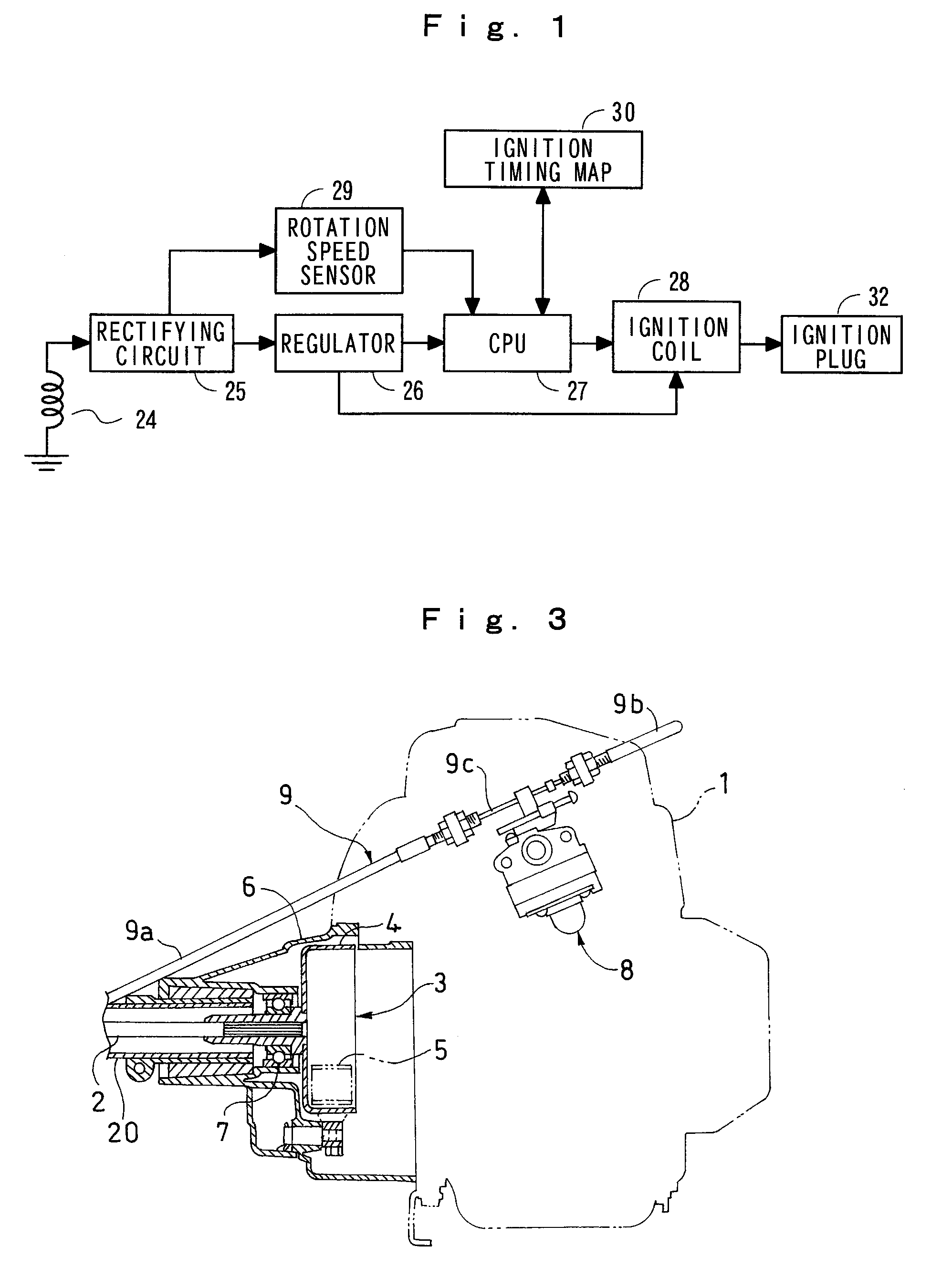
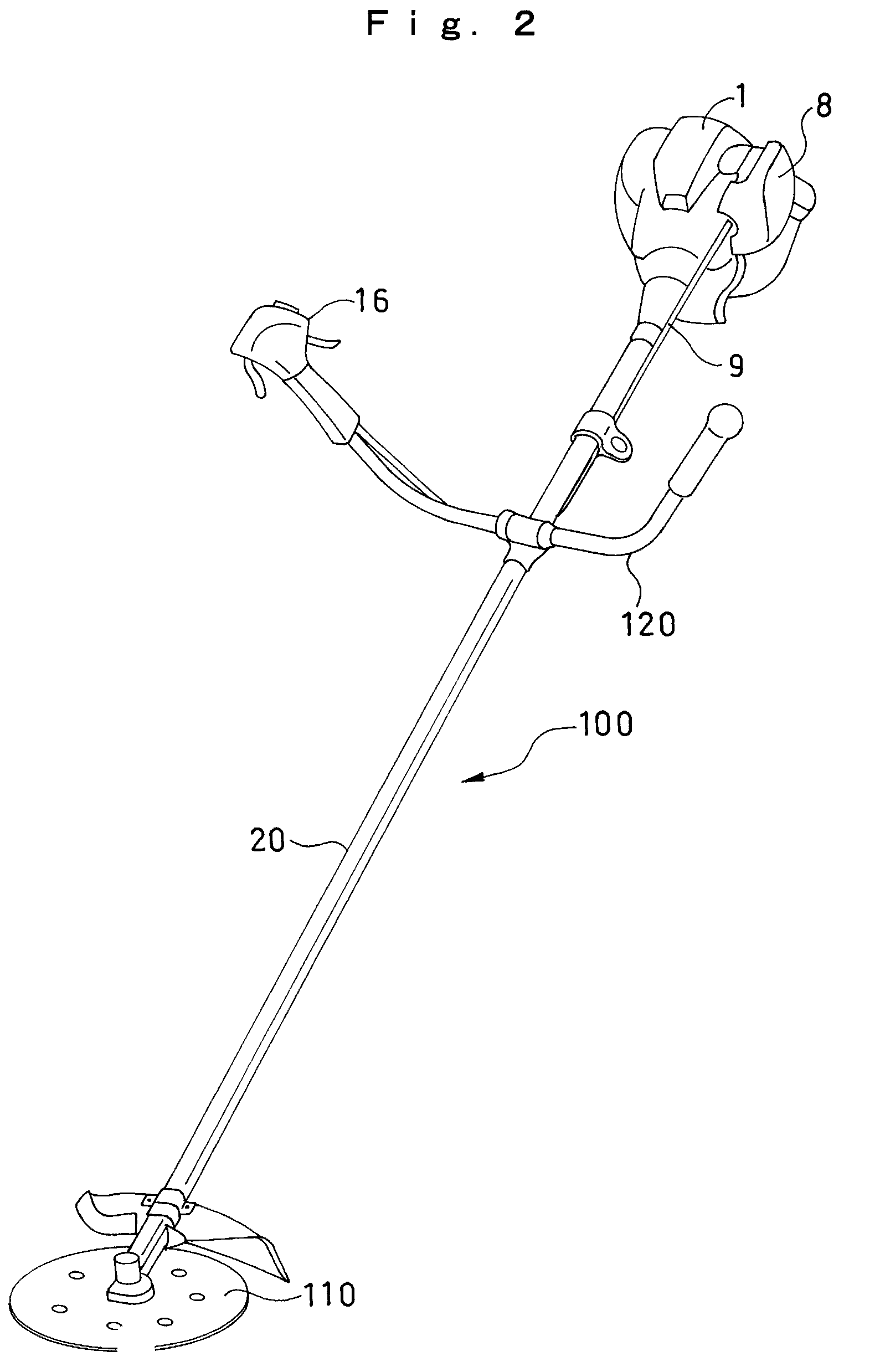
[0028]An embodiment of the present invention will be described below in detail with reference to the drawings. FIG. 2 is a perspective view of a mowing machine equipped with an engine including a rotation speed controller according to an embodiment of the present invention. FIG. 3 is a cross-sectional view of the front portion of the engine. FIG. 4 is a plan view of a carburetor. In FIG. 2, a mowing machine 100 has an engine 1, an operating sleeve 20 extended from the engine 1 and having at its edge a cutting blade 110, a handle 120 provided midway in the operating sleeve 20, and an operating device 16 serving also as a grip and provided at the right end of the handle 120. The mowing machine 100 also has a throttle cable 9 extended from the operating device 16 to a carburetor 8 of the engine. The engine 1 is an air-cooled four-stroke single-cylinder engine of a small type (e.g., the displacement is 25 cm3) preferable for the mowing machine 100.

[0029]In FIGS. 3 and 4, a transmission ...