[0004]The object of the present invention is to achieve a rotary parlour for
milking of animals of the initial kind having a platform, which is considerably lighter than conventional platforms and easier to assemble.
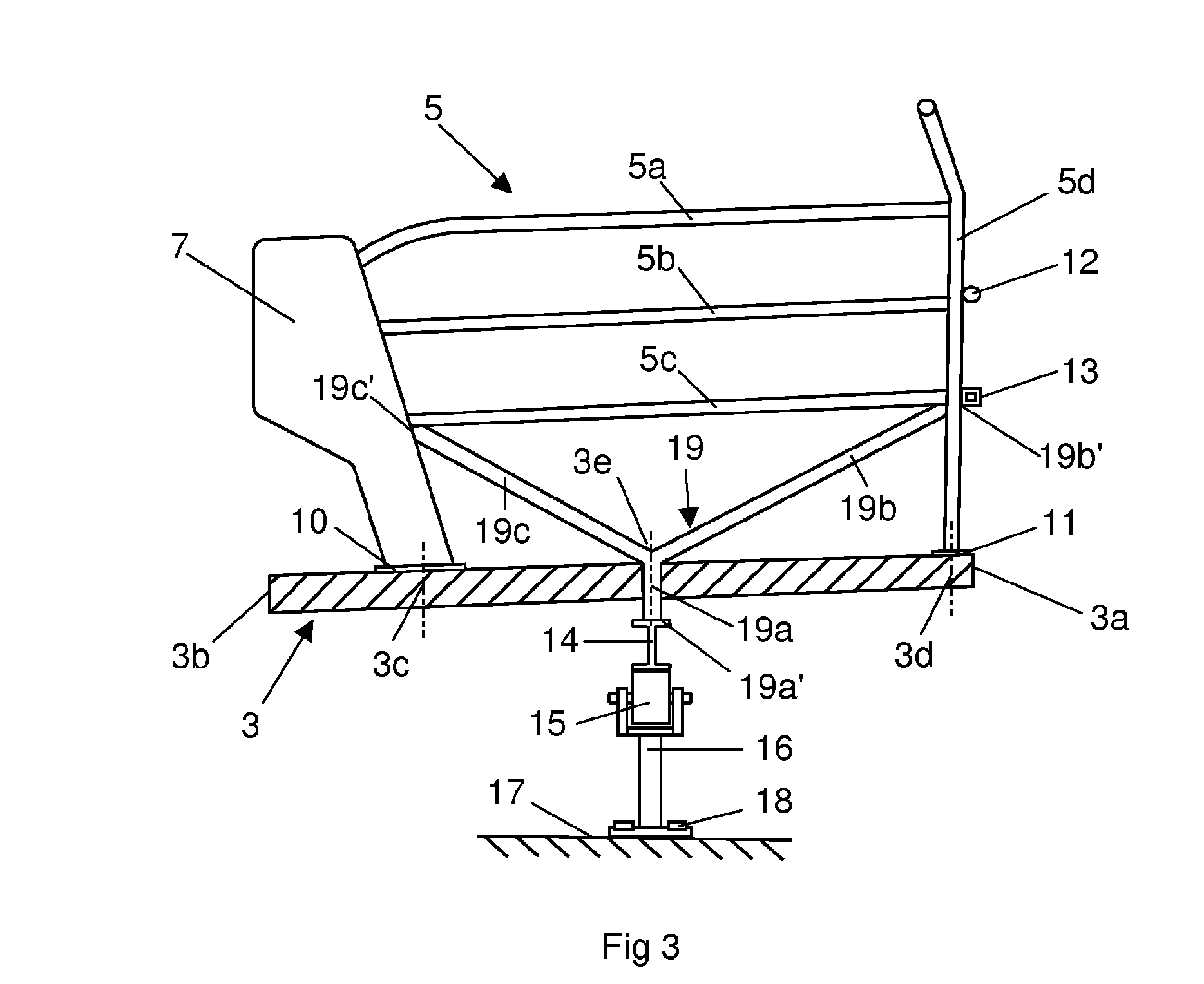
[0005]This object is achieved by the rotary parlour initially defined, which is characterised in that the rotary parlour comprises a rigid connection between the object and the rail member which comprises a bar arrangement. Such a rigid bar arrangement counteracts relative motions between the rail member and the object. Since the object and the rail member is rigid elements, the bar arrangement also counteracts relative motions between the fastening positions of the rail member and the object in the platform. If a cow stands, for example, with the front legs in an area in the vicinity of the fastening position of the object, the weight is transferred from the platform, via the stiff object and the stiff bar arrangement, to the rail member. Consequently, the platform needs only to take up a smaller part of the weight from the front legs of the cow. Thereby, the platform can be manufactured of a relative thin material. Furthermore, the platform can be provided with a considerably smaller underlying framework. Alternatively, the underlying framework can be excluded. Further, the rigid connection between the object and the rail member stabilises the position of the rail member in relation to the rolling members. This results in a good stability of the platform on the rolling members during rotation. Consequently, a rotary parlour comprising such a rigid bar arrangement can be provided with a light platform which is easy to assemble.
[0006]According to an embodiment of the invention, the bar arrangement comprises a first bar element having an extension through the platform. Thereby, it is possible to minimise the length of the bar arrangement. Furthermore, such an extension of the first bar element makes it is easy to accomplish a connection between the bar arrangement and the platform. The first bar element may be a straight rod element having a relatively
high stiffness. The first bar element may constitute a rigid connection between the platform and the rail member. The first bar element may be connected to the rail member at an lower end, for example, by
welding. In this way, a fix connection is achieved between the first bar element and the rail member.
[0007]According to a further embodiment of the invention, the bar arrangement comprise a second bar element arranged on the upper side of the platform, which constitutes a rigid connection between the first bar element and the object. Such a second bar element can also constitute a substantially straight rod element having a
high stiffness. The second part can be connected to the first bar element and the object by
welding. The bar arrangement may also comprise a third bar element arranged on the upper side of the platform, which constitutes a rigid connection between the first bar element and a second rigid object arranged on the upper side of the platform. Such a second bar element can also constitute a substantially straight rod element having a
high stiffness. The second bar element can be connected to the first bar element and the second object by
welding. In this case, a substantially Y-shaped bar arrangement is obtained, which can supply a increased stiffness to a relatively large part of the platform.
[0011]According to a further embodiment of the invention the platform is made of concrete. Concrete is a stiff material which is suitable to use in platforms for rotary parlours. It is relatively easy to connect elements of different kinds to a concrete platform by means of bolts or the like. Alternatively, the platform is made of steel. Steel is a stiff material which is suitable to use in platforms for rotary parlours. It is also relatively easy to connect different elements to a steel platform by means of welding or bolt. Certainly, it is possible to manufacture the platform in other materials such as suitable
plastic materials and combinations of materials. The annular platform may have has an inner circumference edge located at a higher level than an outer circumference edge. Preferably, the annular platform has a plane surface sloping about 30 in relation to a horizontal plane. This simplifies the cleaning of the platform because water and
dirt rinse off easily. Such a sloping of the platform is preferred if the milking members are attached by operators working from the outside of the platform. Alternatively, the annular platform has an inner circumference edge located at a lower level than an outer circumference edge. Such a sloping of the platform is preferred if the milking members are attached by operators working from the inside of the platform.


 Login to View More
  Login to View More